

58
2 Critical Mass, Efficiency, and Yield
2.2 Critical Mass: Bare Core
We now consider critical mass per se. Qualitatively, the concept of critical mass
derives from the observation that some species of nuclei fission upon being struck
by a bombarding neutron and consequently release secondary neutrons which can
potentially go on to induce other fissions, resulting in a chain reaction. However,
the development in the preceding section indicates that we can expect that a certain
number of neutrons will reach the surface of the mass and escape, particularly if the
mass is small. If the density of neutrons within the mass is increasing with time,
criticality is said to obtain. Whether or not this condition is fulfilled depends on
quantities such as the density of the material, its cross-section for fission, the number
of neutrons emitted per fission, and the kinetic-energy spectrum of the neutrons. The
number of neutrons emitted per fission is designated by the symbol ν.
A comment on ν is appropriate here. A given fission reaction will release some
integer number of neutrons, which on rare occasions could in fact be zero. In carrying
out calculations, we will assume an operative average number of neutrons per fission.
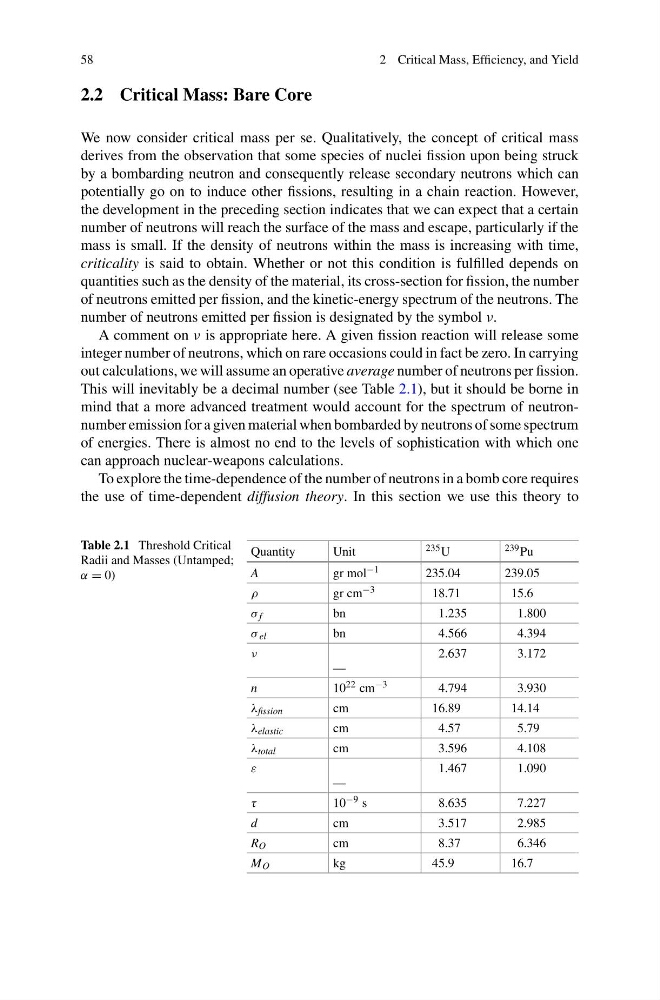
This will inevitably be a decimal number (see Table 2.1), but it should be borne in
mind that a more advanced treatment would account for the spectrum of neutronnumber emission for a given material when bombarded by neutrons of some spectrum
of energies. There is almost no end to the levels of sophistication with which one
can approach nuclear-weapons calculations.
To explore the time-dependence of the number of neutrons in a bomb core requires
the use of time-dependent diffusion theory. In this section we use this theory to
Table 2.1 Threshold Critical
Radii and Masses (Untamped;
α = 0)
Quantity
Unit
235 U
239 Pu
A
gr mol −1
235.04
239.05
ρ
gr cm −3
18.71
15.6
σ f
bn
1.235
1.800
σ el
bn
4.566
4.394
ν
—
2.637
3.172
n
10 22 cm −3
4.794
3.930
λ fission
cm
16.89
14.14
λ elastic
cm
4.57
5.79
λ total
cm
3.596
4.108
ε
—
1.467
1.090
τ
10 −9 s
8.635
7.227
d
cm
3.517
2.985
R O
cm
8.37
6.346
M O
kg
45.9
16.7
2 Critical Mass, Efficiency, and Yield
2.2 Critical Mass: Bare Core
We now consider critical mass per se. Qualitatively, the concept of critical mass
derives from the observation that some species of nuclei fission upon being struck
by a bombarding neutron and consequently release secondary neutrons which can
potentially go on to induce other fissions, resulting in a chain reaction. However,
the development in the preceding section indicates that we can expect that a certain
number of neutrons will reach the surface of the mass and escape, particularly if the
mass is small. If the density of neutrons within the mass is increasing with time,
criticality is said to obtain. Whether or not this condition is fulfilled depends on
quantities such as the density of the material, its cross-section for fission, the number
of neutrons emitted per fission, and the kinetic-energy spectrum of the neutrons. The
number of neutrons emitted per fission is designated by the symbol ν.
A comment on ν is appropriate here. A given fission reaction will release some
integer number of neutrons, which on rare occasions could in fact be zero. In carrying
out calculations, we will assume an operative average number of neutrons per fission.
This will inevitably be a decimal number (see Table 2.1), but it should be borne in
mind that a more advanced treatment would account for the spectrum of neutronnumber emission for a given material when bombarded by neutrons of some spectrum
of energies. There is almost no end to the levels of sophistication with which one
can approach nuclear-weapons calculations.
To explore the time-dependence of the number of neutrons in a bomb core requires
the use of time-dependent diffusion theory. In this section we use this theory to
Table 2.1 Threshold Critical
Radii and Masses (Untamped;
α = 0)
Quantity
Unit
235 U
239 Pu
A
gr mol −1
235.04
239.05
ρ
gr cm −3
18.71
15.6
σ f
bn
1.235
1.800
σ el
bn
4.566
4.394
ν
—
2.637
3.172
n
10 22 cm −3
4.794
3.930
λ fission
cm
16.89
14.14
λ elastic
cm
4.57
5.79
λ total
cm
3.596
4.108
ε
—
1.467
1.090
τ
10 −9 s
8.635
7.227
d
cm
3.517
2.985
R O
cm
8.37
6.346
M O
kg
45.9
16.7