

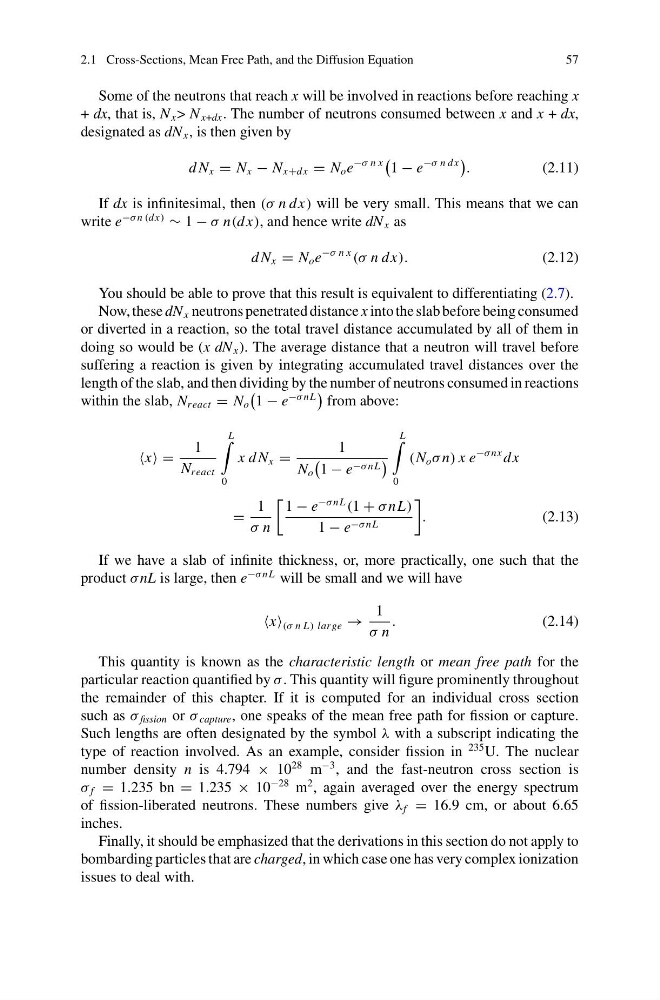
2.1 Cross-Sections, Mean Free Path, and the Diffusion Equation
57
Some of the neutrons that reach x will be involved in reactions before reaching x
+ dx, that is, N x > N x+dx . The number of neutrons consumed between x and x + dx,
designated as dN x , is then given by
d N x = N x − N x+dx = N o e
−σ n x
1 − e
−σ n dx
.
(2.11)
If dx is infinitesimal, then (σ n dx) will be very small. This means that we can
write e
−σ n (dx)
∼ 1 − σ n(dx), and hence write dN x as
d N x = N o e
−σ n x
(σ n dx).
(2.12)
You should be able to prove that this result is equivalent to differentiating (2.7).
Now, these dN x neutrons penetrated distance x into the slab before being consumed
or diverted in a reaction, so the total travel distance accumulated by all of them in
doing so would be (x dN x ). The average distance that a neutron will travel before
suffering a reaction is given by integrating accumulated travel distances over the
length of the slab, and then dividing by the number of neutrons consumed in reactions
within the slab, N react = N o
1 − e
−σ nL
from above:
x =
1
N react
L
0
x d N x =
1
N o
1 − e −σ nL
L
0
(N o σ n) x e
−σ nx dx
=
1
σ n
1 − e
−σ nL
(1 + σ nL)
1 − e −σ nL
.
(2.13)
If we have a slab of infinite thickness, or, more practically, one such that the
product σ nL is large, then e
−σ nL will be small and we will have
x (σ n L) large →
1
σ n
.
(2.14)
This quantity is known as the characteristic length or mean free path for the
particular reaction quantified by σ. This quantity will figure prominently throughout
the remainder of this chapter. If it is computed for an individual cross section
such as σ fission or σ capture , one speaks of the mean free path for fission or capture.
Such lengths are often designated by the symbol λ with a subscript indicating the
type of reaction involved. As an example, consider fission in
235 U. The nuclear
number density n is 4.794 × 10
28 m
−3 , and the fast-neutron cross section is
σ f = 1.235 bn = 1.235 × 10
−28 m
2 , again averaged over the energy spectrum
of fission-liberated neutrons. These numbers give λ f = 16.9 cm, or about 6.65
inches.
Finally, it should be emphasized that the derivations in this section do not apply to
bombarding particles that are charged, in which case one has very complex ionization
issues to deal with.
57
Some of the neutrons that reach x will be involved in reactions before reaching x
+ dx, that is, N x > N x+dx . The number of neutrons consumed between x and x + dx,
designated as dN x , is then given by
d N x = N x − N x+dx = N o e
−σ n x
1 − e
−σ n dx
.
(2.11)
If dx is infinitesimal, then (σ n dx) will be very small. This means that we can
write e
−σ n (dx)
∼ 1 − σ n(dx), and hence write dN x as
d N x = N o e
−σ n x
(σ n dx).
(2.12)
You should be able to prove that this result is equivalent to differentiating (2.7).
Now, these dN x neutrons penetrated distance x into the slab before being consumed
or diverted in a reaction, so the total travel distance accumulated by all of them in
doing so would be (x dN x ). The average distance that a neutron will travel before
suffering a reaction is given by integrating accumulated travel distances over the
length of the slab, and then dividing by the number of neutrons consumed in reactions
within the slab, N react = N o
1 − e
−σ nL
from above:
x =
1
N react
L
0
x d N x =
1
N o
1 − e −σ nL
L
0
(N o σ n) x e
−σ nx dx
=
1
σ n
1 − e
−σ nL
(1 + σ nL)
1 − e −σ nL
.
(2.13)
If we have a slab of infinite thickness, or, more practically, one such that the
product σ nL is large, then e
−σ nL will be small and we will have
x (σ n L) large →
1
σ n
.
(2.14)
This quantity is known as the characteristic length or mean free path for the
particular reaction quantified by σ. This quantity will figure prominently throughout
the remainder of this chapter. If it is computed for an individual cross section
such as σ fission or σ capture , one speaks of the mean free path for fission or capture.
Such lengths are often designated by the symbol λ with a subscript indicating the
type of reaction involved. As an example, consider fission in
235 U. The nuclear
number density n is 4.794 × 10
28 m
−3 , and the fast-neutron cross section is
σ f = 1.235 bn = 1.235 × 10
−28 m
2 , again averaged over the energy spectrum
of fission-liberated neutrons. These numbers give λ f = 16.9 cm, or about 6.65
inches.
Finally, it should be emphasized that the derivations in this section do not apply to
bombarding particles that are charged, in which case one has very complex ionization
issues to deal with.