

1.11 A Numerical Model of the Fission Process
41
the central vertical axis. Modeling the fission process in this way allows us to avoid
introducing any curvature discontinuities into the shape of the distorted surface.
As the spheres move apart, R must decrease in order to conserve nuclear volume,
as was assumed in Sect. 1.7. The radius of the neck will decrease and eventually reach
zero, at which point the teardrop-shaped products will break contact and fly apart
due to mutual repulsion. A convenient coordinate for parameterizing the process is
the angle γ , which is measured from the polar axis to a line joining the centers of
the upper sphere and the imaginary one that defines the equatorial neck. At the start
of the process, γ = π /2. At any general configuration such as sketched in Fig. 1.14,
the separation of the centers of the emergent spheres is given by
2d(γ ) = 4R(γ ) cos γ.
(1.93)
The full height of the equatorial neck at any time is d(γ ) = 2R(γ ) cosγ . At
the end of the fission process, the radius of the equatorial neck will have shrunk
to zero, that is, the right-angle triangle given by joining the center of the upper (or
lower) emergent sphere, the center of the nucleus, and the center of the left (or right)
imaginary neck-defining sphere will have a base length R and a hypotenuse of length
2R, and hence γ = Sin
−1 (1/2) = π /6.
Volume and surface areas; volume conservation
In order to formulate an expression for R(γ ), it is necessary to develop an expression
for the volume of the distorted nucleus and then demand conservation of volume. It
is also necessary to determine the surface area of the nucleus as a function of γ in
order to formulate the surface energy U S . These issues are taken up first, then the
surface and Coulomb energies are developed.
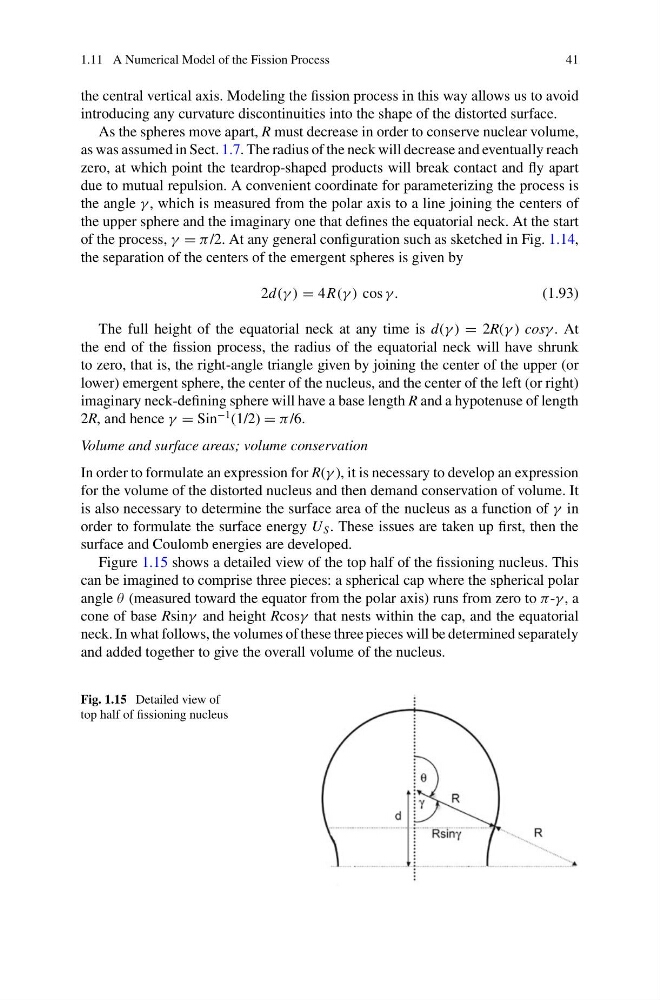
Figure 1.15 shows a detailed view of the top half of the fissioning nucleus. This
can be imagined to comprise three pieces: a spherical cap where the spherical polar
angle θ (measured toward the equator from the polar axis) runs from zero to π-γ , a
cone of base Rsinγ and height Rcosγ that nests within the cap, and the equatorial
neck. In what follows, the volumes of these three pieces will be determined separately
and added together to give the overall volume of the nucleus.
Fig. 1.15 Detailed view of
top half of fissioning nucleus
41
the central vertical axis. Modeling the fission process in this way allows us to avoid
introducing any curvature discontinuities into the shape of the distorted surface.
As the spheres move apart, R must decrease in order to conserve nuclear volume,
as was assumed in Sect. 1.7. The radius of the neck will decrease and eventually reach
zero, at which point the teardrop-shaped products will break contact and fly apart
due to mutual repulsion. A convenient coordinate for parameterizing the process is
the angle γ , which is measured from the polar axis to a line joining the centers of
the upper sphere and the imaginary one that defines the equatorial neck. At the start
of the process, γ = π /2. At any general configuration such as sketched in Fig. 1.14,
the separation of the centers of the emergent spheres is given by
2d(γ ) = 4R(γ ) cos γ.
(1.93)
The full height of the equatorial neck at any time is d(γ ) = 2R(γ ) cosγ . At
the end of the fission process, the radius of the equatorial neck will have shrunk
to zero, that is, the right-angle triangle given by joining the center of the upper (or
lower) emergent sphere, the center of the nucleus, and the center of the left (or right)
imaginary neck-defining sphere will have a base length R and a hypotenuse of length
2R, and hence γ = Sin
−1 (1/2) = π /6.
Volume and surface areas; volume conservation
In order to formulate an expression for R(γ ), it is necessary to develop an expression
for the volume of the distorted nucleus and then demand conservation of volume. It
is also necessary to determine the surface area of the nucleus as a function of γ in
order to formulate the surface energy U S . These issues are taken up first, then the
surface and Coulomb energies are developed.
Figure 1.15 shows a detailed view of the top half of the fissioning nucleus. This
can be imagined to comprise three pieces: a spherical cap where the spherical polar
angle θ (measured toward the equator from the polar axis) runs from zero to π-γ , a
cone of base Rsinγ and height Rcosγ that nests within the cap, and the equatorial
neck. In what follows, the volumes of these three pieces will be determined separately
and added together to give the overall volume of the nucleus.
Fig. 1.15 Detailed view of
top half of fissioning nucleus