

40
1 Energy Release in Nuclear Reactions, Neutrons, Fission, and Characteristics …
on in the separation, or does this occur near the middle or the end of the process? To
try to analytically model the intermediate stages of fission is extremely complex: In
principle, one would have to examine all possible “deformation trajectories” between
an initial spherical configuration and a final two-product configuration, and then
isolate the minimum excitation energy in order to determine a minimum barrier
energy. It is therefore not surprising that with the rapid development of electronic
computers following World War II, numerical simulations came to the fore; models
involving up to tenth-order polynomials were published as early as 1947; see Frankel
and Metropolis (1947). As a result of this complexity, many texts skip over the details
of barrier energetics.
The purpose of this section is to develop a tractable but physically sensible numerical simulation of the fission process. This simulation is based on imagining the
nucleus to divide symmetrically into two identical products. A symmetric model
does represent some sacrifice of physical reality, but possesses the redeeming feature
that the shape of the nucleus can be modeled in such a way that its curvature is never
discontinuous.
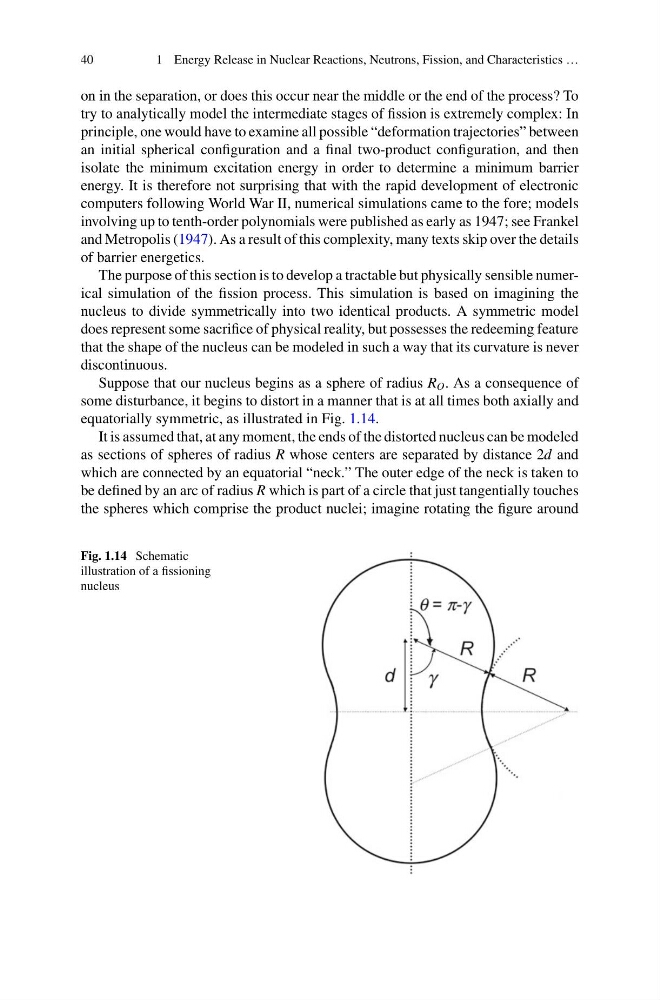
Suppose that our nucleus begins as a sphere of radius R O . As a consequence of
some disturbance, it begins to distort in a manner that is at all times both axially and
equatorially symmetric, as illustrated in Fig. 1.14.
It is assumed that, at any moment, the ends of the distorted nucleus can be modeled
as sections of spheres of radius R whose centers are separated by distance 2d and
which are connected by an equatorial “neck.” The outer edge of the neck is taken to
be defined by an arc of radius R which is part of a circle that just tangentially touches
the spheres which comprise the product nuclei; imagine rotating the figure around
Fig. 1.14 Schematic
illustration of a fissioning
nucleus
1 Energy Release in Nuclear Reactions, Neutrons, Fission, and Characteristics …
on in the separation, or does this occur near the middle or the end of the process? To
try to analytically model the intermediate stages of fission is extremely complex: In
principle, one would have to examine all possible “deformation trajectories” between
an initial spherical configuration and a final two-product configuration, and then
isolate the minimum excitation energy in order to determine a minimum barrier
energy. It is therefore not surprising that with the rapid development of electronic
computers following World War II, numerical simulations came to the fore; models
involving up to tenth-order polynomials were published as early as 1947; see Frankel
and Metropolis (1947). As a result of this complexity, many texts skip over the details
of barrier energetics.
The purpose of this section is to develop a tractable but physically sensible numerical simulation of the fission process. This simulation is based on imagining the
nucleus to divide symmetrically into two identical products. A symmetric model
does represent some sacrifice of physical reality, but possesses the redeeming feature
that the shape of the nucleus can be modeled in such a way that its curvature is never
discontinuous.
Suppose that our nucleus begins as a sphere of radius R O . As a consequence of
some disturbance, it begins to distort in a manner that is at all times both axially and
equatorially symmetric, as illustrated in Fig. 1.14.
It is assumed that, at any moment, the ends of the distorted nucleus can be modeled
as sections of spheres of radius R whose centers are separated by distance 2d and
which are connected by an equatorial “neck.” The outer edge of the neck is taken to
be defined by an arc of radius R which is part of a circle that just tangentially touches
the spheres which comprise the product nuclei; imagine rotating the figure around
Fig. 1.14 Schematic
illustration of a fissioning
nucleus