

42
1 Energy Release in Nuclear Reactions, Neutrons, Fission, and Characteristics …
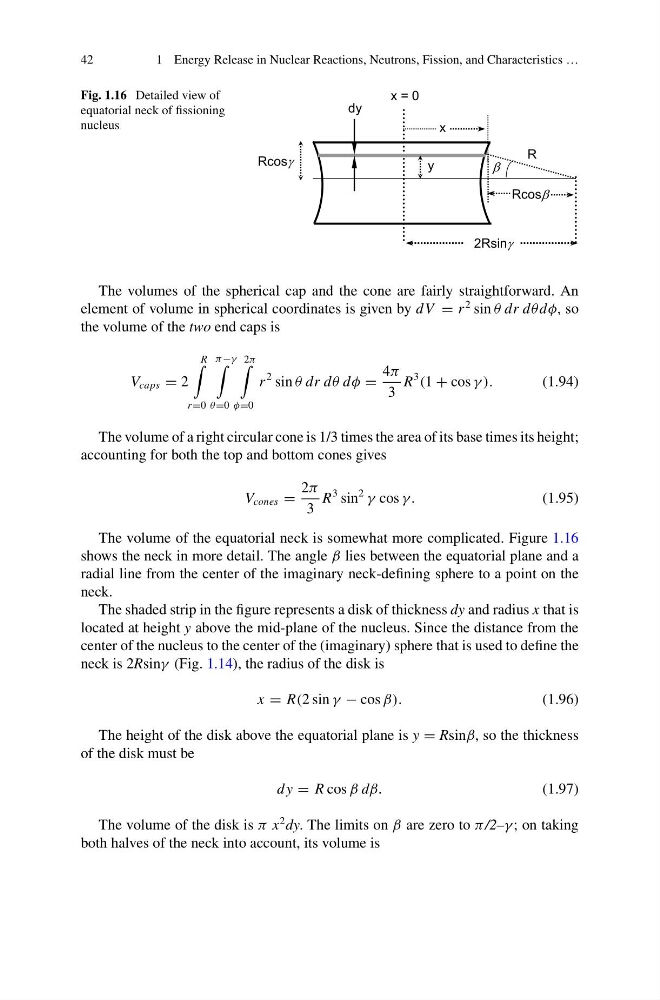
Fig. 1.16 Detailed view of
equatorial neck of fissioning
nucleus
The volumes of the spherical cap and the cone are fairly straightforward. An
element of volume in spherical coordinates is given by dV = r
2 sin θ dr dθ dφ, so
the volume of the two end caps is
V caps = 2
R
r =0
π−γ
θ=0
2π
φ=0
r
2 sin θ dr dθ dφ =
4π
3
R
3
(1 + cos γ ).
(1.94)
The volume of a right circular cone is 1/3 times the area of its base times its height;
accounting for both the top and bottom cones gives
V cones =
2π
3
R
3 sin
2
γ cos γ.
(1.95)
The volume of the equatorial neck is somewhat more complicated. Figure 1.16
shows the neck in more detail. The angle β lies between the equatorial plane and a
radial line from the center of the imaginary neck-defining sphere to a point on the
neck.
The shaded strip in the figure represents a disk of thickness dy and radius x that is
located at height y above the mid-plane of the nucleus. Since the distance from the
center of the nucleus to the center of the (imaginary) sphere that is used to define the
neck is 2Rsinγ (Fig. 1.14), the radius of the disk is
x = R(2 sin γ − cos β).
(1.96)
The height of the disk above the equatorial plane is y = Rsinβ, so the thickness
of the disk must be
dy = R cos β dβ.
(1.97)
The volume of the disk is π x
2 dy. The limits on β are zero to π /2–γ ; on taking
both halves of the neck into account, its volume is
1 Energy Release in Nuclear Reactions, Neutrons, Fission, and Characteristics …
Fig. 1.16 Detailed view of
equatorial neck of fissioning
nucleus
The volumes of the spherical cap and the cone are fairly straightforward. An
element of volume in spherical coordinates is given by dV = r
2 sin θ dr dθ dφ, so
the volume of the two end caps is
V caps = 2
R
r =0
π−γ
θ=0
2π
φ=0
r
2 sin θ dr dθ dφ =
4π
3
R
3
(1 + cos γ ).
(1.94)
The volume of a right circular cone is 1/3 times the area of its base times its height;
accounting for both the top and bottom cones gives
V cones =
2π
3
R
3 sin
2
γ cos γ.
(1.95)
The volume of the equatorial neck is somewhat more complicated. Figure 1.16
shows the neck in more detail. The angle β lies between the equatorial plane and a
radial line from the center of the imaginary neck-defining sphere to a point on the
neck.
The shaded strip in the figure represents a disk of thickness dy and radius x that is
located at height y above the mid-plane of the nucleus. Since the distance from the
center of the nucleus to the center of the (imaginary) sphere that is used to define the
neck is 2Rsinγ (Fig. 1.14), the radius of the disk is
x = R(2 sin γ − cos β).
(1.96)
The height of the disk above the equatorial plane is y = Rsinβ, so the thickness
of the disk must be
dy = R cos β dβ.
(1.97)
The volume of the disk is π x
2 dy. The limits on β are zero to π /2–γ ; on taking
both halves of the neck into account, its volume is