

30
1 Energy Release in Nuclear Reactions, Neutrons, Fission, and Characteristics …
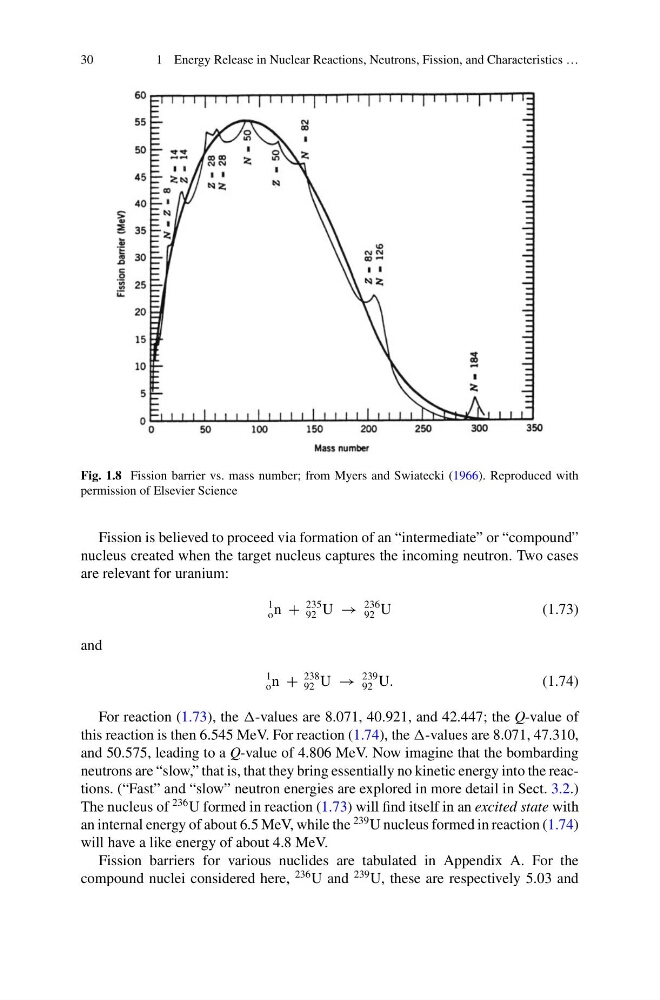
Fig. 1.8 Fission barrier vs. mass number; from Myers and Swiatecki (1966). Reproduced with
permission of Elsevier Science
Fission is believed to proceed via formation of an “intermediate” or “compound”
nucleus created when the target nucleus captures the incoming neutron. Two cases
are relevant for uranium:
1
o n +
235
92 U →
236
92 U
(1.73)
and
1
o n +
238
92 U →
239
92 U.
(1.74)
For reaction (1.73), the -values are 8.071, 40.921, and 42.447; the Q-value of
this reaction is then 6.545 MeV. For reaction (1.74), the -values are 8.071, 47.310,
and 50.575, leading to a Q-value of 4.806 MeV. Now imagine that the bombarding
neutrons are “slow,” that is, that they bring essentially no kinetic energy into the reactions. (“Fast” and “slow” neutron energies are explored in more detail in Sect. 3.2.)
The nucleus of
236 U formed in reaction (1.73) will find itself in an excited state with
an internal energy of about 6.5 MeV, while the
239 U nucleus formed in reaction (1.74)
will have a like energy of about 4.8 MeV.
Fission barriers for various nuclides are tabulated in Appendix A. For the
compound nuclei considered here,
236 U and
239 U, these are respectively 5.03 and
1 Energy Release in Nuclear Reactions, Neutrons, Fission, and Characteristics …
Fig. 1.8 Fission barrier vs. mass number; from Myers and Swiatecki (1966). Reproduced with
permission of Elsevier Science
Fission is believed to proceed via formation of an “intermediate” or “compound”
nucleus created when the target nucleus captures the incoming neutron. Two cases
are relevant for uranium:
1
o n +
235
92 U →
236
92 U
(1.73)
and
1
o n +
238
92 U →
239
92 U.
(1.74)
For reaction (1.73), the -values are 8.071, 40.921, and 42.447; the Q-value of
this reaction is then 6.545 MeV. For reaction (1.74), the -values are 8.071, 47.310,
and 50.575, leading to a Q-value of 4.806 MeV. Now imagine that the bombarding
neutrons are “slow,” that is, that they bring essentially no kinetic energy into the reactions. (“Fast” and “slow” neutron energies are explored in more detail in Sect. 3.2.)
The nucleus of
236 U formed in reaction (1.73) will find itself in an excited state with
an internal energy of about 6.5 MeV, while the
239 U nucleus formed in reaction (1.74)
will have a like energy of about 4.8 MeV.
Fission barriers for various nuclides are tabulated in Appendix A. For the
compound nuclei considered here,
236 U and
239 U, these are respectively 5.03 and