

1.9 Leaping the Fission Barrier
29
0
0.2
0.4
0.6
0.8
1
0
0.5
1
1.5
2
fraction
z
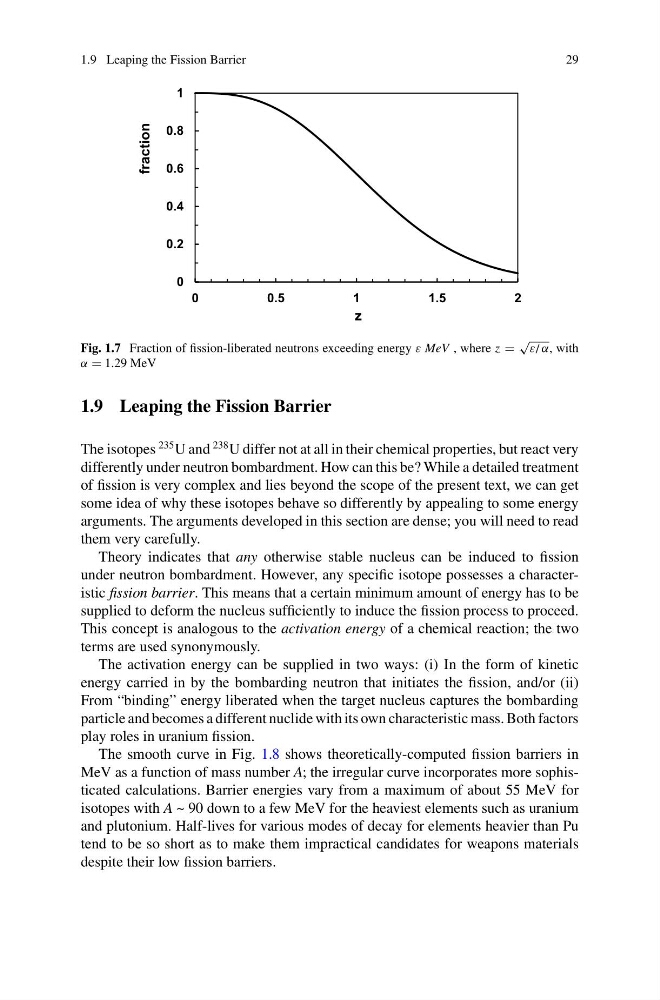
Fig. 1.7 Fraction of fission-liberated neutrons exceeding energy ε MeV , where z =
√ ε/ α, with
α = 1.29 MeV
1.9 Leaping the Fission Barrier
The isotopes
235 U and
238 U differ not at all in their chemical properties, but react very
differently under neutron bombardment. How can this be? While a detailed treatment
of fission is very complex and lies beyond the scope of the present text, we can get
some idea of why these isotopes behave so differently by appealing to some energy
arguments. The arguments developed in this section are dense; you will need to read
them very carefully.
Theory indicates that any otherwise stable nucleus can be induced to fission
under neutron bombardment. However, any specific isotope possesses a characteristic fission barrier. This means that a certain minimum amount of energy has to be
supplied to deform the nucleus sufficiently to induce the fission process to proceed.
This concept is analogous to the activation energy of a chemical reaction; the two
terms are used synonymously.
The activation energy can be supplied in two ways: (i) In the form of kinetic
energy carried in by the bombarding neutron that initiates the fission, and/or (ii)
From “binding” energy liberated when the target nucleus captures the bombarding
particle and becomes a different nuclide with its own characteristic mass. Both factors
play roles in uranium fission.
The smooth curve in Fig. 1.8 shows theoretically-computed fission barriers in
MeV as a function of mass number A; the irregular curve incorporates more sophisticated calculations. Barrier energies vary from a maximum of about 55 MeV for
isotopes with A ~ 90 down to a few MeV for the heaviest elements such as uranium
and plutonium. Half-lives for various modes of decay for elements heavier than Pu
tend to be so short as to make them impractical candidates for weapons materials
despite their low fission barriers.
29
0
0.2
0.4
0.6
0.8
1
0
0.5
1
1.5
2
fraction
z
Fig. 1.7 Fraction of fission-liberated neutrons exceeding energy ε MeV , where z =
√ ε/ α, with
α = 1.29 MeV
1.9 Leaping the Fission Barrier
The isotopes
235 U and
238 U differ not at all in their chemical properties, but react very
differently under neutron bombardment. How can this be? While a detailed treatment
of fission is very complex and lies beyond the scope of the present text, we can get
some idea of why these isotopes behave so differently by appealing to some energy
arguments. The arguments developed in this section are dense; you will need to read
them very carefully.
Theory indicates that any otherwise stable nucleus can be induced to fission
under neutron bombardment. However, any specific isotope possesses a characteristic fission barrier. This means that a certain minimum amount of energy has to be
supplied to deform the nucleus sufficiently to induce the fission process to proceed.
This concept is analogous to the activation energy of a chemical reaction; the two
terms are used synonymously.
The activation energy can be supplied in two ways: (i) In the form of kinetic
energy carried in by the bombarding neutron that initiates the fission, and/or (ii)
From “binding” energy liberated when the target nucleus captures the bombarding
particle and becomes a different nuclide with its own characteristic mass. Both factors
play roles in uranium fission.
The smooth curve in Fig. 1.8 shows theoretically-computed fission barriers in
MeV as a function of mass number A; the irregular curve incorporates more sophisticated calculations. Barrier energies vary from a maximum of about 55 MeV for
isotopes with A ~ 90 down to a few MeV for the heaviest elements such as uranium
and plutonium. Half-lives for various modes of decay for elements heavier than Pu
tend to be so short as to make them impractical candidates for weapons materials
despite their low fission barriers.