

28
1 Energy Release in Nuclear Reactions, Neutrons, Fission, and Characteristics …
E = 2K α
5/2
∞
0
x
4 e
−x
2 dx.
(1.69)
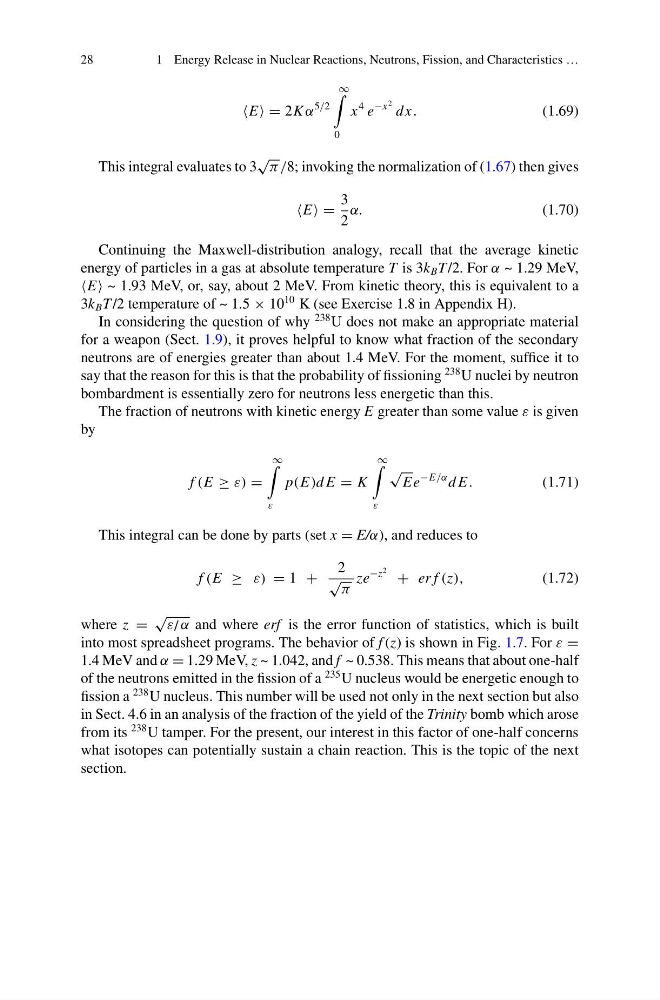
This integral evaluates to 3
√ π/8; invoking the normalization of (1.67) then gives
E =
3
2
α.
(1.70)
Continuing the Maxwell-distribution analogy, recall that the average kinetic
energy of particles in a gas at absolute temperature T is 3k B T /2. For α ~ 1.29 MeV,
E ~ 1.93 MeV, or, say, about 2 MeV. From kinetic theory, this is equivalent to a
3k B T /2 temperature of ~ 1.5 × 10
10 K (see Exercise 1.8 in Appendix H).
In considering the question of why
238 U does not make an appropriate material
for a weapon (Sect. 1.9), it proves helpful to know what fraction of the secondary
neutrons are of energies greater than about 1.4 MeV. For the moment, suffice it to
say that the reason for this is that the probability of fissioning
238 U nuclei by neutron
bombardment is essentially zero for neutrons less energetic than this.
The fraction of neutrons with kinetic energy E greater than some value ε is given
by
f (E ≥ ε) =
∞
ε
p(E)d E = K
∞
ε
√
Ee
−E/α d E.
(1.71)
This integral can be done by parts (set x = E/α), and reduces to
f (E ≥ ε) = 1 +
2
√
π
ze
−z
2 + er f (z),
(1.72)
where z =
√ ε/ α and where erf is the error function of statistics, which is built
into most spreadsheet programs. The behavior of f (z) is shown in Fig. 1.7. For ε =
1.4 MeV and α = 1.29 MeV, z ~ 1.042, and f ~ 0.538. This means that about one-half
of the neutrons emitted in the fission of a
235 U nucleus would be energetic enough to
fission a
238 U nucleus. This number will be used not only in the next section but also
in Sect. 4.6 in an analysis of the fraction of the yield of the Trinity bomb which arose
from its
238 U tamper. For the present, our interest in this factor of one-half concerns
what isotopes can potentially sustain a chain reaction. This is the topic of the next
section.
1 Energy Release in Nuclear Reactions, Neutrons, Fission, and Characteristics …
E = 2K α
5/2
∞
0
x
4 e
−x
2 dx.
(1.69)
This integral evaluates to 3
√ π/8; invoking the normalization of (1.67) then gives
E =
3
2
α.
(1.70)
Continuing the Maxwell-distribution analogy, recall that the average kinetic
energy of particles in a gas at absolute temperature T is 3k B T /2. For α ~ 1.29 MeV,
E ~ 1.93 MeV, or, say, about 2 MeV. From kinetic theory, this is equivalent to a
3k B T /2 temperature of ~ 1.5 × 10
10 K (see Exercise 1.8 in Appendix H).
In considering the question of why
238 U does not make an appropriate material
for a weapon (Sect. 1.9), it proves helpful to know what fraction of the secondary
neutrons are of energies greater than about 1.4 MeV. For the moment, suffice it to
say that the reason for this is that the probability of fissioning
238 U nuclei by neutron
bombardment is essentially zero for neutrons less energetic than this.
The fraction of neutrons with kinetic energy E greater than some value ε is given
by
f (E ≥ ε) =
∞
ε
p(E)d E = K
∞
ε
√
Ee
−E/α d E.
(1.71)
This integral can be done by parts (set x = E/α), and reduces to
f (E ≥ ε) = 1 +
2
√
π
ze
−z
2 + er f (z),
(1.72)
where z =
√ ε/ α and where erf is the error function of statistics, which is built
into most spreadsheet programs. The behavior of f (z) is shown in Fig. 1.7. For ε =
1.4 MeV and α = 1.29 MeV, z ~ 1.042, and f ~ 0.538. This means that about one-half
of the neutrons emitted in the fission of a
235 U nucleus would be energetic enough to
fission a
238 U nucleus. This number will be used not only in the next section but also
in Sect. 4.6 in an analysis of the fraction of the yield of the Trinity bomb which arose
from its
238 U tamper. For the present, our interest in this factor of one-half concerns
what isotopes can potentially sustain a chain reaction. This is the topic of the next
section.