

1.9 Leaping the Fission Barrier
31
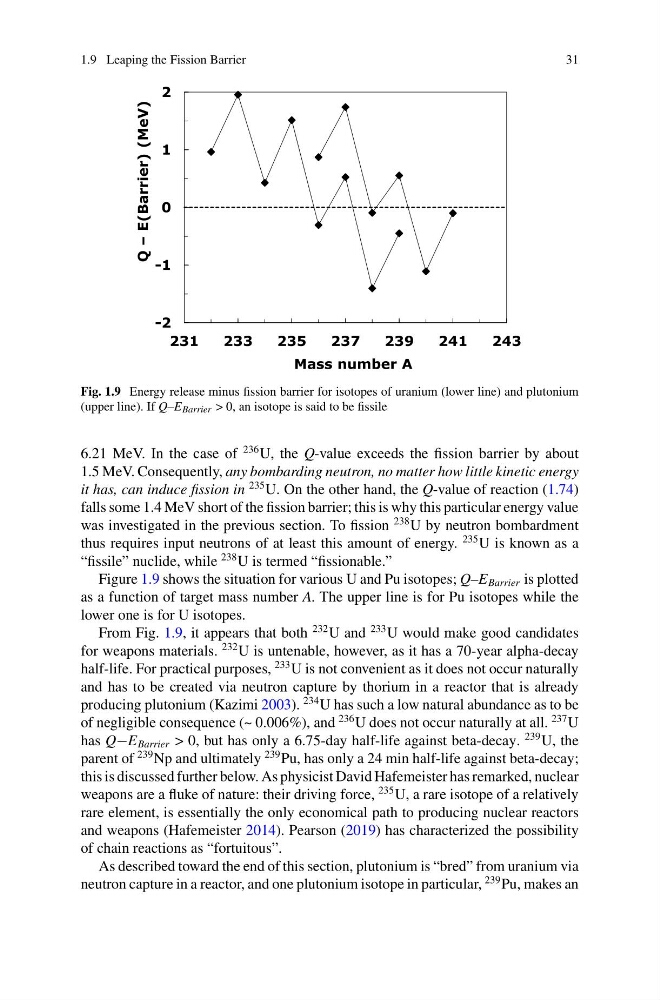
Fig. 1.9 Energy release minus fission barrier for isotopes of uranium (lower line) and plutonium
(upper line). If Q–E Barrier > 0, an isotope is said to be fissile
6.21 MeV. In the case of
236 U, the Q-value exceeds the fission barrier by about
1.5 MeV. Consequently, any bombarding neutron, no matter how little kinetic energy
it has, can induce fission in
235 U. On the other hand, the Q-value of reaction (1.74)
falls some 1.4 MeV short of the fission barrier; this is why this particular energy value
was investigated in the previous section. To fission
238 U by neutron bombardment
thus requires input neutrons of at least this amount of energy.
235 U is known as a
“fissile” nuclide, while
238 U is termed “fissionable.”
Figure 1.9 shows the situation for various U and Pu isotopes; Q–E Barrier is plotted
as a function of target mass number A. The upper line is for Pu isotopes while the
lower one is for U isotopes.
From Fig. 1.9, it appears that both
232 U and
233 U would make good candidates
for weapons materials.
232 U is untenable, however, as it has a 70-year alpha-decay
half-life. For practical purposes,
233 U is not convenient as it does not occur naturally
and has to be created via neutron capture by thorium in a reactor that is already
producing plutonium (Kazimi 2003).
234 U has such a low natural abundance as to be
of negligible consequence (~ 0.006%), and
236 U does not occur naturally at all.
237 U
has Q−E Barrier > 0, but has only a 6.75-day half-life against beta-decay.
239 U, the
parent of
239 Np and ultimately
239 Pu, has only a 24 min half-life against beta-decay;
this is discussed further below. As physicist David Hafemeister has remarked, nuclear
weapons are a fluke of nature: their driving force,
235 U, a rare isotope of a relatively
rare element, is essentially the only economical path to producing nuclear reactors
and weapons (Hafemeister 2014). Pearson (2019) has characterized the possibility
of chain reactions as “fortuitous”.
As described toward the end of this section, plutonium is “bred” from uranium via
neutron capture in a reactor, and one plutonium isotope in particular,
239 Pu, makes an
31
Fig. 1.9 Energy release minus fission barrier for isotopes of uranium (lower line) and plutonium
(upper line). If Q–E Barrier > 0, an isotope is said to be fissile
6.21 MeV. In the case of
236 U, the Q-value exceeds the fission barrier by about
1.5 MeV. Consequently, any bombarding neutron, no matter how little kinetic energy
it has, can induce fission in
235 U. On the other hand, the Q-value of reaction (1.74)
falls some 1.4 MeV short of the fission barrier; this is why this particular energy value
was investigated in the previous section. To fission
238 U by neutron bombardment
thus requires input neutrons of at least this amount of energy.
235 U is known as a
“fissile” nuclide, while
238 U is termed “fissionable.”
Figure 1.9 shows the situation for various U and Pu isotopes; Q–E Barrier is plotted
as a function of target mass number A. The upper line is for Pu isotopes while the
lower one is for U isotopes.
From Fig. 1.9, it appears that both
232 U and
233 U would make good candidates
for weapons materials.
232 U is untenable, however, as it has a 70-year alpha-decay
half-life. For practical purposes,
233 U is not convenient as it does not occur naturally
and has to be created via neutron capture by thorium in a reactor that is already
producing plutonium (Kazimi 2003).
234 U has such a low natural abundance as to be
of negligible consequence (~ 0.006%), and
236 U does not occur naturally at all.
237 U
has Q−E Barrier > 0, but has only a 6.75-day half-life against beta-decay.
239 U, the
parent of
239 Np and ultimately
239 Pu, has only a 24 min half-life against beta-decay;
this is discussed further below. As physicist David Hafemeister has remarked, nuclear
weapons are a fluke of nature: their driving force,
235 U, a rare isotope of a relatively
rare element, is essentially the only economical path to producing nuclear reactors
and weapons (Hafemeister 2014). Pearson (2019) has characterized the possibility
of chain reactions as “fortuitous”.
As described toward the end of this section, plutonium is “bred” from uranium via
neutron capture in a reactor, and one plutonium isotope in particular,
239 Pu, makes an