

1.5 Artificially-Induced Radioactivity and the Path to Fission
15
The values are respectively 2.425, –17.197, 8.071 and –20.201, which give Q
~ –2.64 MeV. Despite this threshold (negative Q-value), the incoming alpha is more
than energetic enough to cause the reaction to proceed. The
30 P nucleus subsequently
undergoes positron decay to
30 Si with a half-life of 2.5 min:
30
15 P
β
+
→
2.5 min
30
14 Si.
(1.37)
It was this positron emission that alerted the Joliot-Curies to the fact that they had
induced radioactivity in aluminum. When the bombarded aluminum was dissolved
in acid, the small amount of phosphorous created could be separated and chemically
identified as such; that the radioactivity carried with the phosphorous and not the
aluminum verified their suspicion.
The Joliot-Curies’ success stimulated Enrico Fermi to see if he could similarly
induce radioactivity by neutron bombardment. He soon succeeded with fluorine:
1
0 n +
19
9 F →
20
9 F
β
- -
→
11.1 sec
20
10 Ne,
(1.38)
and also with aluminum, discovering a different half-life than had the Joliot-Curies:
1
0 n +
27
13 Al →
1
1 H +
27
12 Mg
β
−
→
9.5 min
27
13 Al.
(1.39)
It was not long before Fermi and his collaborators had worked their way through
the periodic table to uranium, neutron bombardment of which would lead to the
discovery of fission.
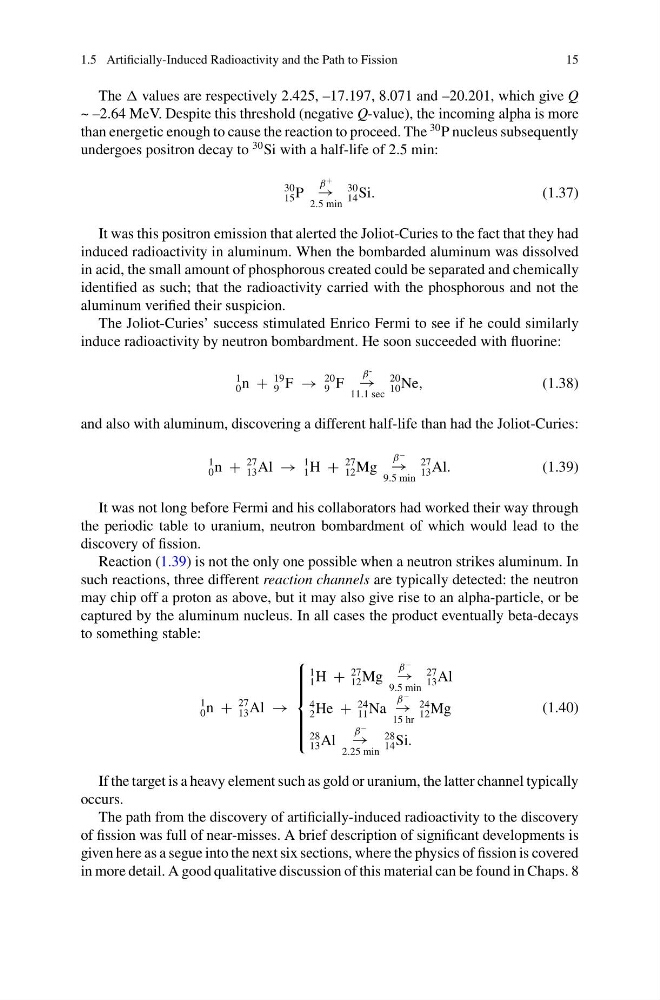
Reaction (1.39) is not the only one possible when a neutron strikes aluminum. In
such reactions, three different reaction channels are typically detected: the neutron
may chip off a proton as above, but it may also give rise to an alpha-particle, or be
captured by the aluminum nucleus. In all cases the product eventually beta-decays
to something stable:
1
0 n +
27
13 Al →
⎧
⎪ ⎪ ⎪ ⎪ ⎨
⎪ ⎪ ⎪ ⎪ ⎩
1
1 H +
27
12 Mg
β
−
→
9.5 min
27
13 Al
4
2 He +
24
11 Na
β
−
→
15 hr
24
12 Mg
28
13 Al
β
−
→
2.25 min
28
14 Si.
(1.40)
If the target is a heavy element such as gold or uranium, the latter channel typically
occurs.
The path from the discovery of artificially-induced radioactivity to the discovery
of fission was full of near-misses. A brief description of significant developments is
given here as a segue into the next six sections, where the physics of fission is covered
in more detail. A good qualitative discussion of this material can be found in Chaps. 8
15
The values are respectively 2.425, –17.197, 8.071 and –20.201, which give Q
~ –2.64 MeV. Despite this threshold (negative Q-value), the incoming alpha is more
than energetic enough to cause the reaction to proceed. The
30 P nucleus subsequently
undergoes positron decay to
30 Si with a half-life of 2.5 min:
30
15 P
β
+
→
2.5 min
30
14 Si.
(1.37)
It was this positron emission that alerted the Joliot-Curies to the fact that they had
induced radioactivity in aluminum. When the bombarded aluminum was dissolved
in acid, the small amount of phosphorous created could be separated and chemically
identified as such; that the radioactivity carried with the phosphorous and not the
aluminum verified their suspicion.
The Joliot-Curies’ success stimulated Enrico Fermi to see if he could similarly
induce radioactivity by neutron bombardment. He soon succeeded with fluorine:
1
0 n +
19
9 F →
20
9 F
β
- -
→
11.1 sec
20
10 Ne,
(1.38)
and also with aluminum, discovering a different half-life than had the Joliot-Curies:
1
0 n +
27
13 Al →
1
1 H +
27
12 Mg
β
−
→
9.5 min
27
13 Al.
(1.39)
It was not long before Fermi and his collaborators had worked their way through
the periodic table to uranium, neutron bombardment of which would lead to the
discovery of fission.
Reaction (1.39) is not the only one possible when a neutron strikes aluminum. In
such reactions, three different reaction channels are typically detected: the neutron
may chip off a proton as above, but it may also give rise to an alpha-particle, or be
captured by the aluminum nucleus. In all cases the product eventually beta-decays
to something stable:
1
0 n +
27
13 Al →
⎧
⎪ ⎪ ⎪ ⎪ ⎨
⎪ ⎪ ⎪ ⎪ ⎩
1
1 H +
27
12 Mg
β
−
→
9.5 min
27
13 Al
4
2 He +
24
11 Na
β
−
→
15 hr
24
12 Mg
28
13 Al
β
−
→
2.25 min
28
14 Si.
(1.40)
If the target is a heavy element such as gold or uranium, the latter channel typically
occurs.
The path from the discovery of artificially-induced radioactivity to the discovery
of fission was full of near-misses. A brief description of significant developments is
given here as a segue into the next six sections, where the physics of fission is covered
in more detail. A good qualitative discussion of this material can be found in Chaps. 8