

16
1 Energy Release in Nuclear Reactions, Neutrons, Fission, and Characteristics …
and 9 of Rhodes (1986), and more technical ones in Sime (1996) and in Chaps. 2 and
3 of Reed (2019); a comprehensive technical discussion of developments between
the discovery of the neutron and the discovery of fission appears in Amaldi (1984).
As neutron sources, Fermi and his group used small glass vials containing radon
gas mixed with powdered beryllium. Radon alpha-decays with a half-life of 3.8 days
and is consequently a copious source of alpha particles; these alphas strike beryllium
nuclei and produce neutrons of energy ~ 11 MeV as in Chadwick’s polonium-source
experiment. In early 1934, the Rome group began systematically bombarding various
target elements with neutrons. By the spring of 1934 they had come to uranium, for
which, at the time, only one isotope was known:
238 U. (
235 U would be discovered by
University of Chicago mass spectroscopist Arthur Dempster in 1935.) Upon carrying
out the bombardment, they found that β
– activity was induced, with evidence for
several half-lives appearing; in particular, they noted one of 13 min. Consequently,
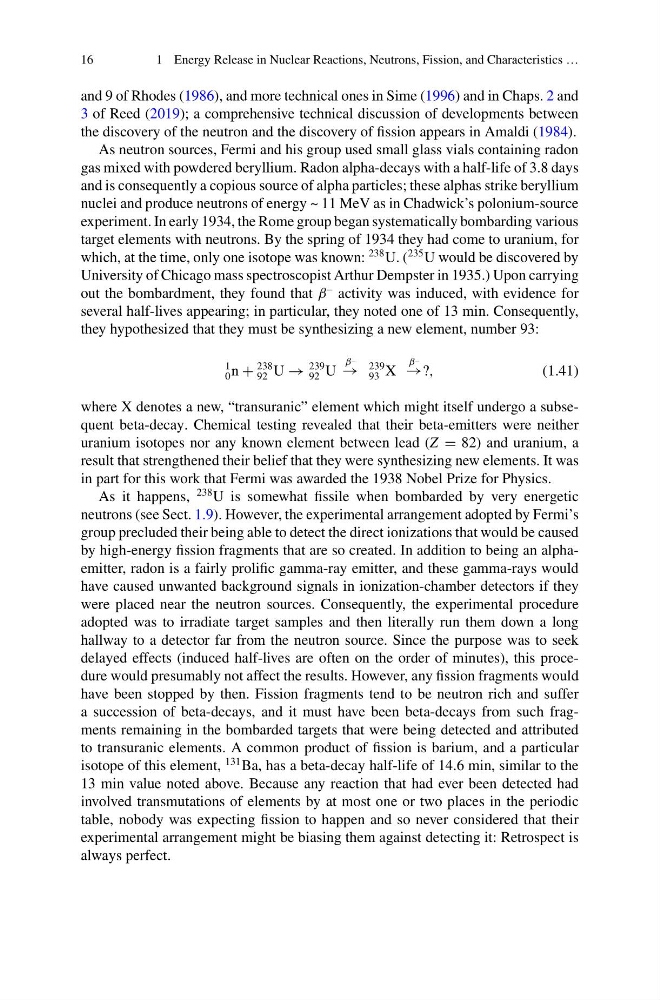
they hypothesized that they must be synthesizing a new element, number 93:
1
0 n +
238
92 U →
239
92 U
β
_
→
239
93 X
β
_
→?,
(1.41)
where X denotes a new, “transuranic” element which might itself undergo a subsequent beta-decay. Chemical testing revealed that their beta-emitters were neither
uranium isotopes nor any known element between lead (Z = 82) and uranium, a
result that strengthened their belief that they were synthesizing new elements. It was
in part for this work that Fermi was awarded the 1938 Nobel Prize for Physics.
As it happens,
238 U is somewhat fissile when bombarded by very energetic
neutrons (see Sect. 1.9). However, the experimental arrangement adopted by Fermi’s
group precluded their being able to detect the direct ionizations that would be caused
by high-energy fission fragments that are so created. In addition to being an alphaemitter, radon is a fairly prolific gamma-ray emitter, and these gamma-rays would
have caused unwanted background signals in ionization-chamber detectors if they
were placed near the neutron sources. Consequently, the experimental procedure
adopted was to irradiate target samples and then literally run them down a long
hallway to a detector far from the neutron source. Since the purpose was to seek
delayed effects (induced half-lives are often on the order of minutes), this procedure would presumably not affect the results. However, any fission fragments would
have been stopped by then. Fission fragments tend to be neutron rich and suffer
a succession of beta-decays, and it must have been beta-decays from such fragments remaining in the bombarded targets that were being detected and attributed
to transuranic elements. A common product of fission is barium, and a particular
isotope of this element,
131 Ba, has a beta-decay half-life of 14.6 min, similar to the
13 min value noted above. Because any reaction that had ever been detected had
involved transmutations of elements by at most one or two places in the periodic
table, nobody was expecting fission to happen and so never considered that their
experimental arrangement might be biasing them against detecting it: Retrospect is
always perfect.
1 Energy Release in Nuclear Reactions, Neutrons, Fission, and Characteristics …
and 9 of Rhodes (1986), and more technical ones in Sime (1996) and in Chaps. 2 and
3 of Reed (2019); a comprehensive technical discussion of developments between
the discovery of the neutron and the discovery of fission appears in Amaldi (1984).
As neutron sources, Fermi and his group used small glass vials containing radon
gas mixed with powdered beryllium. Radon alpha-decays with a half-life of 3.8 days
and is consequently a copious source of alpha particles; these alphas strike beryllium
nuclei and produce neutrons of energy ~ 11 MeV as in Chadwick’s polonium-source
experiment. In early 1934, the Rome group began systematically bombarding various
target elements with neutrons. By the spring of 1934 they had come to uranium, for
which, at the time, only one isotope was known:
238 U. (
235 U would be discovered by
University of Chicago mass spectroscopist Arthur Dempster in 1935.) Upon carrying
out the bombardment, they found that β
– activity was induced, with evidence for
several half-lives appearing; in particular, they noted one of 13 min. Consequently,
they hypothesized that they must be synthesizing a new element, number 93:
1
0 n +
238
92 U →
239
92 U
β
_
→
239
93 X
β
_
→?,
(1.41)
where X denotes a new, “transuranic” element which might itself undergo a subsequent beta-decay. Chemical testing revealed that their beta-emitters were neither
uranium isotopes nor any known element between lead (Z = 82) and uranium, a
result that strengthened their belief that they were synthesizing new elements. It was
in part for this work that Fermi was awarded the 1938 Nobel Prize for Physics.
As it happens,
238 U is somewhat fissile when bombarded by very energetic
neutrons (see Sect. 1.9). However, the experimental arrangement adopted by Fermi’s
group precluded their being able to detect the direct ionizations that would be caused
by high-energy fission fragments that are so created. In addition to being an alphaemitter, radon is a fairly prolific gamma-ray emitter, and these gamma-rays would
have caused unwanted background signals in ionization-chamber detectors if they
were placed near the neutron sources. Consequently, the experimental procedure
adopted was to irradiate target samples and then literally run them down a long
hallway to a detector far from the neutron source. Since the purpose was to seek
delayed effects (induced half-lives are often on the order of minutes), this procedure would presumably not affect the results. However, any fission fragments would
have been stopped by then. Fission fragments tend to be neutron rich and suffer
a succession of beta-decays, and it must have been beta-decays from such fragments remaining in the bombarded targets that were being detected and attributed
to transuranic elements. A common product of fission is barium, and a particular
isotope of this element,
131 Ba, has a beta-decay half-life of 14.6 min, similar to the
13 min value noted above. Because any reaction that had ever been detected had
involved transmutations of elements by at most one or two places in the periodic
table, nobody was expecting fission to happen and so never considered that their
experimental arrangement might be biasing them against detecting it: Retrospect is
always perfect.