

14
1 Energy Release in Nuclear Reactions, Neutrons, Fission, and Characteristics …
estimate the mass of the neutron by a simple classical argument. If the mass of a
proton is 1 unit and that of a nitrogen 14 units, (1.34) indicates that the ratio of the
speed of a recoiling proton to that of a recoiling nitrogen would be (μ +14)/(μ +1);
the measured speeds led him to conclude μ ~1.15 with an uncertainty estimated at
~10%. Further experiments with boron targets led Chadwick to report a final estimate
of the neutron mass as between 1.005 and 1.008 mass units. The modern figure is
1.00866; the accuracy he achieved with equipment which would now be regarded as
primitive is nothing short of awe-inspiring.
In summary, Chadwick’s analysis comprised four main points: (1) If the “beryllium radiation” comprises gamma-rays, then they must be of energy ~55 MeV to set
protons into motion as observed. (2) Such a high energy is unlikely from an α-Be
collision, although not inconceivable if the reaction happens in some unusual way
involving considerable mass loss. (3) Letting the same “gamma-rays” strike nitrogen
nuclei causes the latter to recoil with energies indicating that the gamma-rays must
have energies of ~90 MeV, utterly inconsistent with point (1). (4) If instead the
“beryllium radiation” is assumed to be a neutral particle of mass close to that of a
proton, consistent results emerge for both the proton and nitrogen recoil energies.
Chadwick was awarded the 1935 Nobel Prize in Physics for his discovery of
the neutron. He further speculated in his Paper 2 that neutrons might be complex
particles comprising protons and electrons somehow bound together, but this proved
not to be the case: Heisenberg’s uncertainty principle ruled against the possibility
of containing electrons within such a small volume. Subsequent experiments by
Chadwick himself showed that the neutron is a fundamental particle in its own right.
1.5 Artificially-Induced Radioactivity and the Path
to Fission
Irène and Frédéric Joliot-Curie narrowly missed discovering the neutron in early
1932, but scored a success two years later with their discovery that normally stable
nuclei could be induced to become radioactive upon alpha-particle bombardment.
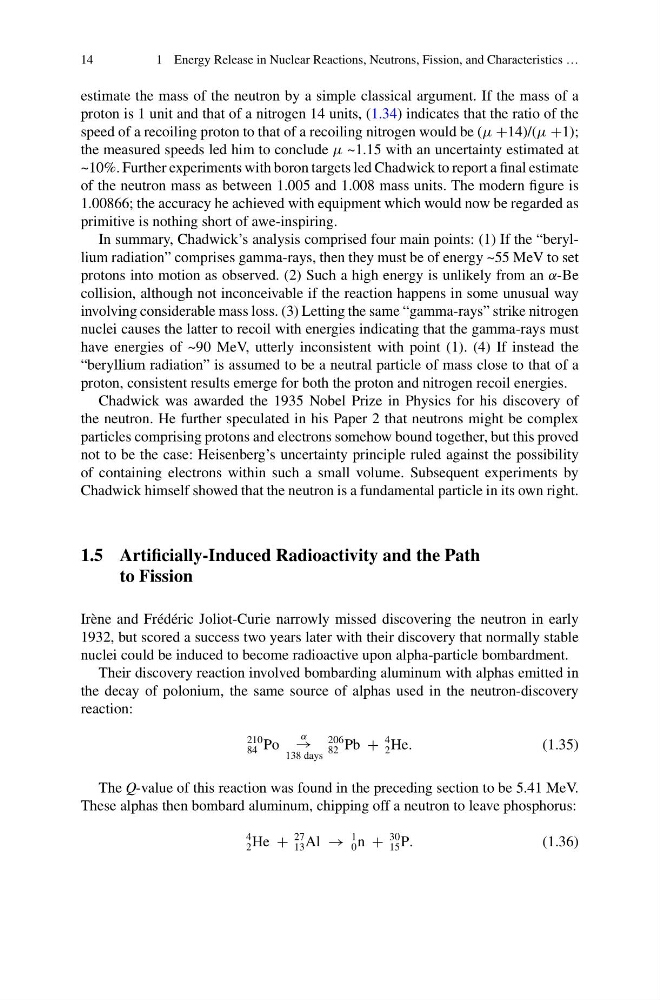
Their discovery reaction involved bombarding aluminum with alphas emitted in
the decay of polonium, the same source of alphas used in the neutron-discovery
reaction:
210
84 Po
α
→
138 days
206
82 Pb +
4
2 He.
(1.35)
The Q-value of this reaction was found in the preceding section to be 5.41 MeV.
These alphas then bombard aluminum, chipping off a neutron to leave phosphorus:
4
2 He +
27
13 Al →
1
0 n +
30
15 P.
(1.36)
1 Energy Release in Nuclear Reactions, Neutrons, Fission, and Characteristics …
estimate the mass of the neutron by a simple classical argument. If the mass of a
proton is 1 unit and that of a nitrogen 14 units, (1.34) indicates that the ratio of the
speed of a recoiling proton to that of a recoiling nitrogen would be (μ +14)/(μ +1);
the measured speeds led him to conclude μ ~1.15 with an uncertainty estimated at
~10%. Further experiments with boron targets led Chadwick to report a final estimate
of the neutron mass as between 1.005 and 1.008 mass units. The modern figure is
1.00866; the accuracy he achieved with equipment which would now be regarded as
primitive is nothing short of awe-inspiring.
In summary, Chadwick’s analysis comprised four main points: (1) If the “beryllium radiation” comprises gamma-rays, then they must be of energy ~55 MeV to set
protons into motion as observed. (2) Such a high energy is unlikely from an α-Be
collision, although not inconceivable if the reaction happens in some unusual way
involving considerable mass loss. (3) Letting the same “gamma-rays” strike nitrogen
nuclei causes the latter to recoil with energies indicating that the gamma-rays must
have energies of ~90 MeV, utterly inconsistent with point (1). (4) If instead the
“beryllium radiation” is assumed to be a neutral particle of mass close to that of a
proton, consistent results emerge for both the proton and nitrogen recoil energies.
Chadwick was awarded the 1935 Nobel Prize in Physics for his discovery of
the neutron. He further speculated in his Paper 2 that neutrons might be complex
particles comprising protons and electrons somehow bound together, but this proved
not to be the case: Heisenberg’s uncertainty principle ruled against the possibility
of containing electrons within such a small volume. Subsequent experiments by
Chadwick himself showed that the neutron is a fundamental particle in its own right.
1.5 Artificially-Induced Radioactivity and the Path
to Fission
Irène and Frédéric Joliot-Curie narrowly missed discovering the neutron in early
1932, but scored a success two years later with their discovery that normally stable
nuclei could be induced to become radioactive upon alpha-particle bombardment.
Their discovery reaction involved bombarding aluminum with alphas emitted in
the decay of polonium, the same source of alphas used in the neutron-discovery
reaction:
210
84 Po
α
→
138 days
206
82 Pb +
4
2 He.
(1.35)
The Q-value of this reaction was found in the preceding section to be 5.41 MeV.
These alphas then bombard aluminum, chipping off a neutron to leave phosphorus:
4
2 He +
27
13 Al →
1
0 n +
30
15 P.
(1.36)