

1.4 Discovery of the Neutron
13
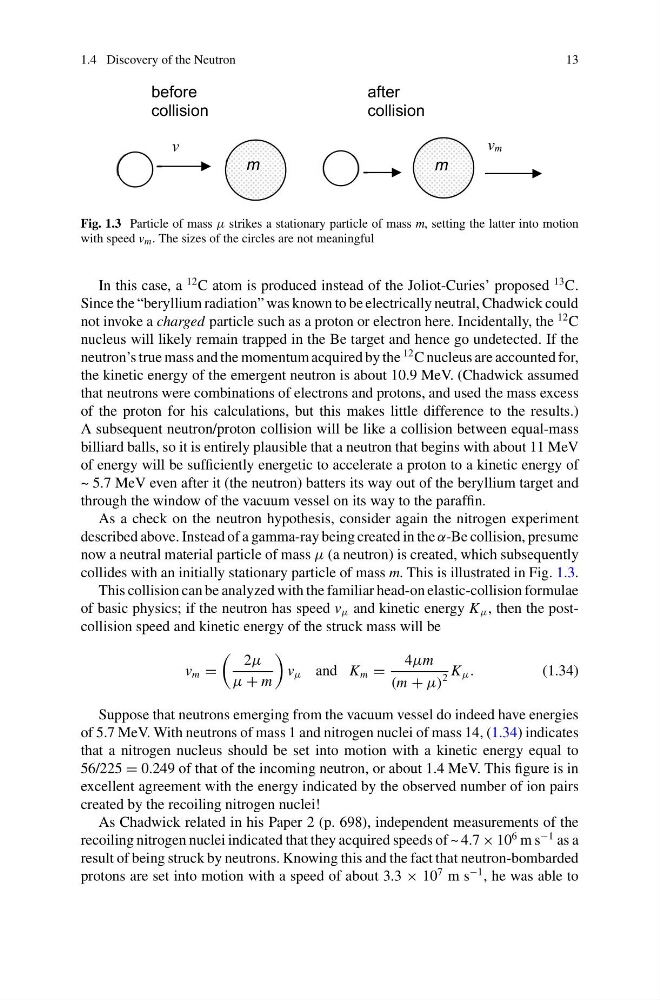
Fig. 1.3 Particle of mass μ strikes a stationary particle of mass m, setting the latter into motion
with speed v m . The sizes of the circles are not meaningful
In this case, a
12 C atom is produced instead of the Joliot-Curies’ proposed
13 C.
Since the “beryllium radiation” was known to be electrically neutral, Chadwick could
not invoke a charged particle such as a proton or electron here. Incidentally, the
12 C
nucleus will likely remain trapped in the Be target and hence go undetected. If the
neutron’s true mass and the momentum acquired by the
12 C nucleus are accounted for,
the kinetic energy of the emergent neutron is about 10.9 MeV. (Chadwick assumed
that neutrons were combinations of electrons and protons, and used the mass excess
of the proton for his calculations, but this makes little difference to the results.)
A subsequent neutron/proton collision will be like a collision between equal-mass
billiard balls, so it is entirely plausible that a neutron that begins with about 11 MeV
of energy will be sufficiently energetic to accelerate a proton to a kinetic energy of
~ 5.7 MeV even after it (the neutron) batters its way out of the beryllium target and
through the window of the vacuum vessel on its way to the paraffin.
As a check on the neutron hypothesis, consider again the nitrogen experiment
described above. Instead of a gamma-ray being created in the α-Be collision, presume
now a neutral material particle of mass μ (a neutron) is created, which subsequently
collides with an initially stationary particle of mass m. This is illustrated in Fig. 1.3.
This collision can be analyzed with the familiar head-on elastic-collision formulae
of basic physics; if the neutron has speed v μ and kinetic energy K μ , then the postcollision speed and kinetic energy of the struck mass will be
v m =
2μ
μ + m
v μ and K m =
4μm
(m + μ)
2
K μ .
(1.34)
Suppose that neutrons emerging from the vacuum vessel do indeed have energies
of 5.7 MeV. With neutrons of mass 1 and nitrogen nuclei of mass 14, (1.34) indicates
that a nitrogen nucleus should be set into motion with a kinetic energy equal to
56/225 = 0.249 of that of the incoming neutron, or about 1.4 MeV. This figure is in
excellent agreement with the energy indicated by the observed number of ion pairs
created by the recoiling nitrogen nuclei!
As Chadwick related in his Paper 2 (p. 698), independent measurements of the
recoiling nitrogen nuclei indicated that they acquired speeds of ~ 4.7 × 10
6 m s
−1 as a
result of being struck by neutrons. Knowing this and the fact that neutron-bombarded
protons are set into motion with a speed of about 3.3 × 10
7 m s
−1 , he was able to
13
Fig. 1.3 Particle of mass μ strikes a stationary particle of mass m, setting the latter into motion
with speed v m . The sizes of the circles are not meaningful
In this case, a
12 C atom is produced instead of the Joliot-Curies’ proposed
13 C.
Since the “beryllium radiation” was known to be electrically neutral, Chadwick could
not invoke a charged particle such as a proton or electron here. Incidentally, the
12 C
nucleus will likely remain trapped in the Be target and hence go undetected. If the
neutron’s true mass and the momentum acquired by the
12 C nucleus are accounted for,
the kinetic energy of the emergent neutron is about 10.9 MeV. (Chadwick assumed
that neutrons were combinations of electrons and protons, and used the mass excess
of the proton for his calculations, but this makes little difference to the results.)
A subsequent neutron/proton collision will be like a collision between equal-mass
billiard balls, so it is entirely plausible that a neutron that begins with about 11 MeV
of energy will be sufficiently energetic to accelerate a proton to a kinetic energy of
~ 5.7 MeV even after it (the neutron) batters its way out of the beryllium target and
through the window of the vacuum vessel on its way to the paraffin.
As a check on the neutron hypothesis, consider again the nitrogen experiment
described above. Instead of a gamma-ray being created in the α-Be collision, presume
now a neutral material particle of mass μ (a neutron) is created, which subsequently
collides with an initially stationary particle of mass m. This is illustrated in Fig. 1.3.
This collision can be analyzed with the familiar head-on elastic-collision formulae
of basic physics; if the neutron has speed v μ and kinetic energy K μ , then the postcollision speed and kinetic energy of the struck mass will be
v m =
2μ
μ + m
v μ and K m =
4μm
(m + μ)
2
K μ .
(1.34)
Suppose that neutrons emerging from the vacuum vessel do indeed have energies
of 5.7 MeV. With neutrons of mass 1 and nitrogen nuclei of mass 14, (1.34) indicates
that a nitrogen nucleus should be set into motion with a kinetic energy equal to
56/225 = 0.249 of that of the incoming neutron, or about 1.4 MeV. This figure is in
excellent agreement with the energy indicated by the observed number of ion pairs
created by the recoiling nitrogen nuclei!
As Chadwick related in his Paper 2 (p. 698), independent measurements of the
recoiling nitrogen nuclei indicated that they acquired speeds of ~ 4.7 × 10
6 m s
−1 as a
result of being struck by neutrons. Knowing this and the fact that neutron-bombarded
protons are set into motion with a speed of about 3.3 × 10
7 m s
−1 , he was able to