

224
6 Appendices
⎛
⎜
⎜
⎜
⎝
total radial distance
traveled by all neutrons
moving in directions (θ, φ)
that escape in timet
⎞
⎟
⎟
⎟
⎠
=
number that escape
in time t
×
average radial distance
traveled by each neutron
=
N A λ
2
t
4π
cos
2
θ sin θ dθ dφ.
(6.108)
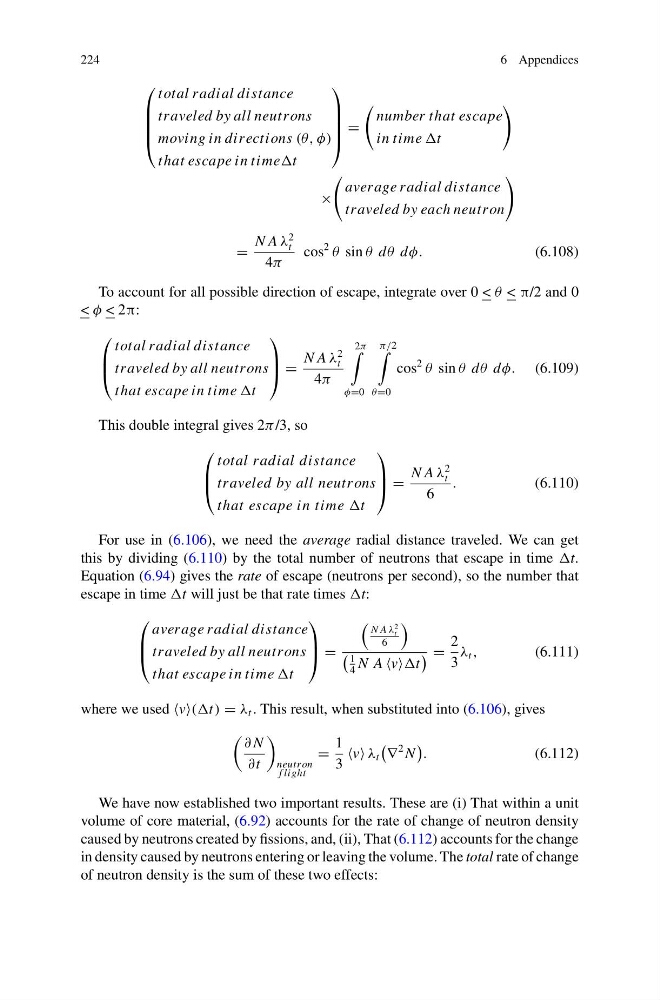
To account for all possible direction of escape, integrate over 0 < θ < π/2 and 0
< φ < 2π:
⎛
⎜
⎝
total radial distance
traveled by all neutrons
that escape in time t
⎞
⎟
⎠ =
N A λ
2
t
4π
2π
φ=0
π/2
θ=0
cos
2
θ sin θ dθ dφ. (6.109)
This double integral gives 2π /3, so
⎛
⎜
⎝
total radial distance
traveled by all neutrons
that escape in time t
⎞
⎟
⎠ =
N A λ
2
t
6
.
(6.110)
For use in (6.106), we need the average radial distance traveled. We can get
this by dividing (6.110) by the total number of neutrons that escape in time t.
Equation (6.94) gives the rate of escape (neutrons per second), so the number that
escape in time t will just be that rate times t:
⎛
⎜
⎝
average radial distance
traveled by all neutrons
that escape in time t
⎞
⎟
⎠ =
N A λ
2
t
6
1
4
N A vt
=
2
3
λ t ,
(6.111)
where we used v(t) = λ t . This result, when substituted into (6.106), gives
∂ N
∂t
neutron
f light
=
1
3
v λ t
∇
2 N
.
(6.112)
We have now established two important results. These are (i) That within a unit
volume of core material, (6.92) accounts for the rate of change of neutron density
caused by neutrons created by fissions, and, (ii), That (6.112) accounts for the change
in density caused by neutrons entering or leaving the volume. The total rate of change
of neutron density is the sum of these two effects:
6 Appendices
⎛
⎜
⎜
⎜
⎝
total radial distance
traveled by all neutrons
moving in directions (θ, φ)
that escape in timet
⎞
⎟
⎟
⎟
⎠
=
number that escape
in time t
×
average radial distance
traveled by each neutron
=
N A λ
2
t
4π
cos
2
θ sin θ dθ dφ.
(6.108)
To account for all possible direction of escape, integrate over 0 < θ < π/2 and 0
< φ < 2π:
⎛
⎜
⎝
total radial distance
traveled by all neutrons
that escape in time t
⎞
⎟
⎠ =
N A λ
2
t
4π
2π
φ=0
π/2
θ=0
cos
2
θ sin θ dθ dφ. (6.109)
This double integral gives 2π /3, so
⎛
⎜
⎝
total radial distance
traveled by all neutrons
that escape in time t
⎞
⎟
⎠ =
N A λ
2
t
6
.
(6.110)
For use in (6.106), we need the average radial distance traveled. We can get
this by dividing (6.110) by the total number of neutrons that escape in time t.
Equation (6.94) gives the rate of escape (neutrons per second), so the number that
escape in time t will just be that rate times t:
⎛
⎜
⎝
average radial distance
traveled by all neutrons
that escape in time t
⎞
⎟
⎠ =
N A λ
2
t
6
1
4
N A vt
=
2
3
λ t ,
(6.111)
where we used v(t) = λ t . This result, when substituted into (6.106), gives
∂ N
∂t
neutron
f light
=
1
3
v λ t
∇
2 N
.
(6.112)
We have now established two important results. These are (i) That within a unit
volume of core material, (6.92) accounts for the rate of change of neutron density
caused by neutrons created by fissions, and, (ii), That (6.112) accounts for the change
in density caused by neutrons entering or leaving the volume. The total rate of change
of neutron density is the sum of these two effects: