

6.7 Appendix G: The Neutron Diffusion Equation
225
d N
dt
=
v
λ f
(ν − 1) N +
v λ t
3
∇
2 N
,
(6.113)
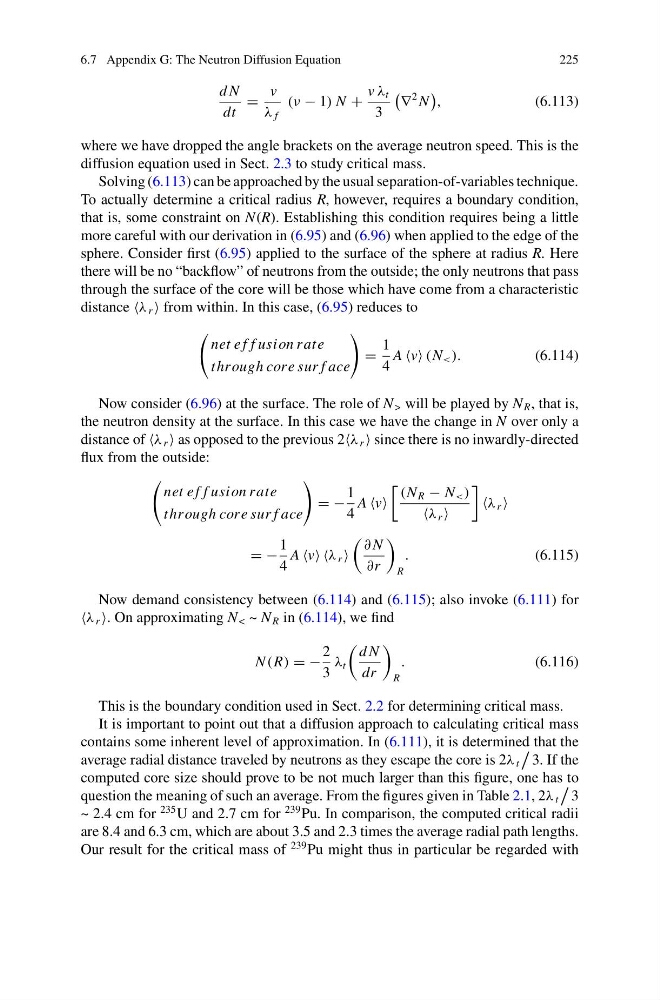
where we have dropped the angle brackets on the average neutron speed. This is the
diffusion equation used in Sect. 2.3 to study critical mass.
Solving (6.113) can be approached by the usual separation-of-variables technique.
To actually determine a critical radius R, however, requires a boundary condition,
that is, some constraint on N(R). Establishing this condition requires being a little
more careful with our derivation in (6.95) and (6.96) when applied to the edge of the
sphere. Consider first (6.95) applied to the surface of the sphere at radius R. Here
there will be no “backflow” of neutrons from the outside; the only neutrons that pass
through the surface of the core will be those which have come from a characteristic
distance λ r from within. In this case, (6.95) reduces to
net e f f usion rate
through core sur f ace
=
1
4
A v (N < ).
(6.114)
Now consider (6.96) at the surface. The role of N > will be played by N R , that is,
the neutron density at the surface. In this case we have the change in N over only a
distance of λ r as opposed to the previous 2λ r since there is no inwardly-directed
flux from the outside:
net e f f usion rate
through core sur f ace
= −
1
4
A v
(N R − N < )
λ r
λ r
= −
1
4
A v λ r
∂ N
∂r
R
.
(6.115)
Now demand consistency between (6.114) and (6.115); also invoke (6.111) for
λ r . On approximating N < ~ N R in (6.114), we find
N (R) = −
2
3
λ t
d N
dr
R
.
(6.116)
This is the boundary condition used in Sect. 2.2 for determining critical mass.
It is important to point out that a diffusion approach to calculating critical mass
contains some inherent level of approximation. In (6.111), it is determined that the
average radial distance traveled by neutrons as they escape the core is 2λ t
3. If the
computed core size should prove to be not much larger than this figure, one has to
question the meaning of such an average. From the figures given in Table 2.1, 2λ t
3
~ 2.4 cm for
235 U and 2.7 cm for
239 Pu. In comparison, the computed critical radii
are 8.4 and 6.3 cm, which are about 3.5 and 2.3 times the average radial path lengths.
Our result for the critical mass of
239 Pu might thus in particular be regarded with
225
d N
dt
=
v
λ f
(ν − 1) N +
v λ t
3
∇
2 N
,
(6.113)
where we have dropped the angle brackets on the average neutron speed. This is the
diffusion equation used in Sect. 2.3 to study critical mass.
Solving (6.113) can be approached by the usual separation-of-variables technique.
To actually determine a critical radius R, however, requires a boundary condition,
that is, some constraint on N(R). Establishing this condition requires being a little
more careful with our derivation in (6.95) and (6.96) when applied to the edge of the
sphere. Consider first (6.95) applied to the surface of the sphere at radius R. Here
there will be no “backflow” of neutrons from the outside; the only neutrons that pass
through the surface of the core will be those which have come from a characteristic
distance λ r from within. In this case, (6.95) reduces to
net e f f usion rate
through core sur f ace
=
1
4
A v (N < ).
(6.114)
Now consider (6.96) at the surface. The role of N > will be played by N R , that is,
the neutron density at the surface. In this case we have the change in N over only a
distance of λ r as opposed to the previous 2λ r since there is no inwardly-directed
flux from the outside:
net e f f usion rate
through core sur f ace
= −
1
4
A v
(N R − N < )
λ r
λ r
= −
1
4
A v λ r
∂ N
∂r
R
.
(6.115)
Now demand consistency between (6.114) and (6.115); also invoke (6.111) for
λ r . On approximating N < ~ N R in (6.114), we find
N (R) = −
2
3
λ t
d N
dr
R
.
(6.116)
This is the boundary condition used in Sect. 2.2 for determining critical mass.
It is important to point out that a diffusion approach to calculating critical mass
contains some inherent level of approximation. In (6.111), it is determined that the
average radial distance traveled by neutrons as they escape the core is 2λ t
3. If the
computed core size should prove to be not much larger than this figure, one has to
question the meaning of such an average. From the figures given in Table 2.1, 2λ t
3
~ 2.4 cm for
235 U and 2.7 cm for
239 Pu. In comparison, the computed critical radii
are 8.4 and 6.3 cm, which are about 3.5 and 2.3 times the average radial path lengths.
Our result for the critical mass of
239 Pu might thus in particular be regarded with