

6.7 Appendix G: The Neutron Diffusion Equation
223
⎛
⎜
⎝
net rate o f
neutrons
entering shell
⎞
⎟
⎠ = 2 π v λ r
r
2
∇
2 N
r
dr + 2r
∂
2 N
∂r 2
r
dr
2
+
∂ N
∂r
r
dr
2
+
∂
2 N
∂r 2
r
dr
3
. (6.104)
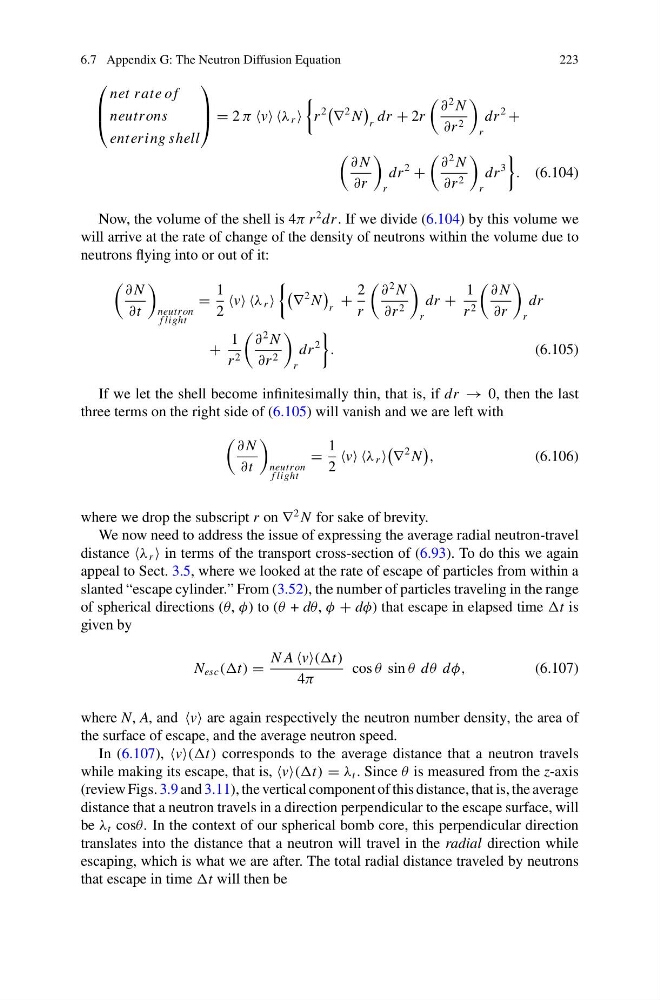
Now, the volume of the shell is 4π r
2 dr. If we divide (6.104) by this volume we
will arrive at the rate of change of the density of neutrons within the volume due to
neutrons flying into or out of it:
∂ N
∂t
neutron
f light
=
1
2
v λ r
∇
2 N
r
+
2
r
∂
2 N
∂r 2
r
dr +
1
r 2
∂ N
∂r
r
dr
+
1
r 2
∂
2 N
∂r 2
r
dr
2
.
(6.105)
If we let the shell become infinitesimally thin, that is, if dr → 0, then the last
three terms on the right side of (6.105) will vanish and we are left with
∂ N
∂t
neutron
f light
=
1
2
v λ r
∇
2 N
,
(6.106)
where we drop the subscript r on ∇
2 N for sake of brevity.
We now need to address the issue of expressing the average radial neutron-travel
distance λ r in terms of the transport cross-section of (6.93). To do this we again
appeal to Sect. 3.5, where we looked at the rate of escape of particles from within a
slanted “escape cylinder.” From (3.52), the number of particles traveling in the range
of spherical directions (θ, φ) to (θ + dθ, φ + dφ) that escape in elapsed time t is
given by
N esc (t) =
N A v(t)
4π
cos θ sin θ dθ dφ,
(6.107)
where N, A, and v are again respectively the neutron number density, the area of
the surface of escape, and the average neutron speed.
In (6.107), v(t) corresponds to the average distance that a neutron travels
while making its escape, that is, v(t) = λ t . Since θ is measured from the z-axis
(review Figs. 3.9 and 3.11), the vertical component of this distance, that is, the average
distance that a neutron travels in a direction perpendicular to the escape surface, will
be λ t cosθ . In the context of our spherical bomb core, this perpendicular direction
translates into the distance that a neutron will travel in the radial direction while
escaping, which is what we are after. The total radial distance traveled by neutrons
that escape in time t will then be
223
⎛
⎜
⎝
net rate o f
neutrons
entering shell
⎞
⎟
⎠ = 2 π v λ r
r
2
∇
2 N
r
dr + 2r
∂
2 N
∂r 2
r
dr
2
+
∂ N
∂r
r
dr
2
+
∂
2 N
∂r 2
r
dr
3
. (6.104)
Now, the volume of the shell is 4π r
2 dr. If we divide (6.104) by this volume we
will arrive at the rate of change of the density of neutrons within the volume due to
neutrons flying into or out of it:
∂ N
∂t
neutron
f light
=
1
2
v λ r
∇
2 N
r
+
2
r
∂
2 N
∂r 2
r
dr +
1
r 2
∂ N
∂r
r
dr
+
1
r 2
∂
2 N
∂r 2
r
dr
2
.
(6.105)
If we let the shell become infinitesimally thin, that is, if dr → 0, then the last
three terms on the right side of (6.105) will vanish and we are left with
∂ N
∂t
neutron
f light
=
1
2
v λ r
∇
2 N
,
(6.106)
where we drop the subscript r on ∇
2 N for sake of brevity.
We now need to address the issue of expressing the average radial neutron-travel
distance λ r in terms of the transport cross-section of (6.93). To do this we again
appeal to Sect. 3.5, where we looked at the rate of escape of particles from within a
slanted “escape cylinder.” From (3.52), the number of particles traveling in the range
of spherical directions (θ, φ) to (θ + dθ, φ + dφ) that escape in elapsed time t is
given by
N esc (t) =
N A v(t)
4π
cos θ sin θ dθ dφ,
(6.107)
where N, A, and v are again respectively the neutron number density, the area of
the surface of escape, and the average neutron speed.
In (6.107), v(t) corresponds to the average distance that a neutron travels
while making its escape, that is, v(t) = λ t . Since θ is measured from the z-axis
(review Figs. 3.9 and 3.11), the vertical component of this distance, that is, the average
distance that a neutron travels in a direction perpendicular to the escape surface, will
be λ t cosθ . In the context of our spherical bomb core, this perpendicular direction
translates into the distance that a neutron will travel in the radial direction while
escaping, which is what we are after. The total radial distance traveled by neutrons
that escape in time t will then be