

6.7 Appendix G: The Neutron Diffusion Equation
219
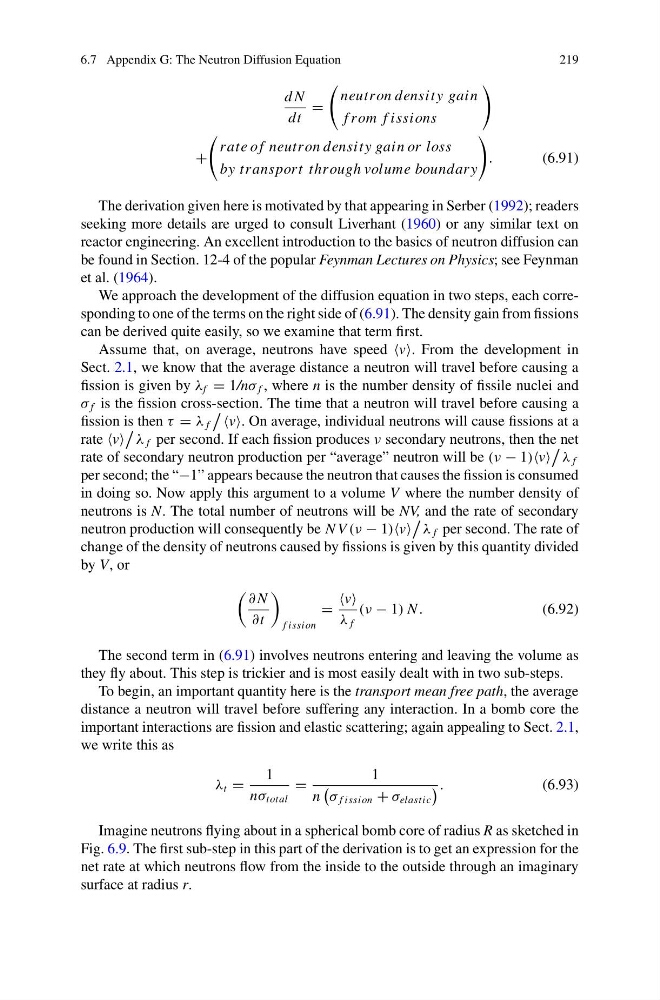
d N
dt
=
neutron densit y gain
f rom f issions
+
rate of neutron densit y gain or loss
by transport through volume boundar y
.
(6.91)
The derivation given here is motivated by that appearing in Serber (1992); readers
seeking more details are urged to consult Liverhant (1960) or any similar text on
reactor engineering. An excellent introduction to the basics of neutron diffusion can
be found in Section. 12-4 of the popular Feynman Lectures on Physics; see Feynman
et al. (1964).
We approach the development of the diffusion equation in two steps, each corresponding to one of the terms on the right side of (6.91). The density gain from fissions
can be derived quite easily, so we examine that term first.
Assume that, on average, neutrons have speed v. From the development in
Sect. 2.1, we know that the average distance a neutron will travel before causing a
fission is given by λ f = 1/nσ f , where n is the number density of fissile nuclei and
σ f is the fission cross-section. The time that a neutron will travel before causing a
fission is then τ = λ f
v. On average, individual neutrons will cause fissions at a
rate v
λ f per second. If each fission produces ν secondary neutrons, then the net
rate of secondary neutron production per “average” neutron will be (ν − 1)v
λ f
per second; the “−1” appears because the neutron that causes the fission is consumed
in doing so. Now apply this argument to a volume V where the number density of
neutrons is N. The total number of neutrons will be NV, and the rate of secondary
neutron production will consequently be N V (ν − 1)v
λ f per second. The rate of
change of the density of neutrons caused by fissions is given by this quantity divided
by V, or
∂ N
∂t
f ission
=
v
λ f
(ν − 1) N .
(6.92)
The second term in (6.91) involves neutrons entering and leaving the volume as
they fly about. This step is trickier and is most easily dealt with in two sub-steps.
To begin, an important quantity here is the transport mean free path, the average
distance a neutron will travel before suffering any interaction. In a bomb core the
important interactions are fission and elastic scattering; again appealing to Sect. 2.1,
we write this as
λ t =
1
nσ total
=
1
n
σ f ission + σ elastic
.
(6.93)
Imagine neutrons flying about in a spherical bomb core of radius R as sketched in
Fig. 6.9. The first sub-step in this part of the derivation is to get an expression for the
net rate at which neutrons flow from the inside to the outside through an imaginary
surface at radius r.
219
d N
dt
=
neutron densit y gain
f rom f issions
+
rate of neutron densit y gain or loss
by transport through volume boundar y
.
(6.91)
The derivation given here is motivated by that appearing in Serber (1992); readers
seeking more details are urged to consult Liverhant (1960) or any similar text on
reactor engineering. An excellent introduction to the basics of neutron diffusion can
be found in Section. 12-4 of the popular Feynman Lectures on Physics; see Feynman
et al. (1964).
We approach the development of the diffusion equation in two steps, each corresponding to one of the terms on the right side of (6.91). The density gain from fissions
can be derived quite easily, so we examine that term first.
Assume that, on average, neutrons have speed v. From the development in
Sect. 2.1, we know that the average distance a neutron will travel before causing a
fission is given by λ f = 1/nσ f , where n is the number density of fissile nuclei and
σ f is the fission cross-section. The time that a neutron will travel before causing a
fission is then τ = λ f
v. On average, individual neutrons will cause fissions at a
rate v
λ f per second. If each fission produces ν secondary neutrons, then the net
rate of secondary neutron production per “average” neutron will be (ν − 1)v
λ f
per second; the “−1” appears because the neutron that causes the fission is consumed
in doing so. Now apply this argument to a volume V where the number density of
neutrons is N. The total number of neutrons will be NV, and the rate of secondary
neutron production will consequently be N V (ν − 1)v
λ f per second. The rate of
change of the density of neutrons caused by fissions is given by this quantity divided
by V, or
∂ N
∂t
f ission
=
v
λ f
(ν − 1) N .
(6.92)
The second term in (6.91) involves neutrons entering and leaving the volume as
they fly about. This step is trickier and is most easily dealt with in two sub-steps.
To begin, an important quantity here is the transport mean free path, the average
distance a neutron will travel before suffering any interaction. In a bomb core the
important interactions are fission and elastic scattering; again appealing to Sect. 2.1,
we write this as
λ t =
1
nσ total
=
1
n
σ f ission + σ elastic
.
(6.93)
Imagine neutrons flying about in a spherical bomb core of radius R as sketched in
Fig. 6.9. The first sub-step in this part of the derivation is to get an expression for the
net rate at which neutrons flow from the inside to the outside through an imaginary
surface at radius r.