

218
6 Appendices
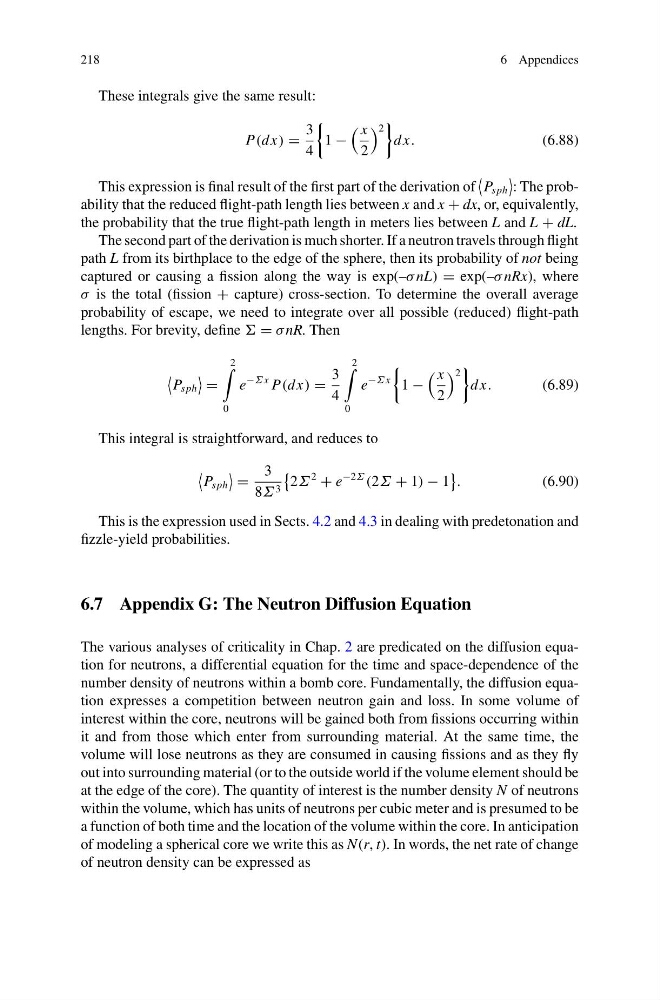
These integrals give the same result:
P(dx) =
3
4
1 −
x
2
2
dx.
(6.88)
This expression is final result of the first part of the derivation of
P sph
: The probability that the reduced flight-path length lies between x and x + dx, or, equivalently,
the probability that the true flight-path length in meters lies between L and L + dL.
The second part of the derivation is much shorter. If a neutron travels through flight
path L from its birthplace to the edge of the sphere, then its probability of not being
captured or causing a fission along the way is exp(–σ nL) = exp(–σ nRx), where
σ is the total (fission + capture) cross-section. To determine the overall average
probability of escape, we need to integrate over all possible (reduced) flight-path
lengths. For brevity, define = σ nR. Then
P sph
=
2
0
e
−Σ x P(dx) =
3
4
2
0
e
−Σ x
1 −
x
2
2
dx.
(6.89)
This integral is straightforward, and reduces to
P sph
=
3
8Σ 3
2Σ
2
+ e
−2Σ
(2Σ + 1) − 1
.
(6.90)
This is the expression used in Sects. 4.2 and 4.3 in dealing with predetonation and
fizzle-yield probabilities.
6.7 Appendix G: The Neutron Diffusion Equation
The various analyses of criticality in Chap. 2 are predicated on the diffusion equation for neutrons, a differential equation for the time and space-dependence of the
number density of neutrons within a bomb core. Fundamentally, the diffusion equation expresses a competition between neutron gain and loss. In some volume of
interest within the core, neutrons will be gained both from fissions occurring within
it and from those which enter from surrounding material. At the same time, the
volume will lose neutrons as they are consumed in causing fissions and as they fly
out into surrounding material (or to the outside world if the volume element should be
at the edge of the core). The quantity of interest is the number density N of neutrons
within the volume, which has units of neutrons per cubic meter and is presumed to be
a function of both time and the location of the volume within the core. In anticipation
of modeling a spherical core we write this as N(r, t). In words, the net rate of change
of neutron density can be expressed as
6 Appendices
These integrals give the same result:
P(dx) =
3
4
1 −
x
2
2
dx.
(6.88)
This expression is final result of the first part of the derivation of
P sph
: The probability that the reduced flight-path length lies between x and x + dx, or, equivalently,
the probability that the true flight-path length in meters lies between L and L + dL.
The second part of the derivation is much shorter. If a neutron travels through flight
path L from its birthplace to the edge of the sphere, then its probability of not being
captured or causing a fission along the way is exp(–σ nL) = exp(–σ nRx), where
σ is the total (fission + capture) cross-section. To determine the overall average
probability of escape, we need to integrate over all possible (reduced) flight-path
lengths. For brevity, define = σ nR. Then
P sph
=
2
0
e
−Σ x P(dx) =
3
4
2
0
e
−Σ x
1 −
x
2
2
dx.
(6.89)
This integral is straightforward, and reduces to
P sph
=
3
8Σ 3
2Σ
2
+ e
−2Σ
(2Σ + 1) − 1
.
(6.90)
This is the expression used in Sects. 4.2 and 4.3 in dealing with predetonation and
fizzle-yield probabilities.
6.7 Appendix G: The Neutron Diffusion Equation
The various analyses of criticality in Chap. 2 are predicated on the diffusion equation for neutrons, a differential equation for the time and space-dependence of the
number density of neutrons within a bomb core. Fundamentally, the diffusion equation expresses a competition between neutron gain and loss. In some volume of
interest within the core, neutrons will be gained both from fissions occurring within
it and from those which enter from surrounding material. At the same time, the
volume will lose neutrons as they are consumed in causing fissions and as they fly
out into surrounding material (or to the outside world if the volume element should be
at the edge of the core). The quantity of interest is the number density N of neutrons
within the volume, which has units of neutrons per cubic meter and is presumed to be
a function of both time and the location of the volume within the core. In anticipation
of modeling a spherical core we write this as N(r, t). In words, the net rate of change
of neutron density can be expressed as