

6.6 Appendix F: Average Neutron Escape Probability from Within a Sphere
217
ρmin = 1-x
ρmax = 1
ρmax = 1
ρmin = x-1
x
x
x
x
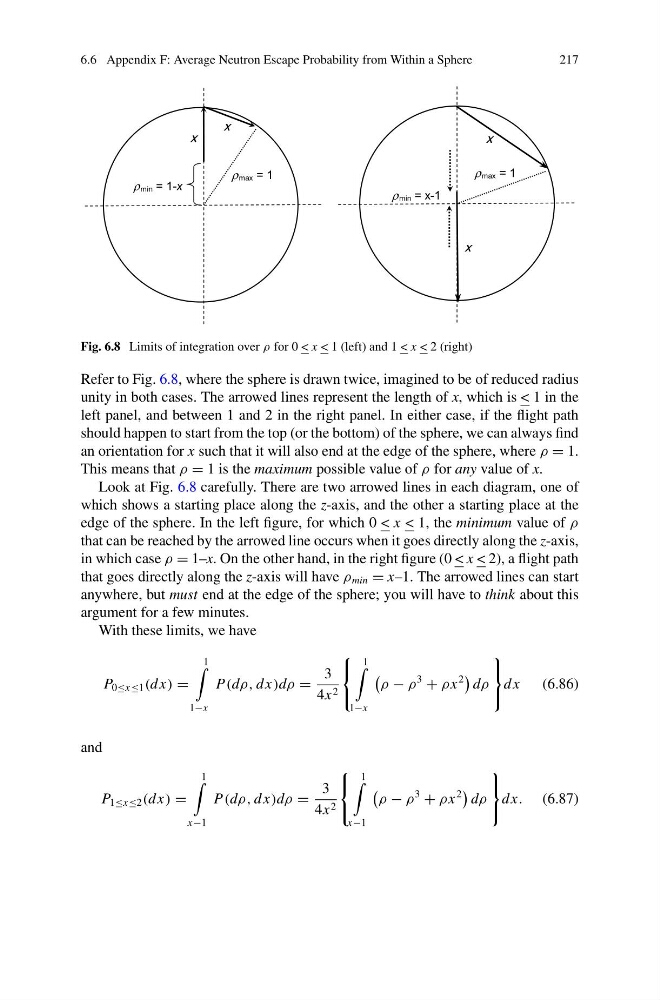
Fig. 6.8 Limits of integration over ρ for 0 < x < 1 (left) and 1 < x < 2 (right)
Refer to Fig. 6.8, where the sphere is drawn twice, imagined to be of reduced radius
unity in both cases. The arrowed lines represent the length of x, which is < 1 in the
left panel, and between 1 and 2 in the right panel. In either case, if the flight path
should happen to start from the top (or the bottom) of the sphere, we can always find
an orientation for x such that it will also end at the edge of the sphere, where ρ = 1.
This means that ρ = 1 is the maximum possible value of ρ for any value of x.
Look at Fig. 6.8 carefully. There are two arrowed lines in each diagram, one of
which shows a starting place along the z-axis, and the other a starting place at the
edge of the sphere. In the left figure, for which 0 < x < 1, the minimum value of ρ
that can be reached by the arrowed line occurs when it goes directly along the z-axis,
in which case ρ = 1–x. On the other hand, in the right figure (0 < x < 2), a flight path
that goes directly along the z-axis will have ρ min = x–1. The arrowed lines can start
anywhere, but must end at the edge of the sphere; you will have to think about this
argument for a few minutes.
With these limits, we have
P 0≤x≤1 (dx) =
1
1−x
P(dρ, dx)dρ =
3
4x 2
⎧
⎨
⎩
1
1−x
ρ − ρ
3
+ ρx
2
dρ
⎫
⎬
⎭
dx
(6.86)
and
P 1≤x≤2 (dx) =
1
x−1
P(dρ, dx)dρ =
3
4x 2
⎧
⎨
⎩
1
x−1
ρ − ρ
3
+ ρx
2
dρ
⎫
⎬
⎭
dx. (6.87)
217
ρmin = 1-x
ρmax = 1
ρmax = 1
ρmin = x-1
x
x
x
x
Fig. 6.8 Limits of integration over ρ for 0 < x < 1 (left) and 1 < x < 2 (right)
Refer to Fig. 6.8, where the sphere is drawn twice, imagined to be of reduced radius
unity in both cases. The arrowed lines represent the length of x, which is < 1 in the
left panel, and between 1 and 2 in the right panel. In either case, if the flight path
should happen to start from the top (or the bottom) of the sphere, we can always find
an orientation for x such that it will also end at the edge of the sphere, where ρ = 1.
This means that ρ = 1 is the maximum possible value of ρ for any value of x.
Look at Fig. 6.8 carefully. There are two arrowed lines in each diagram, one of
which shows a starting place along the z-axis, and the other a starting place at the
edge of the sphere. In the left figure, for which 0 < x < 1, the minimum value of ρ
that can be reached by the arrowed line occurs when it goes directly along the z-axis,
in which case ρ = 1–x. On the other hand, in the right figure (0 < x < 2), a flight path
that goes directly along the z-axis will have ρ min = x–1. The arrowed lines can start
anywhere, but must end at the edge of the sphere; you will have to think about this
argument for a few minutes.
With these limits, we have
P 0≤x≤1 (dx) =
1
1−x
P(dρ, dx)dρ =
3
4x 2
⎧
⎨
⎩
1
1−x
ρ − ρ
3
+ ρx
2
dρ
⎫
⎬
⎭
dx
(6.86)
and
P 1≤x≤2 (dx) =
1
x−1
P(dρ, dx)dρ =
3
4x 2
⎧
⎨
⎩
1
x−1
ρ − ρ
3
+ ρx
2
dρ
⎫
⎬
⎭
dx. (6.87)