

216
6 Appendices
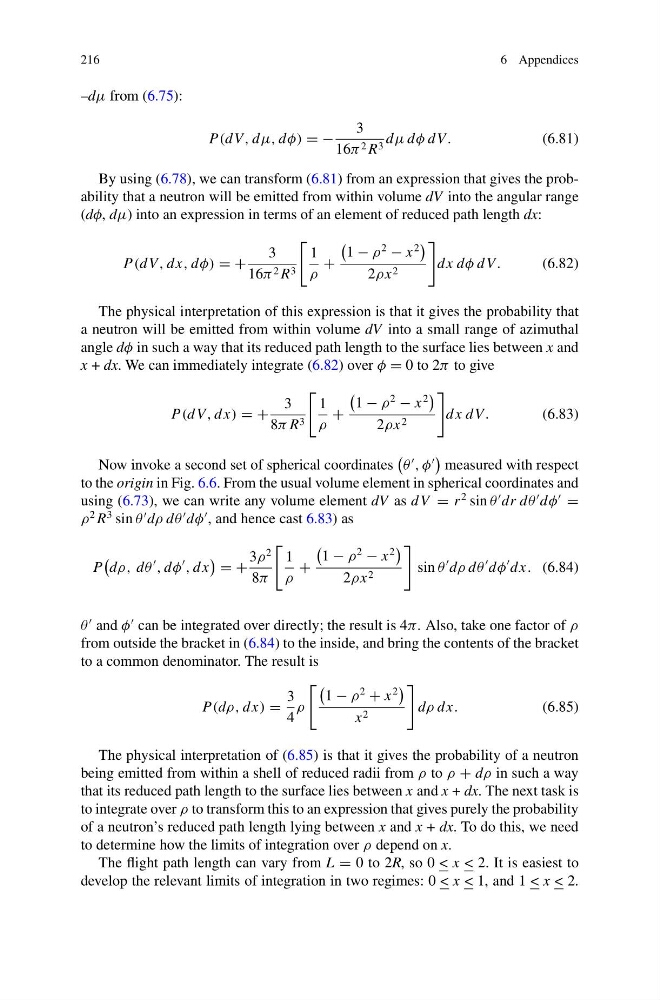
–dμ from (6.75):
P(dV, dμ, dφ) = −
3
16π 2 R 3 dμ dφ dV.
(6.81)
By using (6.78), we can transform (6.81) from an expression that gives the probability that a neutron will be emitted from within volume dV into the angular range
(dφ, dμ) into an expression in terms of an element of reduced path length dx:
P(dV, dx, dφ) = +
3
16π 2 R 3
1
ρ
+
1 − ρ
2
− x
2
2ρx 2
dx dφ dV.
(6.82)
The physical interpretation of this expression is that it gives the probability that
a neutron will be emitted from within volume dV into a small range of azimuthal
angle dφ in such a way that its reduced path length to the surface lies between x and
x + dx. We can immediately integrate (6.82) over φ = 0 to 2π to give
P(dV, dx) = +
3
8π R 3
1
ρ
+
1 − ρ
2
− x
2
2ρx 2
dx dV.
(6.83)
Now invoke a second set of spherical coordinates
θ
, φ
measured with respect
to the origin in Fig. 6.6. From the usual volume element in spherical coordinates and
using (6.73), we can write any volume element dV as dV = r
2 sin θ
dr dθ
dφ
=
ρ
2 R
3 sin θ
dρ dθ
dφ
, and hence cast 6.83) as
P
dρ, dθ
, dφ
, dx
= +
3ρ
2
8π
1
ρ
+
1 − ρ
2
− x
2
2ρx 2
sin θ
dρ dθ
dφ
dx. (6.84)
θ
and φ
can be integrated over directly; the result is 4π . Also, take one factor of ρ
from outside the bracket in (6.84) to the inside, and bring the contents of the bracket
to a common denominator. The result is
P(dρ, dx) =
3
4
ρ
1 − ρ
2
+ x
2
x 2
dρ dx.
(6.85)
The physical interpretation of (6.85) is that it gives the probability of a neutron
being emitted from within a shell of reduced radii from ρ to ρ + dρ in such a way
that its reduced path length to the surface lies between x and x + dx. The next task is
to integrate over ρ to transform this to an expression that gives purely the probability
of a neutron’s reduced path length lying between x and x + dx. To do this, we need
to determine how the limits of integration over ρ depend on x.
The flight path length can vary from L = 0 to 2R, so 0 < x < 2. It is easiest to
develop the relevant limits of integration in two regimes: 0 < x < 1, and 1 < x < 2.
6 Appendices
–dμ from (6.75):
P(dV, dμ, dφ) = −
3
16π 2 R 3 dμ dφ dV.
(6.81)
By using (6.78), we can transform (6.81) from an expression that gives the probability that a neutron will be emitted from within volume dV into the angular range
(dφ, dμ) into an expression in terms of an element of reduced path length dx:
P(dV, dx, dφ) = +
3
16π 2 R 3
1
ρ
+
1 − ρ
2
− x
2
2ρx 2
dx dφ dV.
(6.82)
The physical interpretation of this expression is that it gives the probability that
a neutron will be emitted from within volume dV into a small range of azimuthal
angle dφ in such a way that its reduced path length to the surface lies between x and
x + dx. We can immediately integrate (6.82) over φ = 0 to 2π to give
P(dV, dx) = +
3
8π R 3
1
ρ
+
1 − ρ
2
− x
2
2ρx 2
dx dV.
(6.83)
Now invoke a second set of spherical coordinates
θ
, φ
measured with respect
to the origin in Fig. 6.6. From the usual volume element in spherical coordinates and
using (6.73), we can write any volume element dV as dV = r
2 sin θ
dr dθ
dφ
=
ρ
2 R
3 sin θ
dρ dθ
dφ
, and hence cast 6.83) as
P
dρ, dθ
, dφ
, dx
= +
3ρ
2
8π
1
ρ
+
1 − ρ
2
− x
2
2ρx 2
sin θ
dρ dθ
dφ
dx. (6.84)
θ
and φ
can be integrated over directly; the result is 4π . Also, take one factor of ρ
from outside the bracket in (6.84) to the inside, and bring the contents of the bracket
to a common denominator. The result is
P(dρ, dx) =
3
4
ρ
1 − ρ
2
+ x
2
x 2
dρ dx.
(6.85)
The physical interpretation of (6.85) is that it gives the probability of a neutron
being emitted from within a shell of reduced radii from ρ to ρ + dρ in such a way
that its reduced path length to the surface lies between x and x + dx. The next task is
to integrate over ρ to transform this to an expression that gives purely the probability
of a neutron’s reduced path length lying between x and x + dx. To do this, we need
to determine how the limits of integration over ρ depend on x.
The flight path length can vary from L = 0 to 2R, so 0 < x < 2. It is easiest to
develop the relevant limits of integration in two regimes: 0 < x < 1, and 1 < x < 2.