

6.6 Appendix F: Average Neutron Escape Probability from Within a Sphere
215
ρ =
r
R
,
(6.73)
and
x =
L
R
.
(6.74)
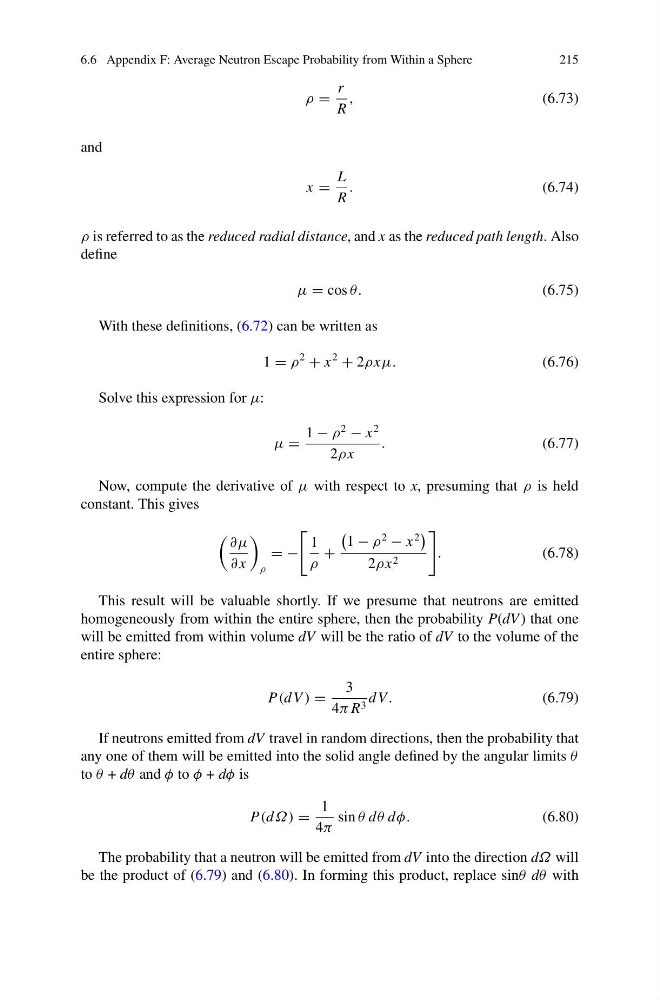
ρ is referred to as the reduced radial distance, and x as the reduced path length. Also
define
μ = cos θ.
(6.75)
With these definitions, (6.72) can be written as
1 = ρ
2
+ x
2
+ 2ρxμ.
(6.76)
Solve this expression for μ:
μ =
1 − ρ
2
− x
2
2ρx
.
(6.77)
Now, compute the derivative of μ with respect to x, presuming that ρ is held
constant. This gives
∂μ
∂ x
ρ
= −
1
ρ
+
1 − ρ
2
− x
2
2ρx 2
.
(6.78)
This result will be valuable shortly. If we presume that neutrons are emitted
homogeneously from within the entire sphere, then the probability P(dV ) that one
will be emitted from within volume dV will be the ratio of dV to the volume of the
entire sphere:
P(dV ) =
3
4π R 3 dV.
(6.79)
If neutrons emitted from dV travel in random directions, then the probability that
any one of them will be emitted into the solid angle defined by the angular limits θ
to θ + dθ and φ to φ + dφ is
P(dΩ) =
1
4π
sin θ dθ dφ.
(6.80)
The probability that a neutron will be emitted from dV into the direction dΩ will
be the product of (6.79) and (6.80). In forming this product, replace sinθ dθ with
215
ρ =
r
R
,
(6.73)
and
x =
L
R
.
(6.74)
ρ is referred to as the reduced radial distance, and x as the reduced path length. Also
define
μ = cos θ.
(6.75)
With these definitions, (6.72) can be written as
1 = ρ
2
+ x
2
+ 2ρxμ.
(6.76)
Solve this expression for μ:
μ =
1 − ρ
2
− x
2
2ρx
.
(6.77)
Now, compute the derivative of μ with respect to x, presuming that ρ is held
constant. This gives
∂μ
∂ x
ρ
= −
1
ρ
+
1 − ρ
2
− x
2
2ρx 2
.
(6.78)
This result will be valuable shortly. If we presume that neutrons are emitted
homogeneously from within the entire sphere, then the probability P(dV ) that one
will be emitted from within volume dV will be the ratio of dV to the volume of the
entire sphere:
P(dV ) =
3
4π R 3 dV.
(6.79)
If neutrons emitted from dV travel in random directions, then the probability that
any one of them will be emitted into the solid angle defined by the angular limits θ
to θ + dθ and φ to φ + dφ is
P(dΩ) =
1
4π
sin θ dθ dφ.
(6.80)
The probability that a neutron will be emitted from dV into the direction dΩ will
be the product of (6.79) and (6.80). In forming this product, replace sinθ dθ with