

220
6 Appendices
R
r
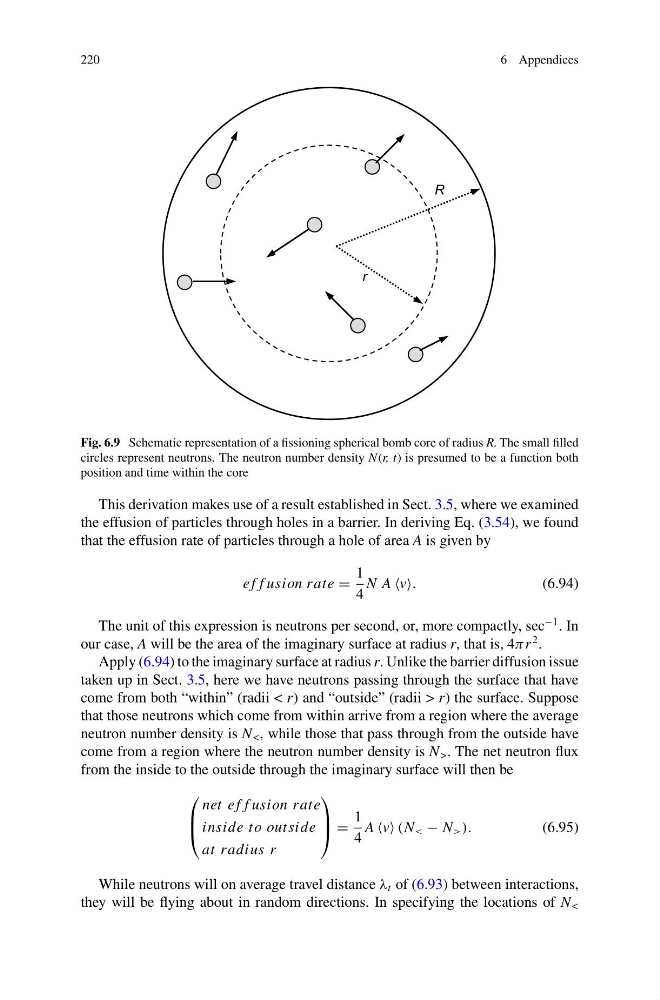
Fig. 6.9 Schematic representation of a fissioning spherical bomb core of radius R. The small filled
circles represent neutrons. The neutron number density N(r, t) is presumed to be a function both
position and time within the core
This derivation makes use of a result established in Sect. 3.5, where we examined
the effusion of particles through holes in a barrier. In deriving Eq. (3.54), we found
that the effusion rate of particles through a hole of area A is given by
e f f usion rate =
1
4
N A v.
(6.94)
The unit of this expression is neutrons per second, or, more compactly, sec
−1 . In
our case, A will be the area of the imaginary surface at radius r, that is, 4πr
2 .
Apply (6.94) to the imaginary surface at radius r. Unlike the barrier diffusion issue
taken up in Sect. 3.5, here we have neutrons passing through the surface that have
come from both “within” (radii < r) and “outside” (radii > r) the surface. Suppose
that those neutrons which come from within arrive from a region where the average
neutron number density is N < , while those that pass through from the outside have
come from a region where the neutron number density is N > . The net neutron flux
from the inside to the outside through the imaginary surface will then be
⎛
⎜
⎝
net e f f usion rate
inside to outside
at radius r
⎞
⎟
⎠ =
1
4
A v (N < − N > ).
(6.95)
While neutrons will on average travel distance λ t of (6.93) between interactions,
they will be flying about in random directions. In specifying the locations of N <
6 Appendices
R
r
Fig. 6.9 Schematic representation of a fissioning spherical bomb core of radius R. The small filled
circles represent neutrons. The neutron number density N(r, t) is presumed to be a function both
position and time within the core
This derivation makes use of a result established in Sect. 3.5, where we examined
the effusion of particles through holes in a barrier. In deriving Eq. (3.54), we found
that the effusion rate of particles through a hole of area A is given by
e f f usion rate =
1
4
N A v.
(6.94)
The unit of this expression is neutrons per second, or, more compactly, sec
−1 . In
our case, A will be the area of the imaginary surface at radius r, that is, 4πr
2 .
Apply (6.94) to the imaginary surface at radius r. Unlike the barrier diffusion issue
taken up in Sect. 3.5, here we have neutrons passing through the surface that have
come from both “within” (radii < r) and “outside” (radii > r) the surface. Suppose
that those neutrons which come from within arrive from a region where the average
neutron number density is N < , while those that pass through from the outside have
come from a region where the neutron number density is N > . The net neutron flux
from the inside to the outside through the imaginary surface will then be
⎛
⎜
⎝
net e f f usion rate
inside to outside
at radius r
⎞
⎟
⎠ =
1
4
A v (N < − N > ).
(6.95)
While neutrons will on average travel distance λ t of (6.93) between interactions,
they will be flying about in random directions. In specifying the locations of N <