

206
6 Appendices
6.5.4 The Coulomb Integral and the SF Limit
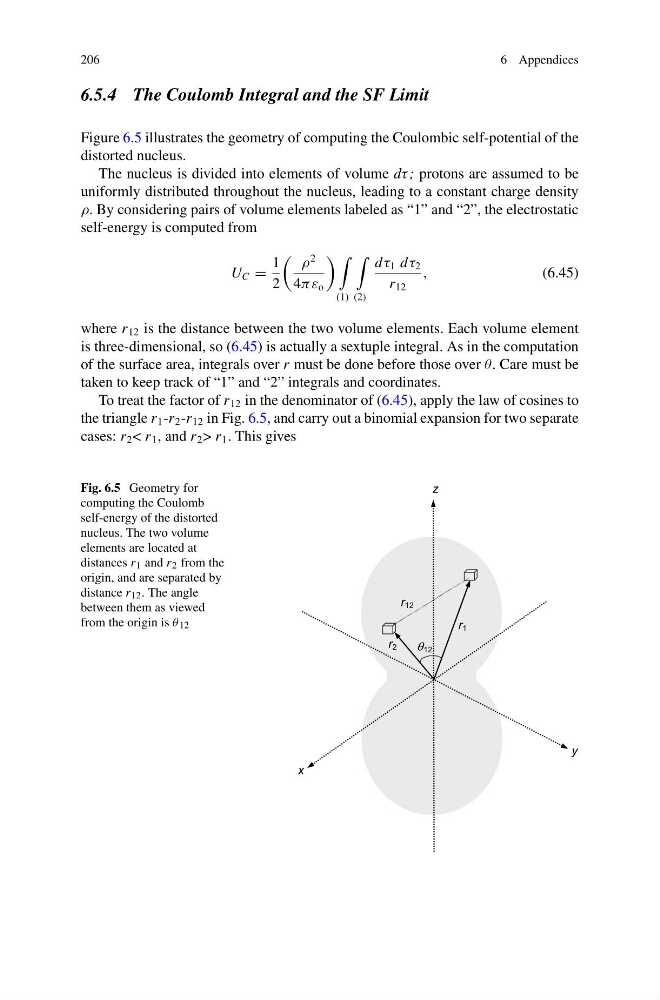
Figure 6.5 illustrates the geometry of computing the Coulombic self-potential of the
distorted nucleus.
The nucleus is divided into elements of volume dτ ; protons are assumed to be
uniformly distributed throughout the nucleus, leading to a constant charge density
ρ. By considering pairs of volume elements labeled as “1” and “2”, the electrostatic
self-energy is computed from
U C =
1
2
ρ
2
4πε o
(1)
(2)
dτ 1 dτ 2
r 12
,
(6.45)
where r 12 is the distance between the two volume elements. Each volume element
is three-dimensional, so (6.45) is actually a sextuple integral. As in the computation
of the surface area, integrals over r must be done before those over θ. Care must be
taken to keep track of “1” and “2” integrals and coordinates.
To treat the factor of r 12 in the denominator of (6.45), apply the law of cosines to
the triangle r 1 -r 2 -r 12 in Fig. 6.5, and carry out a binomial expansion for two separate
cases: r 2 < r 1 , and r 2 > r 1 . This gives
Fig. 6.5 Geometry for
computing the Coulomb
self-energy of the distorted
nucleus. The two volume
elements are located at
distances r 1 and r 2 from the
origin, and are separated by
distance r 12 . The angle
between them as viewed
from the origin is θ 12
y
x
z
θ 12
r 2
r 12
r 1
6 Appendices
6.5.4 The Coulomb Integral and the SF Limit
Figure 6.5 illustrates the geometry of computing the Coulombic self-potential of the
distorted nucleus.
The nucleus is divided into elements of volume dτ ; protons are assumed to be
uniformly distributed throughout the nucleus, leading to a constant charge density
ρ. By considering pairs of volume elements labeled as “1” and “2”, the electrostatic
self-energy is computed from
U C =
1
2
ρ
2
4πε o
(1)
(2)
dτ 1 dτ 2
r 12
,
(6.45)
where r 12 is the distance between the two volume elements. Each volume element
is three-dimensional, so (6.45) is actually a sextuple integral. As in the computation
of the surface area, integrals over r must be done before those over θ. Care must be
taken to keep track of “1” and “2” integrals and coordinates.
To treat the factor of r 12 in the denominator of (6.45), apply the law of cosines to
the triangle r 1 -r 2 -r 12 in Fig. 6.5, and carry out a binomial expansion for two separate
cases: r 2 < r 1 , and r 2 > r 1 . This gives
Fig. 6.5 Geometry for
computing the Coulomb
self-energy of the distorted
nucleus. The two volume
elements are located at
distances r 1 and r 2 from the
origin, and are separated by
distance r 12 . The angle
between them as viewed
from the origin is θ 12
y
x
z
θ 12
r 2
r 12
r 1