

6.5 Appendix E: Formal Derivation of the Bohr-Wheeler Spontaneous Fission Limit
205
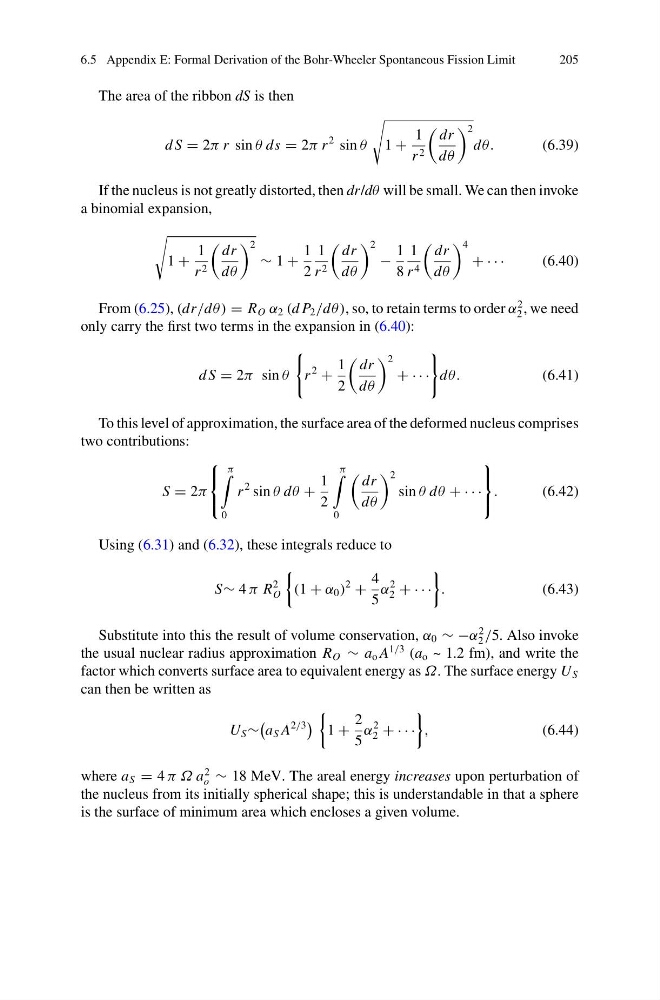
The area of the ribbon dS is then
d S = 2π r sin θ ds = 2π r
2 sin θ
1 +
1
r 2
dr
dθ
2
dθ.
(6.39)
If the nucleus is not greatly distorted, then dr/dθ will be small. We can then invoke
a binomial expansion,
1 +
1
r 2
dr
dθ
2
∼ 1 +
1
2
1
r 2
dr
dθ
2
−
1
8
1
r 4
dr
dθ
4
+ · · ·
(6.40)
From (6.25), (dr/dθ ) = R O α 2 (d P 2 /dθ ), so, to retain terms to order α
2
2 , we need
only carry the first two terms in the expansion in (6.40):
d S = 2π sin θ
r
2
+
1
2
dr
dθ
2
+ · · ·
dθ.
(6.41)
To this level of approximation, the surface area of the deformed nucleus comprises
two contributions:
S = 2π
⎧
⎨
⎩
π
0
r
2 sin θ dθ +
1
2
π
0
dr
dθ
2
sin θ dθ + · · ·
⎫
⎬
⎭
.
(6.42)
Using (6.31) and (6.32), these integrals reduce to
S∼ 4 π R
2
O
(1 + α 0 )
2
+
4
5
α
2
2 + · · ·
.
(6.43)
Substitute into this the result of volume conservation, α 0 ∼ −α
2
2 /5. Also invoke
the usual nuclear radius approximation R O ∼ a o A
1/3 (a o ~ 1.2 fm), and write the
factor which converts surface area to equivalent energy as Ω. The surface energy U S
can then be written as
U S ∼
a S A
2/3
1 +
2
5
α
2
2 + · · ·
,
(6.44)
where a S = 4 π Ω a
2
o ∼ 18 MeV. The areal energy increases upon perturbation of
the nucleus from its initially spherical shape; this is understandable in that a sphere
is the surface of minimum area which encloses a given volume.
205
The area of the ribbon dS is then
d S = 2π r sin θ ds = 2π r
2 sin θ
1 +
1
r 2
dr
dθ
2
dθ.
(6.39)
If the nucleus is not greatly distorted, then dr/dθ will be small. We can then invoke
a binomial expansion,
1 +
1
r 2
dr
dθ
2
∼ 1 +
1
2
1
r 2
dr
dθ
2
−
1
8
1
r 4
dr
dθ
4
+ · · ·
(6.40)
From (6.25), (dr/dθ ) = R O α 2 (d P 2 /dθ ), so, to retain terms to order α
2
2 , we need
only carry the first two terms in the expansion in (6.40):
d S = 2π sin θ
r
2
+
1
2
dr
dθ
2
+ · · ·
dθ.
(6.41)
To this level of approximation, the surface area of the deformed nucleus comprises
two contributions:
S = 2π
⎧
⎨
⎩
π
0
r
2 sin θ dθ +
1
2
π
0
dr
dθ
2
sin θ dθ + · · ·
⎫
⎬
⎭
.
(6.42)
Using (6.31) and (6.32), these integrals reduce to
S∼ 4 π R
2
O
(1 + α 0 )
2
+
4
5
α
2
2 + · · ·
.
(6.43)
Substitute into this the result of volume conservation, α 0 ∼ −α
2
2 /5. Also invoke
the usual nuclear radius approximation R O ∼ a o A
1/3 (a o ~ 1.2 fm), and write the
factor which converts surface area to equivalent energy as Ω. The surface energy U S
can then be written as
U S ∼
a S A
2/3
1 +
2
5
α
2
2 + · · ·
,
(6.44)
where a S = 4 π Ω a
2
o ∼ 18 MeV. The areal energy increases upon perturbation of
the nucleus from its initially spherical shape; this is understandable in that a sphere
is the surface of minimum area which encloses a given volume.