

6.5 Appendix E: Formal Derivation of the Bohr-Wheeler Spontaneous Fission Limit
207
1
r 12
=
⎧
⎪ ⎪ ⎪ ⎪ ⎪ ⎪ ⎪ ⎨
⎪ ⎪ ⎪ ⎪ ⎪ ⎪ ⎪ ⎩
P 0 (cos θ 12 )
r 1
+
r 2
r 2
1
P 1 (cos θ 12 ) +
r 2
2
r 3
1
P 2 (cos θ 12 ) + · · · (r 2 < r 1 )
P 0 (cos θ 12 )
r 2
+
r 1
r 2
2
P 1 (cos θ 12 ) +
r 2
1
r 3
2
P 2 (cos θ 12 ) + · · · (r 2 > r 1 ),
(6.46)
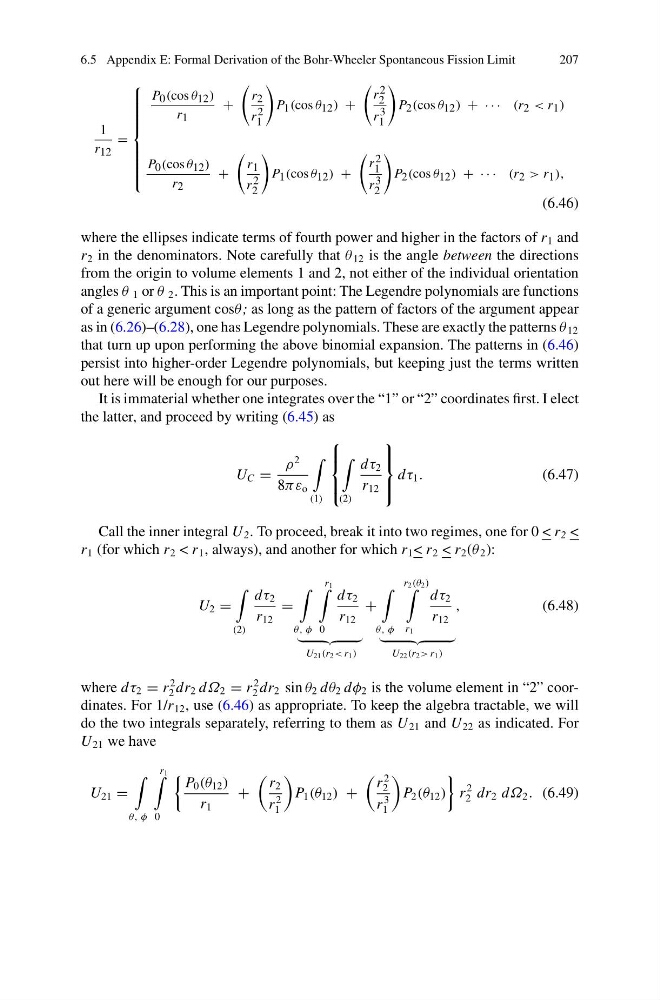
where the ellipses indicate terms of fourth power and higher in the factors of r 1 and
r 2 in the denominators. Note carefully that θ 12 is the angle between the directions
from the origin to volume elements 1 and 2, not either of the individual orientation
angles θ 1 or θ 2 . This is an important point: The Legendre polynomials are functions
of a generic argument cosθ ; as long as the pattern of factors of the argument appear
as in (6.26)–(6.28), one has Legendre polynomials. These are exactly the patterns θ 12
that turn up upon performing the above binomial expansion. The patterns in (6.46)
persist into higher-order Legendre polynomials, but keeping just the terms written
out here will be enough for our purposes.
It is immaterial whether one integrates over the “1” or “2” coordinates first. I elect
the latter, and proceed by writing (6.45) as
U C =
ρ
2
8πε o
(1)
⎧
⎪ ⎨
⎪ ⎩
(2)
dτ 2
r 12
⎫
⎪ ⎬
⎪ ⎭
dτ 1 .
(6.47)
Call the inner integral U 2 . To proceed, break it into two regimes, one for 0 < r 2 <
r 1 (for which r 2 < r 1 , always), and another for which r 1 < r 2 < r 2 (θ 2 ):
U 2 =
(2)
dτ 2
r 12
=
θ, φ
r 1
0
dτ 2
r 12
U 21 (r 2 < r 1 )
+
θ, φ
r 2 (θ2)
r 1
dτ 2
r 12
U 22 (r 2 > r 1 )
,
(6.48)
where dτ 2 = r
2
2 dr 2 dΩ 2 = r
2
2 dr 2 sin θ 2 dθ 2 dφ 2 is the volume element in “2” coordinates. For 1/r 12 , use (6.46) as appropriate. To keep the algebra tractable, we will
do the two integrals separately, referring to them as U 21 and U 22 as indicated. For
U 21 we have
U 21 =
θ, φ
r 1
0
P 0 (θ 12 )
r 1
+
r 2
r
2
1
P 1 (θ 12 ) +
r
2
2
r
3
1
P 2 (θ 12 )
r
2
2 dr 2 dΩ 2 . (6.49)
207
1
r 12
=
⎧
⎪ ⎪ ⎪ ⎪ ⎪ ⎪ ⎪ ⎨
⎪ ⎪ ⎪ ⎪ ⎪ ⎪ ⎪ ⎩
P 0 (cos θ 12 )
r 1
+
r 2
r 2
1
P 1 (cos θ 12 ) +
r 2
2
r 3
1
P 2 (cos θ 12 ) + · · · (r 2 < r 1 )
P 0 (cos θ 12 )
r 2
+
r 1
r 2
2
P 1 (cos θ 12 ) +
r 2
1
r 3
2
P 2 (cos θ 12 ) + · · · (r 2 > r 1 ),
(6.46)
where the ellipses indicate terms of fourth power and higher in the factors of r 1 and
r 2 in the denominators. Note carefully that θ 12 is the angle between the directions
from the origin to volume elements 1 and 2, not either of the individual orientation
angles θ 1 or θ 2 . This is an important point: The Legendre polynomials are functions
of a generic argument cosθ ; as long as the pattern of factors of the argument appear
as in (6.26)–(6.28), one has Legendre polynomials. These are exactly the patterns θ 12
that turn up upon performing the above binomial expansion. The patterns in (6.46)
persist into higher-order Legendre polynomials, but keeping just the terms written
out here will be enough for our purposes.
It is immaterial whether one integrates over the “1” or “2” coordinates first. I elect
the latter, and proceed by writing (6.45) as
U C =
ρ
2
8πε o
(1)
⎧
⎪ ⎨
⎪ ⎩
(2)
dτ 2
r 12
⎫
⎪ ⎬
⎪ ⎭
dτ 1 .
(6.47)
Call the inner integral U 2 . To proceed, break it into two regimes, one for 0 < r 2 <
r 1 (for which r 2 < r 1 , always), and another for which r 1 < r 2 < r 2 (θ 2 ):
U 2 =
(2)
dτ 2
r 12
=
θ, φ
r 1
0
dτ 2
r 12
U 21 (r 2 < r 1 )
+
θ, φ
r 2 (θ2)
r 1
dτ 2
r 12
U 22 (r 2 > r 1 )
,
(6.48)
where dτ 2 = r
2
2 dr 2 dΩ 2 = r
2
2 dr 2 sin θ 2 dθ 2 dφ 2 is the volume element in “2” coordinates. For 1/r 12 , use (6.46) as appropriate. To keep the algebra tractable, we will
do the two integrals separately, referring to them as U 21 and U 22 as indicated. For
U 21 we have
U 21 =
θ, φ
r 1
0
P 0 (θ 12 )
r 1
+
r 2
r
2
1
P 1 (θ 12 ) +
r
2
2
r
3
1
P 2 (θ 12 )
r
2
2 dr 2 dΩ 2 . (6.49)