

1.1 Notational Conventions for Mass Excess and Q-Values
3
Substituting this into (1.6) gives
Q =
A input + μ input
−
A out put + μ out put
ε.
(1.8)
Nucleon number is always conserved, A input = A output , which reduces (1.8) to
Q =
μ input −
μ out put
ε.
(1.9)
The product με for any reactant is conventionally designated as :
Q =
input −
out put
.
(1.10)
-values for various nuclides are tabulated in a number of texts and references, usually in units of MeV. The most extensive such listing is published as the
Nuclear Wallet Cards, and is available from the Brookhaven National Laboratory at
www.nndc.bnl.gov; a list of selected values appears in Appendix A. The advantage
of quoting mass excesses as -values is that the Q-value of any reaction can be
quickly computed via (1.10) without having to worry about factors of c
2 or 931.494.
Many examples of -value calculations appear in the following sections.
For a nuclide of given -value, its mass in atomic mass units is given by
m
(amu)
= A +
ε
.
(1.11)
1.2 Rutherford and the Energy Release in Radium Decay
The energy released in nuclear reactions is on the order of a million or more times
that typical of chemical reactions. This vast energy was first quantified by Rutherford
and Soddy (1903) in a paper titled “Radioactive Change.” In that paper, they wrote:
“It may therefore be stated that the total energy of radiation during the disintegration
of one gram of radium cannot be less than 10
8 g-cal and may be between 10
9 and
10
10 g-cal… The union of hydrogen and oxygen liberates approximately 4 × 10
3
g-cal per gram of water produced, and this reaction sets free more energy for a given
weight than any other chemical change known. The energy of radioactive change
must therefore be at least twenty-thousand times, and may be a million times, as
great as the energy of any molecular change.”
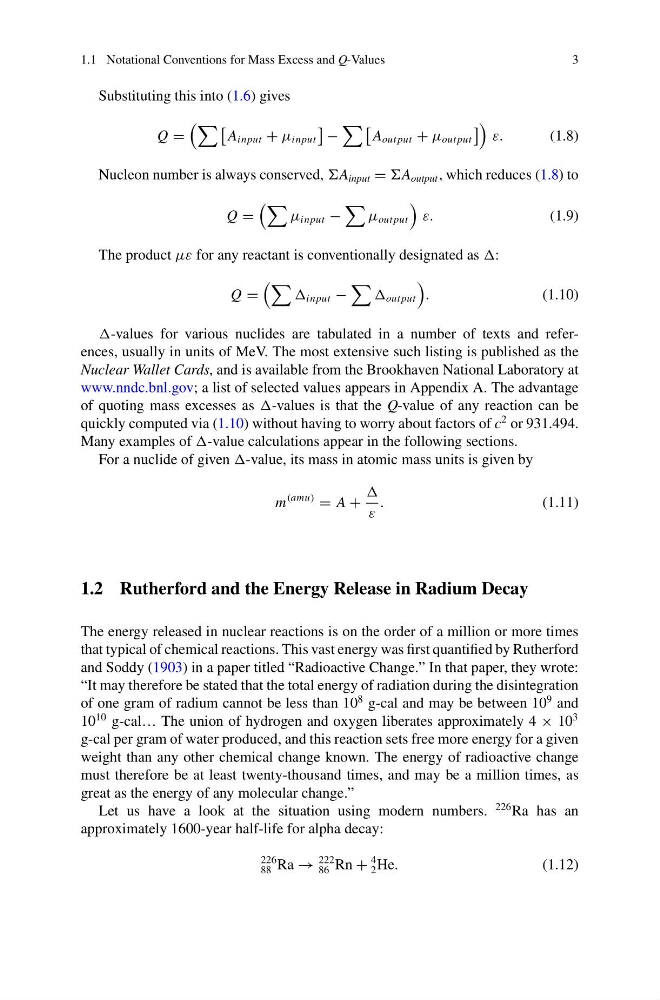
Let us have a look at the situation using modern numbers.
226 Ra has an
approximately 1600-year half-life for alpha decay:
226
88 Ra →
222
86 Rn +
4
2 He.
(1.12)
3
Substituting this into (1.6) gives
Q =
A input + μ input
−
A out put + μ out put
ε.
(1.8)
Nucleon number is always conserved, A input = A output , which reduces (1.8) to
Q =
μ input −
μ out put
ε.
(1.9)
The product με for any reactant is conventionally designated as :
Q =
input −
out put
.
(1.10)
-values for various nuclides are tabulated in a number of texts and references, usually in units of MeV. The most extensive such listing is published as the
Nuclear Wallet Cards, and is available from the Brookhaven National Laboratory at
www.nndc.bnl.gov; a list of selected values appears in Appendix A. The advantage
of quoting mass excesses as -values is that the Q-value of any reaction can be
quickly computed via (1.10) without having to worry about factors of c
2 or 931.494.
Many examples of -value calculations appear in the following sections.
For a nuclide of given -value, its mass in atomic mass units is given by
m
(amu)
= A +
ε
.
(1.11)
1.2 Rutherford and the Energy Release in Radium Decay
The energy released in nuclear reactions is on the order of a million or more times
that typical of chemical reactions. This vast energy was first quantified by Rutherford
and Soddy (1903) in a paper titled “Radioactive Change.” In that paper, they wrote:
“It may therefore be stated that the total energy of radiation during the disintegration
of one gram of radium cannot be less than 10
8 g-cal and may be between 10
9 and
10
10 g-cal… The union of hydrogen and oxygen liberates approximately 4 × 10
3
g-cal per gram of water produced, and this reaction sets free more energy for a given
weight than any other chemical change known. The energy of radioactive change
must therefore be at least twenty-thousand times, and may be a million times, as
great as the energy of any molecular change.”
Let us have a look at the situation using modern numbers.
226 Ra has an
approximately 1600-year half-life for alpha decay:
226
88 Ra →
222
86 Rn +
4
2 He.
(1.12)