

4
1 Energy Release in Nuclear Reactions, Neutrons, Fission, and Characteristics …
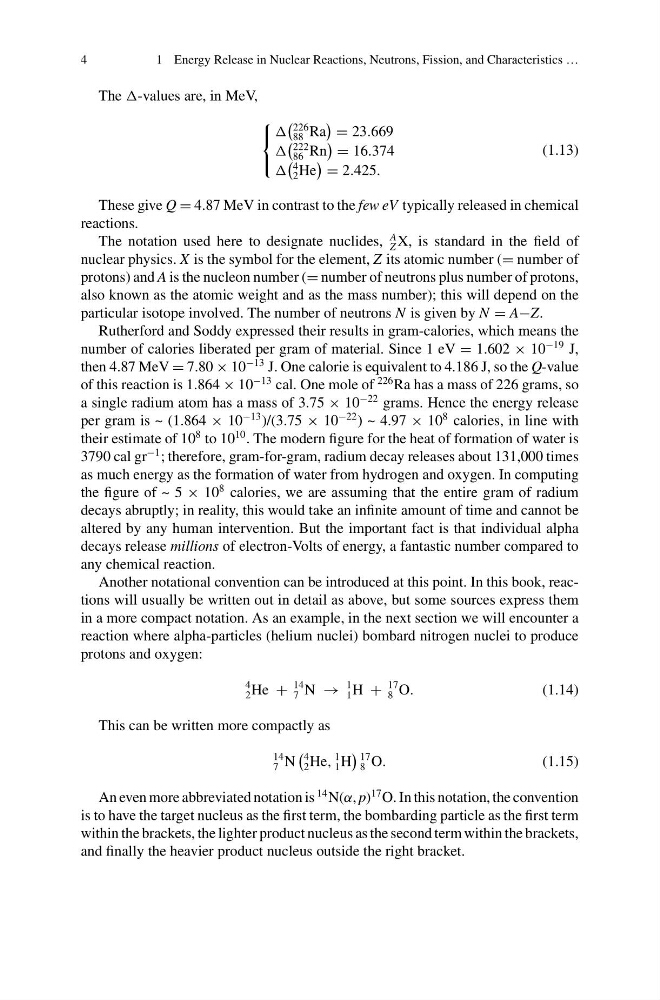
The -values are, in MeV,
⎧
⎨
⎩
226
88 Ra
= 23.669
222
86 Rn
= 16.374
4
2 He
= 2.425.
(1.13)
These give Q = 4.87 MeV in contrast to the few eV typically released in chemical
reactions.
The notation used here to designate nuclides,
A
Z X, is standard in the field of
nuclear physics. X is the symbol for the element, Z its atomic number (= number of
protons) and A is the nucleon number (= number of neutrons plus number of protons,
also known as the atomic weight and as the mass number); this will depend on the
particular isotope involved. The number of neutrons N is given by N = A−Z.
Rutherford and Soddy expressed their results in gram-calories, which means the
number of calories liberated per gram of material. Since 1 eV = 1.602 × 10
−19 J,
then 4.87 MeV = 7.80 × 10
−13 J. One calorie is equivalent to 4.186 J, so the Q-value
of this reaction is 1.864 × 10
−13 cal. One mole of
226 Ra has a mass of 226 grams, so
a single radium atom has a mass of 3.75 × 10
−22 grams. Hence the energy release
per gram is ~ (1.864 × 10
−13 )/(3.75 × 10
−22 ) ~ 4.97 × 10
8 calories, in line with
their estimate of 10
8 to 10
10 . The modern figure for the heat of formation of water is
3790 cal gr
−1 ; therefore, gram-for-gram, radium decay releases about 131,000 times
as much energy as the formation of water from hydrogen and oxygen. In computing
the figure of ~ 5 × 10
8 calories, we are assuming that the entire gram of radium
decays abruptly; in reality, this would take an infinite amount of time and cannot be
altered by any human intervention. But the important fact is that individual alpha
decays release millions of electron-Volts of energy, a fantastic number compared to
any chemical reaction.
Another notational convention can be introduced at this point. In this book, reactions will usually be written out in detail as above, but some sources express them
in a more compact notation. As an example, in the next section we will encounter a
reaction where alpha-particles (helium nuclei) bombard nitrogen nuclei to produce
protons and oxygen:
4
2 He +
14
7 N →
1
1 H +
17
8 O.
(1.14)
This can be written more compactly as
14
7 N
4
2 He,
1
1 H
17
8 O.
(1.15)
An even more abbreviated notation is
14 N(α, p)
17 O. In this notation, the convention
is to have the target nucleus as the first term, the bombarding particle as the first term
within the brackets, the lighter product nucleus as the second term within the brackets,
and finally the heavier product nucleus outside the right bracket.
1 Energy Release in Nuclear Reactions, Neutrons, Fission, and Characteristics …
The -values are, in MeV,
⎧
⎨
⎩
226
88 Ra
= 23.669
222
86 Rn
= 16.374
4
2 He
= 2.425.
(1.13)
These give Q = 4.87 MeV in contrast to the few eV typically released in chemical
reactions.
The notation used here to designate nuclides,
A
Z X, is standard in the field of
nuclear physics. X is the symbol for the element, Z its atomic number (= number of
protons) and A is the nucleon number (= number of neutrons plus number of protons,
also known as the atomic weight and as the mass number); this will depend on the
particular isotope involved. The number of neutrons N is given by N = A−Z.
Rutherford and Soddy expressed their results in gram-calories, which means the
number of calories liberated per gram of material. Since 1 eV = 1.602 × 10
−19 J,
then 4.87 MeV = 7.80 × 10
−13 J. One calorie is equivalent to 4.186 J, so the Q-value
of this reaction is 1.864 × 10
−13 cal. One mole of
226 Ra has a mass of 226 grams, so
a single radium atom has a mass of 3.75 × 10
−22 grams. Hence the energy release
per gram is ~ (1.864 × 10
−13 )/(3.75 × 10
−22 ) ~ 4.97 × 10
8 calories, in line with
their estimate of 10
8 to 10
10 . The modern figure for the heat of formation of water is
3790 cal gr
−1 ; therefore, gram-for-gram, radium decay releases about 131,000 times
as much energy as the formation of water from hydrogen and oxygen. In computing
the figure of ~ 5 × 10
8 calories, we are assuming that the entire gram of radium
decays abruptly; in reality, this would take an infinite amount of time and cannot be
altered by any human intervention. But the important fact is that individual alpha
decays release millions of electron-Volts of energy, a fantastic number compared to
any chemical reaction.
Another notational convention can be introduced at this point. In this book, reactions will usually be written out in detail as above, but some sources express them
in a more compact notation. As an example, in the next section we will encounter a
reaction where alpha-particles (helium nuclei) bombard nitrogen nuclei to produce
protons and oxygen:
4
2 He +
14
7 N →
1
1 H +
17
8 O.
(1.14)
This can be written more compactly as
14
7 N
4
2 He,
1
1 H
17
8 O.
(1.15)
An even more abbreviated notation is
14 N(α, p)
17 O. In this notation, the convention
is to have the target nucleus as the first term, the bombarding particle as the first term
within the brackets, the lighter product nucleus as the second term within the brackets,
and finally the heavier product nucleus outside the right bracket.