

2
1 Energy Release in Nuclear Reactions, Neutrons, Fission, and Characteristics …
K E input +
m input c
2
=
K E out put +
m out put c
2
,
(1.1)
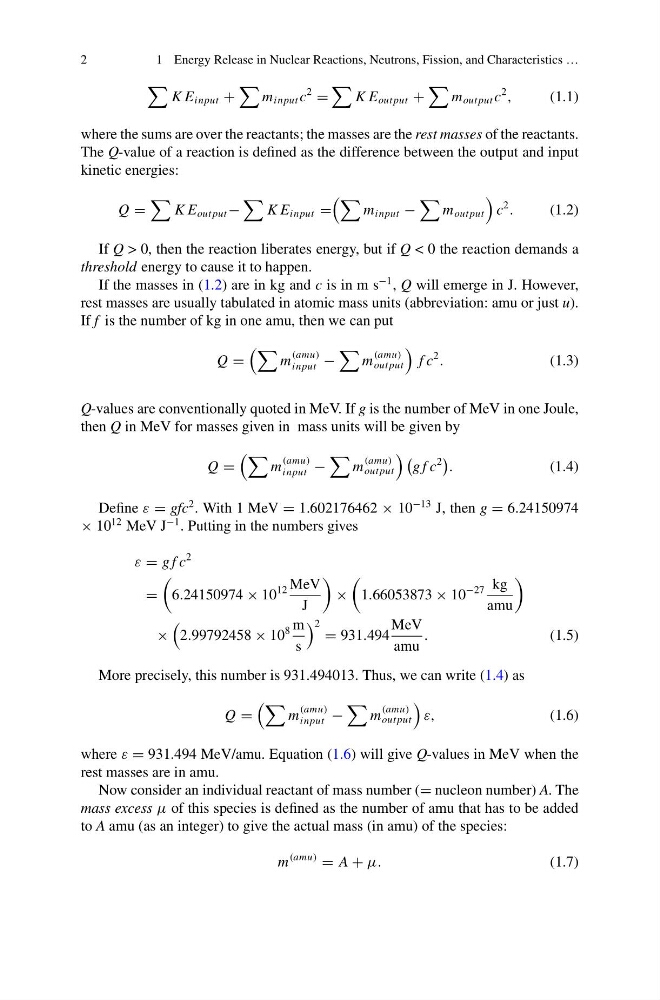
where the sums are over the reactants; the masses are the rest masses of the reactants.
The Q-value of a reaction is defined as the difference between the output and input
kinetic energies:
Q =
K E out put −
K E input =
m input −
m out put
c
2
.
(1.2)
If Q > 0, then the reaction liberates energy, but if Q < 0 the reaction demands a
threshold energy to cause it to happen.
If the masses in (1.2) are in kg and c is in m s
−1 , Q will emerge in J. However,
rest masses are usually tabulated in atomic mass units (abbreviation: amu or just u).
If f is the number of kg in one amu, then we can put
Q =
m
(amu)
input −
m
(amu)
out put
f c
2
.
(1.3)
Q-values are conventionally quoted in MeV. If g is the number of MeV in one Joule,
then Q in MeV for masses given in mass units will be given by
Q =
m
(amu)
input −
m
(amu)
out put
g f c
2
.
(1.4)
Define ε = gfc
2 . With 1 MeV = 1.602176462 × 10
−13 J, then g = 6.24150974
× 10
12 MeV J
−1 . Putting in the numbers gives
ε = g f c
2
=
6.24150974 × 10
12 MeV
J
×
1.66053873 × 10
−27 kg
amu
×
2.99792458 × 10
8 m
s
2 = 931.494
MeV
amu
.
(1.5)
More precisely, this number is 931.494013. Thus, we can write (1.4) as
Q =
m
(amu)
input −
m
(amu)
out put
ε,
(1.6)
where ε = 931.494 MeV/amu. Equation (1.6) will give Q-values in MeV when the
rest masses are in amu.
Now consider an individual reactant of mass number (= nucleon number) A. The
mass excess μ of this species is defined as the number of amu that has to be added
to A amu (as an integer) to give the actual mass (in amu) of the species:
m
(amu)
= A + μ.
(1.7)
1 Energy Release in Nuclear Reactions, Neutrons, Fission, and Characteristics …
K E input +
m input c
2
=
K E out put +
m out put c
2
,
(1.1)
where the sums are over the reactants; the masses are the rest masses of the reactants.
The Q-value of a reaction is defined as the difference between the output and input
kinetic energies:
Q =
K E out put −
K E input =
m input −
m out put
c
2
.
(1.2)
If Q > 0, then the reaction liberates energy, but if Q < 0 the reaction demands a
threshold energy to cause it to happen.
If the masses in (1.2) are in kg and c is in m s
−1 , Q will emerge in J. However,
rest masses are usually tabulated in atomic mass units (abbreviation: amu or just u).
If f is the number of kg in one amu, then we can put
Q =
m
(amu)
input −
m
(amu)
out put
f c
2
.
(1.3)
Q-values are conventionally quoted in MeV. If g is the number of MeV in one Joule,
then Q in MeV for masses given in mass units will be given by
Q =
m
(amu)
input −
m
(amu)
out put
g f c
2
.
(1.4)
Define ε = gfc
2 . With 1 MeV = 1.602176462 × 10
−13 J, then g = 6.24150974
× 10
12 MeV J
−1 . Putting in the numbers gives
ε = g f c
2
=
6.24150974 × 10
12 MeV
J
×
1.66053873 × 10
−27 kg
amu
×
2.99792458 × 10
8 m
s
2 = 931.494
MeV
amu
.
(1.5)
More precisely, this number is 931.494013. Thus, we can write (1.4) as
Q =
m
(amu)
input −
m
(amu)
out put
ε,
(1.6)
where ε = 931.494 MeV/amu. Equation (1.6) will give Q-values in MeV when the
rest masses are in amu.
Now consider an individual reactant of mass number (= nucleon number) A. The
mass excess μ of this species is defined as the number of amu that has to be added
to A amu (as an integer) to give the actual mass (in amu) of the species:
m
(amu)
= A + μ.
(1.7)