

202
6 Appendices
The essence of the Bohr-Wheeler calculation is to compare the total energy of the
deformed nucleus (α 2 = 0) to that which it had in its initial spherical condition (α 0
= α 2 = 0), and then to determine what circumstance must hold so that any perturbation, no matter how slight, will yield a lower-energy configuration toward which the
nucleus would presumably proceed spontaneously. The lowest-order contributions
to these energies both prove to be of order α
2
2 ; it is not necessary to carry through the
algebra to any higher orders to establish the SF limit. Some texts do not emphasize
that the volume of the nucleus is assumed to be conserved, that is, that nuclei are
considered to be incompressible.
Note that there is no “first-order” term α 1 P 1 = α 1 cosθ in (6.25). The reason for this
is sometimes stated as being that such a term (or, indeed, any odd-parity perturbation)
creates only a displacement of the center of mass of the nucleus along the z-axis, but
this is not quite the whole story. Such a term would introduce a distortion of the shape
of the nucleus, rendering it somewhat flattened at the “south pole” (θ = π ) if α 1 > 0.
Incorporating only even-order perturbations from sphericity simplifies the situation
to having a nucleus whose center of mass remains at the coordinate origin, and which
remains symmetric about the xy plane. Because r(θ ) contains no dependence on the
azimuthal angle φ, the nucleus also remains symmetric about the polar axis. The sign
of α 2 dictates the nature of the distortion. If α 2 > 0, the nucleus becomes squeezed at
the equator and elongated at the poles, as suggested in Fig. 6.3; α 2 < 0 produces the
opposite effect, rendering the nucleus somewhat doughnut-shaped in the equatorial
plane (Fig. 6.4). The first term in (6.25) could be written as (1 + α 0 ) since P 0 (cos
θ ) = 1, but I will write out the P’s for sake of explicitness.
Why use Legendre polynomials? The surface of the nucleus could presumably
be described by any arbitrarily-chosen function of the spherical coordinates (θ, φ),
subject only to the condition that the function contains enough parameters to accommodate ensuring conservation of volume. The value of Legendre polynomials is that,
as described below, integrals of products of them satisfy certain orthogonality relationships. These relationships greatly simplify calculations of quantities such as the
surface area and volume of such a distorted shape. In any context where one needs
to model perturbations from circularity or sphericity, Legendre polynomials are a
convenient family of functions for doing so.
The first task is to ensure conservation of volume. The volume of the distorted
nucleus is given by
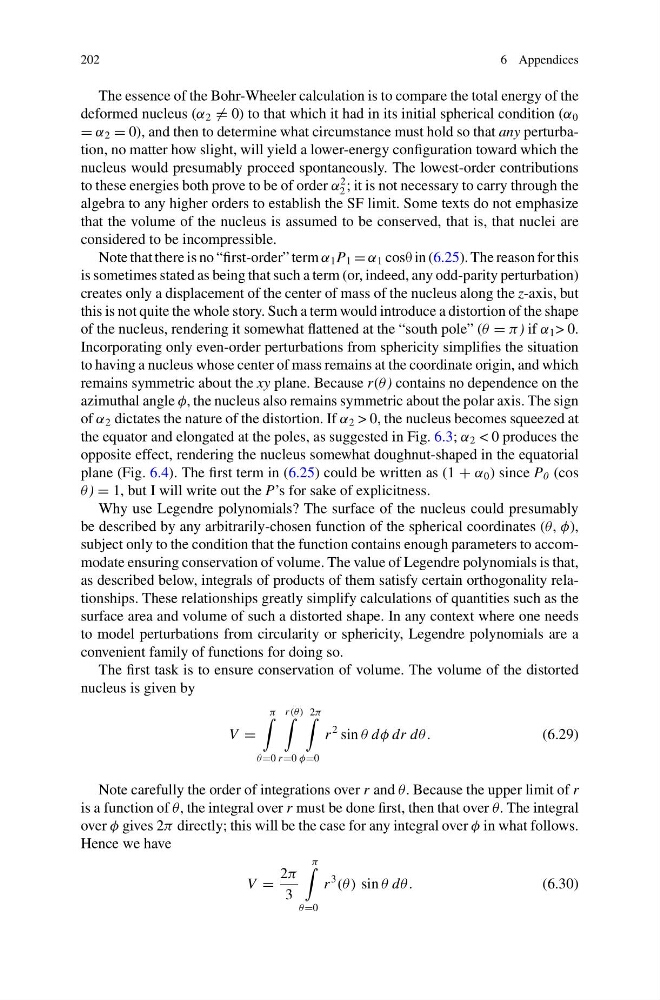
V =
π
θ=0
r (θ)
r =0
2π
φ=0
r
2 sin θ dφ dr dθ.
(6.29)
Note carefully the order of integrations over r and θ. Because the upper limit of r
is a function of θ, the integral over r must be done first, then that over θ. The integral
over φ gives 2π directly; this will be the case for any integral over φ in what follows.
Hence we have
V =
2π
3
π
θ=0
r
3
(θ ) sin θ dθ.
(6.30)
6 Appendices
The essence of the Bohr-Wheeler calculation is to compare the total energy of the
deformed nucleus (α 2 = 0) to that which it had in its initial spherical condition (α 0
= α 2 = 0), and then to determine what circumstance must hold so that any perturbation, no matter how slight, will yield a lower-energy configuration toward which the
nucleus would presumably proceed spontaneously. The lowest-order contributions
to these energies both prove to be of order α
2
2 ; it is not necessary to carry through the
algebra to any higher orders to establish the SF limit. Some texts do not emphasize
that the volume of the nucleus is assumed to be conserved, that is, that nuclei are
considered to be incompressible.
Note that there is no “first-order” term α 1 P 1 = α 1 cosθ in (6.25). The reason for this
is sometimes stated as being that such a term (or, indeed, any odd-parity perturbation)
creates only a displacement of the center of mass of the nucleus along the z-axis, but
this is not quite the whole story. Such a term would introduce a distortion of the shape
of the nucleus, rendering it somewhat flattened at the “south pole” (θ = π ) if α 1 > 0.
Incorporating only even-order perturbations from sphericity simplifies the situation
to having a nucleus whose center of mass remains at the coordinate origin, and which
remains symmetric about the xy plane. Because r(θ ) contains no dependence on the
azimuthal angle φ, the nucleus also remains symmetric about the polar axis. The sign
of α 2 dictates the nature of the distortion. If α 2 > 0, the nucleus becomes squeezed at
the equator and elongated at the poles, as suggested in Fig. 6.3; α 2 < 0 produces the
opposite effect, rendering the nucleus somewhat doughnut-shaped in the equatorial
plane (Fig. 6.4). The first term in (6.25) could be written as (1 + α 0 ) since P 0 (cos
θ ) = 1, but I will write out the P’s for sake of explicitness.
Why use Legendre polynomials? The surface of the nucleus could presumably
be described by any arbitrarily-chosen function of the spherical coordinates (θ, φ),
subject only to the condition that the function contains enough parameters to accommodate ensuring conservation of volume. The value of Legendre polynomials is that,
as described below, integrals of products of them satisfy certain orthogonality relationships. These relationships greatly simplify calculations of quantities such as the
surface area and volume of such a distorted shape. In any context where one needs
to model perturbations from circularity or sphericity, Legendre polynomials are a
convenient family of functions for doing so.
The first task is to ensure conservation of volume. The volume of the distorted
nucleus is given by
V =
π
θ=0
r (θ)
r =0
2π
φ=0
r
2 sin θ dφ dr dθ.
(6.29)
Note carefully the order of integrations over r and θ. Because the upper limit of r
is a function of θ, the integral over r must be done first, then that over θ. The integral
over φ gives 2π directly; this will be the case for any integral over φ in what follows.
Hence we have
V =
2π
3
π
θ=0
r
3
(θ ) sin θ dθ.
(6.30)