

6.5 Appendix E: Formal Derivation of the Bohr-Wheeler Spontaneous Fission Limit
201
and
P 2 (cos θ) =
1
2
3 cos
2
θ − 1
.
(6.28)
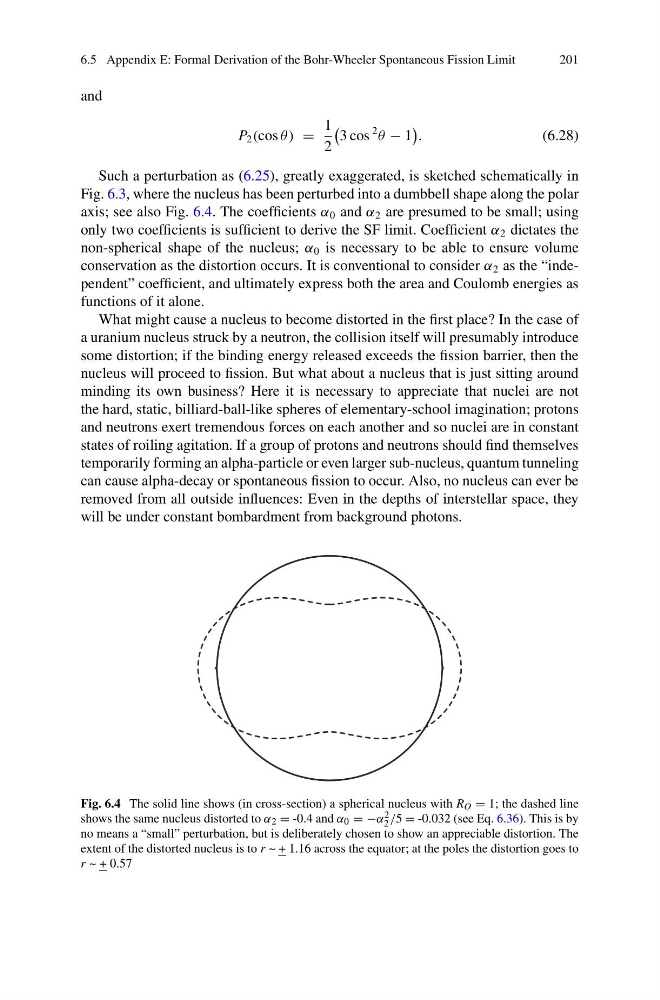
Such a perturbation as (6.25), greatly exaggerated, is sketched schematically in
Fig. 6.3, where the nucleus has been perturbed into a dumbbell shape along the polar
axis; see also Fig. 6.4. The coefficients α 0 and α 2 are presumed to be small; using
only two coefficients is sufficient to derive the SF limit. Coefficient α 2 dictates the
non-spherical shape of the nucleus; α 0 is necessary to be able to ensure volume
conservation as the distortion occurs. It is conventional to consider α 2 as the “independent” coefficient, and ultimately express both the area and Coulomb energies as
functions of it alone.
What might cause a nucleus to become distorted in the first place? In the case of
a uranium nucleus struck by a neutron, the collision itself will presumably introduce
some distortion; if the binding energy released exceeds the fission barrier, then the
nucleus will proceed to fission. But what about a nucleus that is just sitting around
minding its own business? Here it is necessary to appreciate that nuclei are not
the hard, static, billiard-ball-like spheres of elementary-school imagination; protons
and neutrons exert tremendous forces on each another and so nuclei are in constant
states of roiling agitation. If a group of protons and neutrons should find themselves
temporarily forming an alpha-particle or even larger sub-nucleus, quantum tunneling
can cause alpha-decay or spontaneous fission to occur. Also, no nucleus can ever be
removed from all outside influences: Even in the depths of interstellar space, they
will be under constant bombardment from background photons.
Fig. 6.4 The solid line shows (in cross-section) a spherical nucleus with R O = 1; the dashed line
shows the same nucleus distorted to α 2 = -0.4 and α 0 = −α 2
2 /5 = -0.032 (see Eq. 6.36). This is by
no means a “small” perturbation, but is deliberately chosen to show an appreciable distortion. The
extent of the distorted nucleus is to r ~ + 1.16 across the equator; at the poles the distortion goes to
r ~ + 0.57
201
and
P 2 (cos θ) =
1
2
3 cos
2
θ − 1
.
(6.28)
Such a perturbation as (6.25), greatly exaggerated, is sketched schematically in
Fig. 6.3, where the nucleus has been perturbed into a dumbbell shape along the polar
axis; see also Fig. 6.4. The coefficients α 0 and α 2 are presumed to be small; using
only two coefficients is sufficient to derive the SF limit. Coefficient α 2 dictates the
non-spherical shape of the nucleus; α 0 is necessary to be able to ensure volume
conservation as the distortion occurs. It is conventional to consider α 2 as the “independent” coefficient, and ultimately express both the area and Coulomb energies as
functions of it alone.
What might cause a nucleus to become distorted in the first place? In the case of
a uranium nucleus struck by a neutron, the collision itself will presumably introduce
some distortion; if the binding energy released exceeds the fission barrier, then the
nucleus will proceed to fission. But what about a nucleus that is just sitting around
minding its own business? Here it is necessary to appreciate that nuclei are not
the hard, static, billiard-ball-like spheres of elementary-school imagination; protons
and neutrons exert tremendous forces on each another and so nuclei are in constant
states of roiling agitation. If a group of protons and neutrons should find themselves
temporarily forming an alpha-particle or even larger sub-nucleus, quantum tunneling
can cause alpha-decay or spontaneous fission to occur. Also, no nucleus can ever be
removed from all outside influences: Even in the depths of interstellar space, they
will be under constant bombardment from background photons.
Fig. 6.4 The solid line shows (in cross-section) a spherical nucleus with R O = 1; the dashed line
shows the same nucleus distorted to α 2 = -0.4 and α 0 = −α 2
2 /5 = -0.032 (see Eq. 6.36). This is by
no means a “small” perturbation, but is deliberately chosen to show an appreciable distortion. The
extent of the distorted nucleus is to r ~ + 1.16 across the equator; at the poles the distortion goes to
r ~ + 0.57