

6.5 Appendix E: Formal Derivation of the Bohr-Wheeler Spontaneous Fission Limit
203
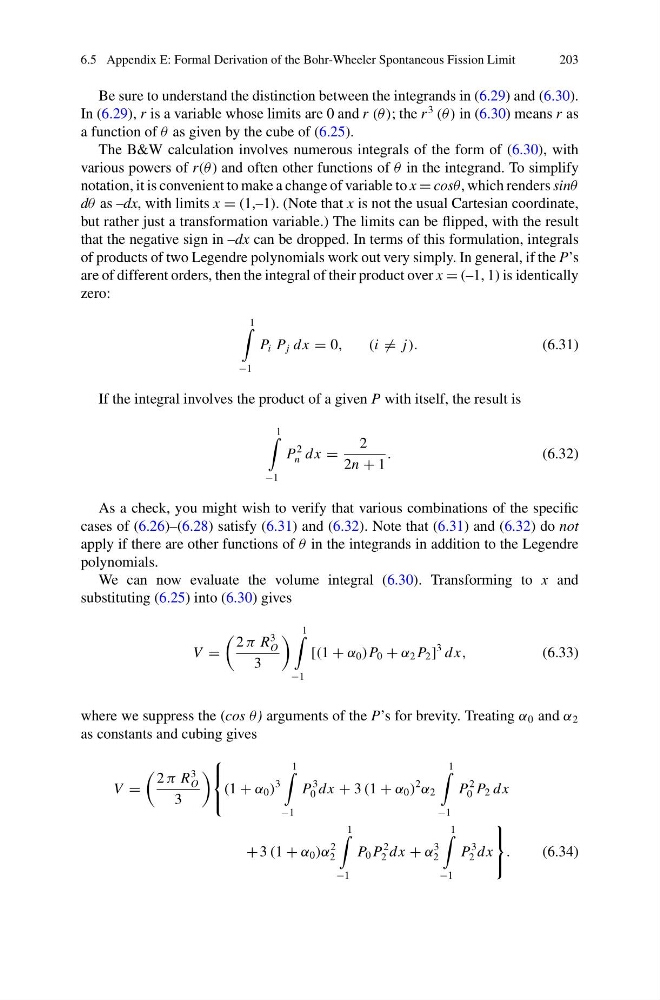
Be sure to understand the distinction between the integrands in (6.29) and (6.30).
In (6.29), r is a variable whose limits are 0 and r (θ ); the r
3
(θ ) in (6.30) means r as
a function of θ as given by the cube of (6.25).
The B&W calculation involves numerous integrals of the form of (6.30), with
various powers of r(θ ) and often other functions of θ in the integrand. To simplify
notation, it is convenient to make a change of variable to x = cosθ, which renders sinθ
dθ as –dx, with limits x = (1,–1). (Note that x is not the usual Cartesian coordinate,
but rather just a transformation variable.) The limits can be flipped, with the result
that the negative sign in –dx can be dropped. In terms of this formulation, integrals
of products of two Legendre polynomials work out very simply. In general, if the P’s
are of different orders, then the integral of their product over x = (–1, 1) is identically
zero:
1
−1
P i P j dx = 0,
(i = j).
(6.31)
If the integral involves the product of a given P with itself, the result is
1
−1
P
2
n dx =
2
2n + 1
.
(6.32)
As a check, you might wish to verify that various combinations of the specific
cases of (6.26)–(6.28) satisfy (6.31) and (6.32). Note that (6.31) and (6.32) do not
apply if there are other functions of θ in the integrands in addition to the Legendre
polynomials.
We can now evaluate the volume integral (6.30). Transforming to x and
substituting (6.25) into (6.30) gives
V =
2 π R
3
O
3
1
−1
[(1 + α 0 )P 0 + α 2 P 2 ]
3 dx,
(6.33)
where we suppress the (cos θ ) arguments of the P’s for brevity. Treating α 0 and α 2
as constants and cubing gives
V =
2 π R
3
O
3
⎧
⎨
⎩
(1 + α 0 )
3
1
−1
P
3
0 dx + 3 (1 + α 0 )
2
α 2
1
−1
P
2
0 P 2 dx
+ 3 (1 + α 0 )α
2
2
1
−1
P 0 P
2
2 dx + α
3
2
1
−1
P
3
2 dx
⎫
⎬
⎭
.
(6.34)
203
Be sure to understand the distinction between the integrands in (6.29) and (6.30).
In (6.29), r is a variable whose limits are 0 and r (θ ); the r
3
(θ ) in (6.30) means r as
a function of θ as given by the cube of (6.25).
The B&W calculation involves numerous integrals of the form of (6.30), with
various powers of r(θ ) and often other functions of θ in the integrand. To simplify
notation, it is convenient to make a change of variable to x = cosθ, which renders sinθ
dθ as –dx, with limits x = (1,–1). (Note that x is not the usual Cartesian coordinate,
but rather just a transformation variable.) The limits can be flipped, with the result
that the negative sign in –dx can be dropped. In terms of this formulation, integrals
of products of two Legendre polynomials work out very simply. In general, if the P’s
are of different orders, then the integral of their product over x = (–1, 1) is identically
zero:
1
−1
P i P j dx = 0,
(i = j).
(6.31)
If the integral involves the product of a given P with itself, the result is
1
−1
P
2
n dx =
2
2n + 1
.
(6.32)
As a check, you might wish to verify that various combinations of the specific
cases of (6.26)–(6.28) satisfy (6.31) and (6.32). Note that (6.31) and (6.32) do not
apply if there are other functions of θ in the integrands in addition to the Legendre
polynomials.
We can now evaluate the volume integral (6.30). Transforming to x and
substituting (6.25) into (6.30) gives
V =
2 π R
3
O
3
1
−1
[(1 + α 0 )P 0 + α 2 P 2 ]
3 dx,
(6.33)
where we suppress the (cos θ ) arguments of the P’s for brevity. Treating α 0 and α 2
as constants and cubing gives
V =
2 π R
3
O
3
⎧
⎨
⎩
(1 + α 0 )
3
1
−1
P
3
0 dx + 3 (1 + α 0 )
2
α 2
1
−1
P
2
0 P 2 dx
+ 3 (1 + α 0 )α
2
2
1
−1
P 0 P
2
2 dx + α
3
2
1
−1
P
3
2 dx
⎫
⎬
⎭
.
(6.34)