

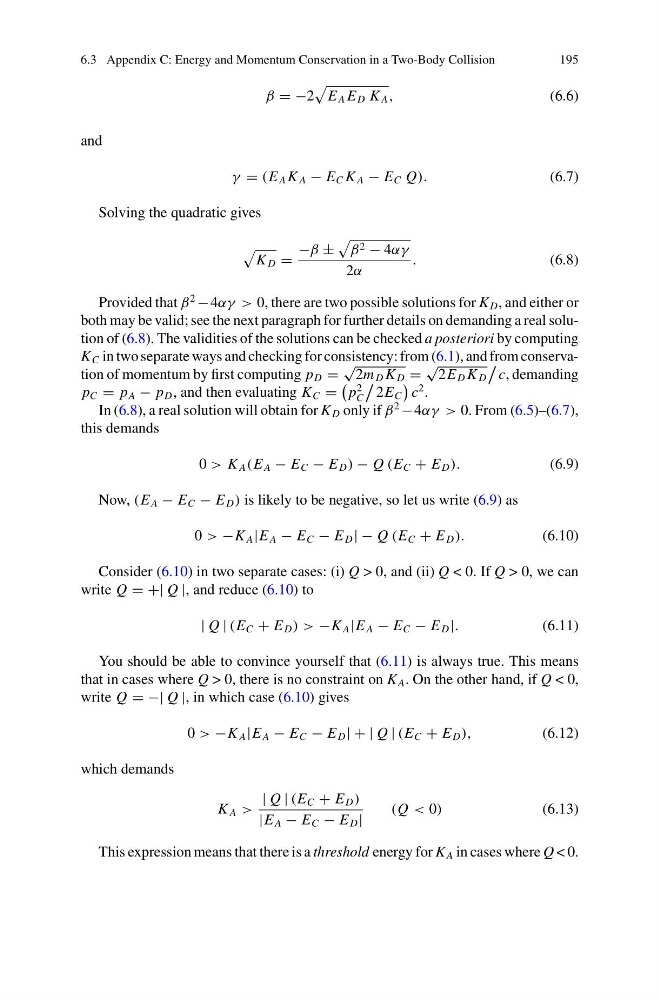
6.3 Appendix C: Energy and Momentum Conservation in a Two-Body Collision
195
β = −2
E A E D K A ,
(6.6)
and
γ = (E A K A − E C K A − E C Q).
(6.7)
Solving the quadratic gives
K D =
−β ±
β 2 − 4αγ
2α
.
(6.8)
Provided that β
2
−4αγ > 0, there are two possible solutions for K D , and either or
both may be valid; see the next paragraph for further details on demanding a real solution of (6.8). The validities of the solutions can be checked a posteriori by computing
K C in two separate ways and checking for consistency: from (6.1), and from conservation of momentum by first computing p D =
√
2m D K D =
√
2E D K D
c, demanding
p C = p A − p D , and then evaluating K C =
p
2
C
2E C
c
2 .
In (6.8), a real solution will obtain for K D only if β
2
−4αγ > 0. From (6.5)–(6.7),
this demands
0 > K A (E A − E C − E D ) − Q (E C + E D ).
(6.9)
Now, (E A − E C − E D ) is likely to be negative, so let us write (6.9) as
0 > −K A |E A − E C − E D | − Q (E C + E D ).
(6.10)
Consider (6.10) in two separate cases: (i) Q > 0, and (ii) Q < 0. If Q > 0, we can
write Q = +| Q |, and reduce (6.10) to
| Q | (E C + E D ) > −K A |E A − E C − E D |.
(6.11)
You should be able to convince yourself that (6.11) is always true. This means
that in cases where Q > 0, there is no constraint on K A . On the other hand, if Q < 0,
write Q = −| Q |, in which case (6.10) gives
0 > −K A |E A − E C − E D | + | Q | (E C + E D ),
(6.12)
which demands
K A >
| Q | (E C + E D )
|E A − E C − E D |
(Q < 0)
(6.13)
This expression means that there is a threshold energy for K A in cases where Q < 0.
195
β = −2
E A E D K A ,
(6.6)
and
γ = (E A K A − E C K A − E C Q).
(6.7)
Solving the quadratic gives
K D =
−β ±
β 2 − 4αγ
2α
.
(6.8)
Provided that β
2
−4αγ > 0, there are two possible solutions for K D , and either or
both may be valid; see the next paragraph for further details on demanding a real solution of (6.8). The validities of the solutions can be checked a posteriori by computing
K C in two separate ways and checking for consistency: from (6.1), and from conservation of momentum by first computing p D =
√
2m D K D =
√
2E D K D
c, demanding
p C = p A − p D , and then evaluating K C =
p
2
C
2E C
c
2 .
In (6.8), a real solution will obtain for K D only if β
2
−4αγ > 0. From (6.5)–(6.7),
this demands
0 > K A (E A − E C − E D ) − Q (E C + E D ).
(6.9)
Now, (E A − E C − E D ) is likely to be negative, so let us write (6.9) as
0 > −K A |E A − E C − E D | − Q (E C + E D ).
(6.10)
Consider (6.10) in two separate cases: (i) Q > 0, and (ii) Q < 0. If Q > 0, we can
write Q = +| Q |, and reduce (6.10) to
| Q | (E C + E D ) > −K A |E A − E C − E D |.
(6.11)
You should be able to convince yourself that (6.11) is always true. This means
that in cases where Q > 0, there is no constraint on K A . On the other hand, if Q < 0,
write Q = −| Q |, in which case (6.10) gives
0 > −K A |E A − E C − E D | + | Q | (E C + E D ),
(6.12)
which demands
K A >
| Q | (E C + E D )
|E A − E C − E D |
(Q < 0)
(6.13)
This expression means that there is a threshold energy for K A in cases where Q < 0.