

194
6 Appendices
m A
m B
K A
m C
m D
K C
K D
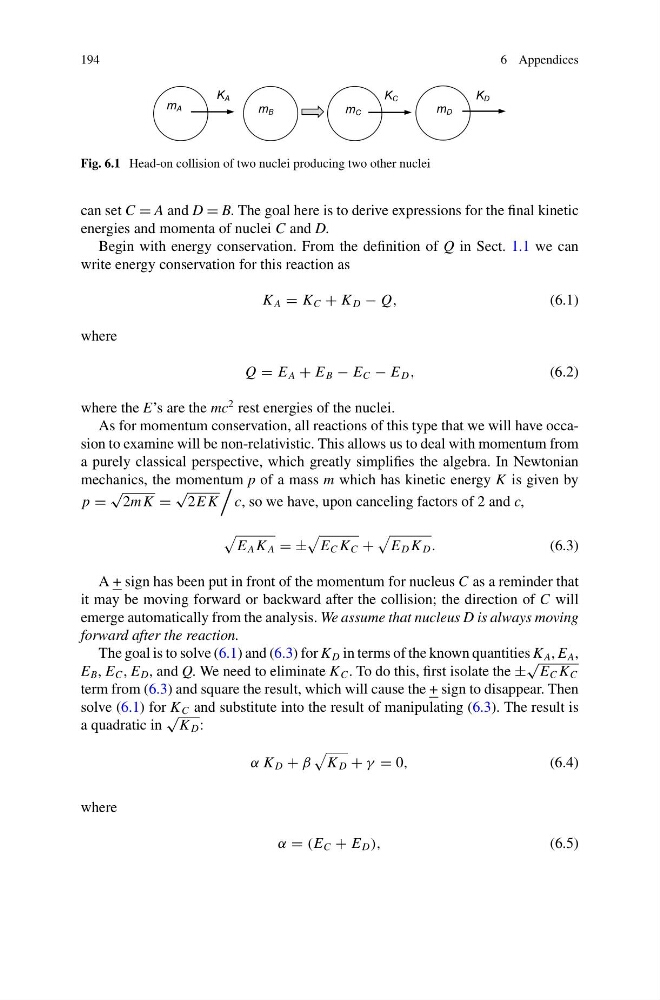
Fig. 6.1 Head-on collision of two nuclei producing two other nuclei
can set C = A and D = B. The goal here is to derive expressions for the final kinetic
energies and momenta of nuclei C and D.
Begin with energy conservation. From the definition of Q in Sect. 1.1 we can
write energy conservation for this reaction as
K A = K C + K D − Q,
(6.1)
where
Q = E A + E B − E C − E D ,
(6.2)
where the E’s are the mc
2 rest energies of the nuclei.
As for momentum conservation, all reactions of this type that we will have occasion to examine will be non-relativistic. This allows us to deal with momentum from
a purely classical perspective, which greatly simplifies the algebra. In Newtonian
mechanics, the momentum p of a mass m which has kinetic energy K is given by
p =
√
2m K =
√
2E K
c, so we have, upon canceling factors of 2 and c,
E A K A = ±
E C K C +
E D K D .
(6.3)
A + sign has been put in front of the momentum for nucleus C as a reminder that
it may be moving forward or backward after the collision; the direction of C will
emerge automatically from the analysis. We assume that nucleus D is always moving
forward after the reaction.
The goal is to solve (6.1) and (6.3) for K D in terms of the known quantities K A , E A ,
E B , E C , E D , and Q. We need to eliminate K C . To do this, first isolate the ±
√
E C K C
term from (6.3) and square the result, which will cause the + sign to disappear. Then
solve (6.1) for K C and substitute into the result of manipulating (6.3). The result is
a quadratic in
√
K D :
α K D + β
K D + γ = 0,
(6.4)
where
α = (E C + E D ),
(6.5)
6 Appendices
m A
m B
K A
m C
m D
K C
K D
Fig. 6.1 Head-on collision of two nuclei producing two other nuclei
can set C = A and D = B. The goal here is to derive expressions for the final kinetic
energies and momenta of nuclei C and D.
Begin with energy conservation. From the definition of Q in Sect. 1.1 we can
write energy conservation for this reaction as
K A = K C + K D − Q,
(6.1)
where
Q = E A + E B − E C − E D ,
(6.2)
where the E’s are the mc
2 rest energies of the nuclei.
As for momentum conservation, all reactions of this type that we will have occasion to examine will be non-relativistic. This allows us to deal with momentum from
a purely classical perspective, which greatly simplifies the algebra. In Newtonian
mechanics, the momentum p of a mass m which has kinetic energy K is given by
p =
√
2m K =
√
2E K
c, so we have, upon canceling factors of 2 and c,
E A K A = ±
E C K C +
E D K D .
(6.3)
A + sign has been put in front of the momentum for nucleus C as a reminder that
it may be moving forward or backward after the collision; the direction of C will
emerge automatically from the analysis. We assume that nucleus D is always moving
forward after the reaction.
The goal is to solve (6.1) and (6.3) for K D in terms of the known quantities K A , E A ,
E B , E C , E D , and Q. We need to eliminate K C . To do this, first isolate the ±
√
E C K C
term from (6.3) and square the result, which will cause the + sign to disappear. Then
solve (6.1) for K C and substitute into the result of manipulating (6.3). The result is
a quadratic in
√
K D :
α K D + β
K D + γ = 0,
(6.4)
where
α = (E C + E D ),
(6.5)