

6.2 Appendix B: Densities, Cross-Sections, Secondary Neutron Numbers …
193
6.2.2 Fast Neutrons (Fission-Spectrum Averages)
Quantity
Unit
235 U
238 U
239 Pu
240 Pu
σ capture
bn
0.089
0.066
0.053
0.093
σ fission
bn
1.235
0.308
1.800
1.357
σ elastic
bn
4.566
4.804
4.394
4.319
σ inelastic
bn
1.804
2.595
1.460
1.950
ν
–
2.637
2.655
3.172
2.257
t 1/2 (SF)
years
1.0 × 10 19
8.2 × 10 15
8.0 × 10 15
1.14 × 10 11
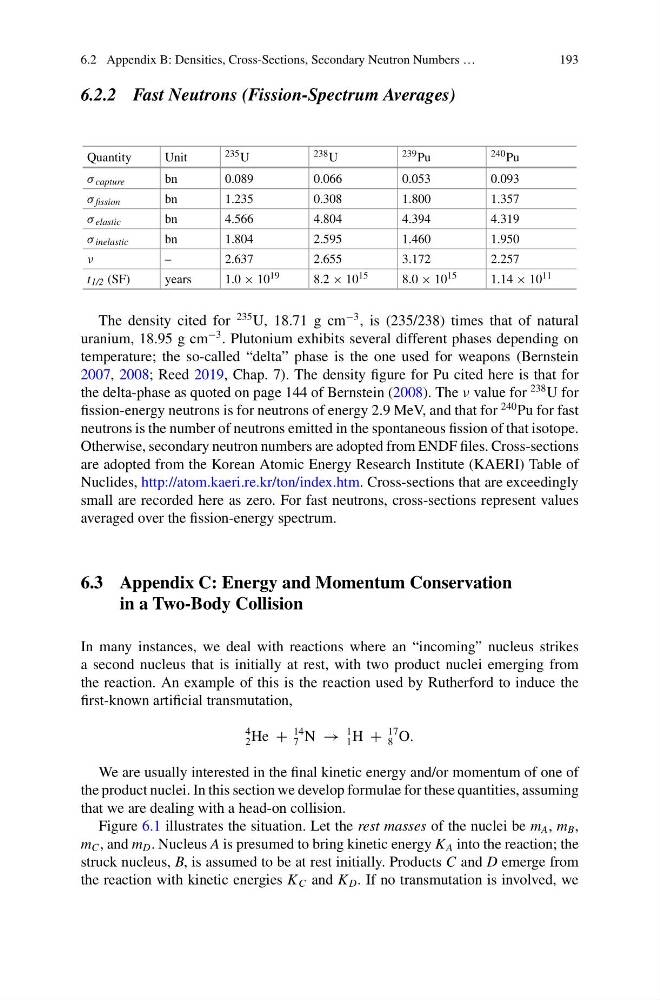
The density cited for
235 U, 18.71 g cm
−3 , is (235/238) times that of natural
uranium, 18.95 g cm
−3 . Plutonium exhibits several different phases depending on
temperature; the so-called “delta” phase is the one used for weapons (Bernstein
2007, 2008; Reed 2019, Chap. 7). The density figure for Pu cited here is that for
the delta-phase as quoted on page 144 of Bernstein (2008). The ν value for
238 U for
fission-energy neutrons is for neutrons of energy 2.9 MeV, and that for
240 Pu for fast
neutrons is the number of neutrons emitted in the spontaneous fission of that isotope.
Otherwise, secondary neutron numbers are adopted from ENDF files. Cross-sections
are adopted from the Korean Atomic Energy Research Institute (KAERI) Table of
Nuclides, http://atom.kaeri.re.kr/ton/index.htm. Cross-sections that are exceedingly
small are recorded here as zero. For fast neutrons, cross-sections represent values
averaged over the fission-energy spectrum.
6.3 Appendix C: Energy and Momentum Conservation
in a Two-Body Collision
In many instances, we deal with reactions where an “incoming” nucleus strikes
a second nucleus that is initially at rest, with two product nuclei emerging from
the reaction. An example of this is the reaction used by Rutherford to induce the
first-known artificial transmutation,
4
2 He +
14
7 N →
1
1 H +
17
8 O.
We are usually interested in the final kinetic energy and/or momentum of one of
the product nuclei. In this section we develop formulae for these quantities, assuming
that we are dealing with a head-on collision.
Figure 6.1 illustrates the situation. Let the rest masses of the nuclei be m A , m B ,
m C , and m D . Nucleus A is presumed to bring kinetic energy K A into the reaction; the
struck nucleus, B, is assumed to be at rest initially. Products C and D emerge from
the reaction with kinetic energies K C and K D . If no transmutation is involved, we
193
6.2.2 Fast Neutrons (Fission-Spectrum Averages)
Quantity
Unit
235 U
238 U
239 Pu
240 Pu
σ capture
bn
0.089
0.066
0.053
0.093
σ fission
bn
1.235
0.308
1.800
1.357
σ elastic
bn
4.566
4.804
4.394
4.319
σ inelastic
bn
1.804
2.595
1.460
1.950
ν
–
2.637
2.655
3.172
2.257
t 1/2 (SF)
years
1.0 × 10 19
8.2 × 10 15
8.0 × 10 15
1.14 × 10 11
The density cited for
235 U, 18.71 g cm
−3 , is (235/238) times that of natural
uranium, 18.95 g cm
−3 . Plutonium exhibits several different phases depending on
temperature; the so-called “delta” phase is the one used for weapons (Bernstein
2007, 2008; Reed 2019, Chap. 7). The density figure for Pu cited here is that for
the delta-phase as quoted on page 144 of Bernstein (2008). The ν value for
238 U for
fission-energy neutrons is for neutrons of energy 2.9 MeV, and that for
240 Pu for fast
neutrons is the number of neutrons emitted in the spontaneous fission of that isotope.
Otherwise, secondary neutron numbers are adopted from ENDF files. Cross-sections
are adopted from the Korean Atomic Energy Research Institute (KAERI) Table of
Nuclides, http://atom.kaeri.re.kr/ton/index.htm. Cross-sections that are exceedingly
small are recorded here as zero. For fast neutrons, cross-sections represent values
averaged over the fission-energy spectrum.
6.3 Appendix C: Energy and Momentum Conservation
in a Two-Body Collision
In many instances, we deal with reactions where an “incoming” nucleus strikes
a second nucleus that is initially at rest, with two product nuclei emerging from
the reaction. An example of this is the reaction used by Rutherford to induce the
first-known artificial transmutation,
4
2 He +
14
7 N →
1
1 H +
17
8 O.
We are usually interested in the final kinetic energy and/or momentum of one of
the product nuclei. In this section we develop formulae for these quantities, assuming
that we are dealing with a head-on collision.
Figure 6.1 illustrates the situation. Let the rest masses of the nuclei be m A , m B ,
m C , and m D . Nucleus A is presumed to bring kinetic energy K A into the reaction; the
struck nucleus, B, is assumed to be at rest initially. Products C and D emerge from
the reaction with kinetic energies K C and K D . If no transmutation is involved, we