

196
6 Appendices
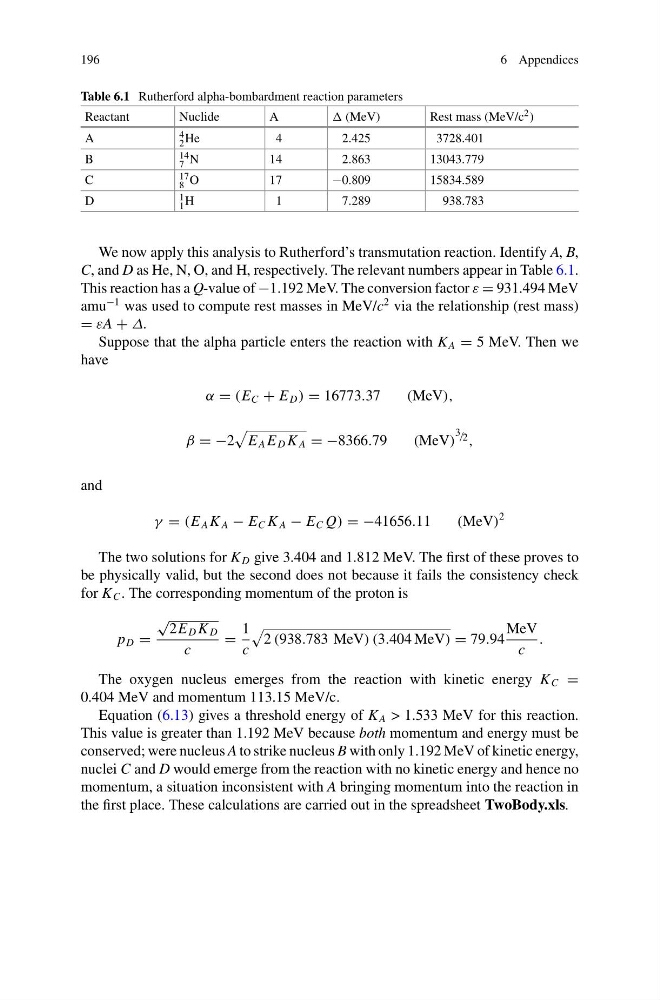
Table 6.1 Rutherford alpha-bombardment reaction parameters
Reactant
Nuclide
A
(MeV)
Rest mass (MeV/c 2 )
A
4
2 He
4
2.425
3728.401
B
14
7 N
14
2.863
13043.779
C
17
8 O
17
−0.809
15834.589
D
1
1 H
1
7.289
938.783
We now apply this analysis to Rutherford’s transmutation reaction. Identify A, B,
C, and D as He, N, O, and H, respectively. The relevant numbers appear in Table 6.1.
This reaction has a Q-value of −1.192 MeV. The conversion factor ε = 931.494 MeV
amu
−1 was used to compute rest masses in MeV/c
2 via the relationship (rest mass)
= εA + Δ.
Suppose that the alpha particle enters the reaction with K A = 5 MeV. Then we
have
α = (E C + E D ) = 16773.37
(MeV),
β = −2
E A E D K A = −8366.79
(MeV)
3 / 2 ,
and
γ = (E A K A − E C K A − E C Q) = −41656.11
(MeV)
2
The two solutions for K D give 3.404 and 1.812 MeV. The first of these proves to
be physically valid, but the second does not because it fails the consistency check
for K C . The corresponding momentum of the proton is
p D =
√
2E D K D
c
=
1
c
2 (938.783 MeV) (3.404 MeV) = 79.94
MeV
c
.
The oxygen nucleus emerges from the reaction with kinetic energy K C =
0.404 MeV and momentum 113.15 MeV/c.
Equation (6.13) gives a threshold energy of K A > 1.533 MeV for this reaction.
This value is greater than 1.192 MeV because both momentum and energy must be
conserved; were nucleus A to strike nucleus B with only 1.192 MeV of kinetic energy,
nuclei C and D would emerge from the reaction with no kinetic energy and hence no
momentum, a situation inconsistent with A bringing momentum into the reaction in
the first place. These calculations are carried out in the spreadsheet TwoBody.xls.
6 Appendices
Table 6.1 Rutherford alpha-bombardment reaction parameters
Reactant
Nuclide
A
(MeV)
Rest mass (MeV/c 2 )
A
4
2 He
4
2.425
3728.401
B
14
7 N
14
2.863
13043.779
C
17
8 O
17
−0.809
15834.589
D
1
1 H
1
7.289
938.783
We now apply this analysis to Rutherford’s transmutation reaction. Identify A, B,
C, and D as He, N, O, and H, respectively. The relevant numbers appear in Table 6.1.
This reaction has a Q-value of −1.192 MeV. The conversion factor ε = 931.494 MeV
amu
−1 was used to compute rest masses in MeV/c
2 via the relationship (rest mass)
= εA + Δ.
Suppose that the alpha particle enters the reaction with K A = 5 MeV. Then we
have
α = (E C + E D ) = 16773.37
(MeV),
β = −2
E A E D K A = −8366.79
(MeV)
3 / 2 ,
and
γ = (E A K A − E C K A − E C Q) = −41656.11
(MeV)
2
The two solutions for K D give 3.404 and 1.812 MeV. The first of these proves to
be physically valid, but the second does not because it fails the consistency check
for K C . The corresponding momentum of the proton is
p D =
√
2E D K D
c
=
1
c
2 (938.783 MeV) (3.404 MeV) = 79.94
MeV
c
.
The oxygen nucleus emerges from the reaction with kinetic energy K C =
0.404 MeV and momentum 113.15 MeV/c.
Equation (6.13) gives a threshold energy of K A > 1.533 MeV for this reaction.
This value is greater than 1.192 MeV because both momentum and energy must be
conserved; were nucleus A to strike nucleus B with only 1.192 MeV of kinetic energy,
nuclei C and D would emerge from the reaction with no kinetic energy and hence no
momentum, a situation inconsistent with A bringing momentum into the reaction in
the first place. These calculations are carried out in the spreadsheet TwoBody.xls.