

178
5 Miscellaneous Calculations
M A − M B = 2.5 log
L B
L A
.
(5.3)
The apparent and absolute magnitudes of a star are related via its distance; the
inverse-square law of light leads to the relationship
m − M = 5 log
d pc
− 5,
(5.4)
where d pc designates the distance of the star in parsecs (pc). By definition, the
apparent and absolute magnitudes are equal for a star at a distance of 10 pc. One
parsec is defined as the distance a star must be from the Sun in order that it has a
parallax of one second of arc when viewed from a baseline equal in length to the
Earth’s orbital radius of one Astronomical Unit (AU). One parsec is equivalent to
206265 AU = 3.086 × 10
16 m = 3.26 light-years. The closest star to the Sun, Proxima
Centauri, is about 1.3 pc (4.2 light-years) distant.
Equations (5.2)–(5.4) reflect the historical definition of astronomical magnitude
as originally developed by Hipparchus around the second century B.C, who defined
the brightest stars visible to the naked eye to have m = +1 and the faintest as having
m = +6. Numerically lower magnitudes are associated with brighter objects. In
the modern calibration of magnitudes, Sirius has m ~ –1.4, whereas Venus, at its
brightest, appears at m ~ –4.5. The full moon has m ~ –12.7 and the Sun m ~ –27.
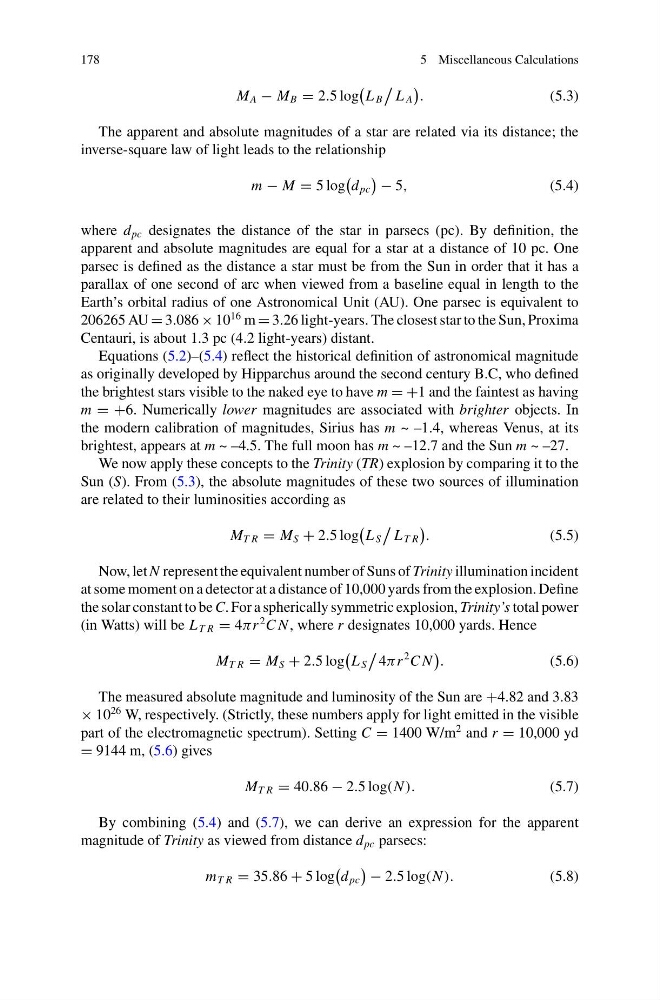
We now apply these concepts to the Trinity (TR) explosion by comparing it to the
Sun (S). From (5.3), the absolute magnitudes of these two sources of illumination
are related to their luminosities according as
M T R = M S + 2.5 log
L S
L T R
.
(5.5)
Now, let N represent the equivalent number of Suns of Trinity illumination incident
at some moment on a detector at a distance of 10,000 yards from the explosion. Define
the solar constant to be C. For a spherically symmetric explosion, Trinity’s total power
(in Watts) will be L T R = 4πr
2 C N , where r designates 10,000 yards. Hence
M T R = M S + 2.5 log
L S
4πr
2 C N
.
(5.6)
The measured absolute magnitude and luminosity of the Sun are +4.82 and 3.83
× 10
26 W, respectively. (Strictly, these numbers apply for light emitted in the visible
part of the electromagnetic spectrum). Setting C = 1400 W/m
2 and r = 10,000 yd
= 9144 m, (5.6) gives
M T R = 40.86 − 2.5 log(N ).
(5.7)
By combining (5.4) and (5.7), we can derive an expression for the apparent
magnitude of Trinity as viewed from distance d pc parsecs:
m T R = 35.86 + 5 log
d pc
− 2.5 log(N ).
(5.8)
5 Miscellaneous Calculations
M A − M B = 2.5 log
L B
L A
.
(5.3)
The apparent and absolute magnitudes of a star are related via its distance; the
inverse-square law of light leads to the relationship
m − M = 5 log
d pc
− 5,
(5.4)
where d pc designates the distance of the star in parsecs (pc). By definition, the
apparent and absolute magnitudes are equal for a star at a distance of 10 pc. One
parsec is defined as the distance a star must be from the Sun in order that it has a
parallax of one second of arc when viewed from a baseline equal in length to the
Earth’s orbital radius of one Astronomical Unit (AU). One parsec is equivalent to
206265 AU = 3.086 × 10
16 m = 3.26 light-years. The closest star to the Sun, Proxima
Centauri, is about 1.3 pc (4.2 light-years) distant.
Equations (5.2)–(5.4) reflect the historical definition of astronomical magnitude
as originally developed by Hipparchus around the second century B.C, who defined
the brightest stars visible to the naked eye to have m = +1 and the faintest as having
m = +6. Numerically lower magnitudes are associated with brighter objects. In
the modern calibration of magnitudes, Sirius has m ~ –1.4, whereas Venus, at its
brightest, appears at m ~ –4.5. The full moon has m ~ –12.7 and the Sun m ~ –27.
We now apply these concepts to the Trinity (TR) explosion by comparing it to the
Sun (S). From (5.3), the absolute magnitudes of these two sources of illumination
are related to their luminosities according as
M T R = M S + 2.5 log
L S
L T R
.
(5.5)
Now, let N represent the equivalent number of Suns of Trinity illumination incident
at some moment on a detector at a distance of 10,000 yards from the explosion. Define
the solar constant to be C. For a spherically symmetric explosion, Trinity’s total power
(in Watts) will be L T R = 4πr
2 C N , where r designates 10,000 yards. Hence
M T R = M S + 2.5 log
L S
4πr
2 C N
.
(5.6)
The measured absolute magnitude and luminosity of the Sun are +4.82 and 3.83
× 10
26 W, respectively. (Strictly, these numbers apply for light emitted in the visible
part of the electromagnetic spectrum). Setting C = 1400 W/m
2 and r = 10,000 yd
= 9144 m, (5.6) gives
M T R = 40.86 − 2.5 log(N ).
(5.7)
By combining (5.4) and (5.7), we can derive an expression for the apparent
magnitude of Trinity as viewed from distance d pc parsecs:
m T R = 35.86 + 5 log
d pc
− 2.5 log(N ).
(5.8)