

5.2 Brightness of the Trinity Explosion
179
For practical purposes, solar-system distances are more conveniently measured
in AUs: d pc = d AU /206265. With this conversion, (5.8) becomes
m T R = 9.29 + 5 log(d AU ) − 2.5 log(N ).
(5.9)
We are now ready to compute Trinity apparent magnitudes. Consider first an
observer located on the moon, with d = 384,400 km = 2.57 × 10
–3 AU. With N =
80, we find m TR = –8.4. Neglecting any effects due to atmospheric absorption and
cloud cover, Trinity would momentarily have appeared over 30 times brighter than
Venus to an observer located on the moon; apply (5.2) in the sense of comparing
the brightnesses of the two. Not until the fireball cooled to N ~ 2.2 a few tenths of
a second after the explosion would it have diminished to the brightness of Venus
for our lunar observer, and, even after 10 s (N ~ 0.4, m ~ –2.7) would still have
outshone Jupiter (m ~ –2). In actuality on the morning of the Trinity test, the moon
was at first-quarter phase and had set about 1 AM New Mexico time, some four and
one-half hours before the test.
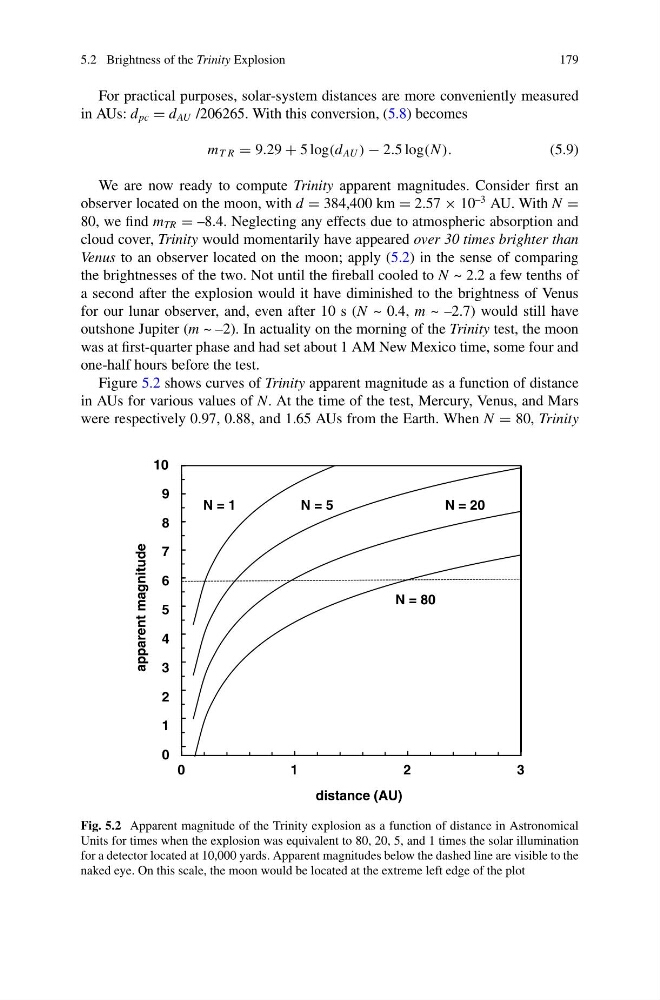
Figure 5.2 shows curves of Trinity apparent magnitude as a function of distance
in AUs for various values of N. At the time of the test, Mercury, Venus, and Mars
were respectively 0.97, 0.88, and 1.65 AUs from the Earth. When N = 80, Trinity
0
1
2
3
4
5
6
7
8
9
10
0
1
2
3
apparent magnitude
distance (AU)
N = 5
N = 20
N = 80
N = 1
Fig. 5.2 Apparent magnitude of the Trinity explosion as a function of distance in Astronomical
Units for times when the explosion was equivalent to 80, 20, 5, and 1 times the solar illumination
for a detector located at 10,000 yards. Apparent magnitudes below the dashed line are visible to the
naked eye. On this scale, the moon would be located at the extreme left edge of the plot
179
For practical purposes, solar-system distances are more conveniently measured
in AUs: d pc = d AU /206265. With this conversion, (5.8) becomes
m T R = 9.29 + 5 log(d AU ) − 2.5 log(N ).
(5.9)
We are now ready to compute Trinity apparent magnitudes. Consider first an
observer located on the moon, with d = 384,400 km = 2.57 × 10
–3 AU. With N =
80, we find m TR = –8.4. Neglecting any effects due to atmospheric absorption and
cloud cover, Trinity would momentarily have appeared over 30 times brighter than
Venus to an observer located on the moon; apply (5.2) in the sense of comparing
the brightnesses of the two. Not until the fireball cooled to N ~ 2.2 a few tenths of
a second after the explosion would it have diminished to the brightness of Venus
for our lunar observer, and, even after 10 s (N ~ 0.4, m ~ –2.7) would still have
outshone Jupiter (m ~ –2). In actuality on the morning of the Trinity test, the moon
was at first-quarter phase and had set about 1 AM New Mexico time, some four and
one-half hours before the test.
Figure 5.2 shows curves of Trinity apparent magnitude as a function of distance
in AUs for various values of N. At the time of the test, Mercury, Venus, and Mars
were respectively 0.97, 0.88, and 1.65 AUs from the Earth. When N = 80, Trinity
0
1
2
3
4
5
6
7
8
9
10
0
1
2
3
apparent magnitude
distance (AU)
N = 5
N = 20
N = 80
N = 1
Fig. 5.2 Apparent magnitude of the Trinity explosion as a function of distance in Astronomical
Units for times when the explosion was equivalent to 80, 20, 5, and 1 times the solar illumination
for a detector located at 10,000 yards. Apparent magnitudes below the dashed line are visible to the
naked eye. On this scale, the moon would be located at the extreme left edge of the plot