

5.2 Brightness of the Trinity Explosion
177
+2
-4
-3
-2
-1
0
+1
log time (seconds)
+1
0
-1
-2
log brightness @ 10
4 yd
(solar equivalent)
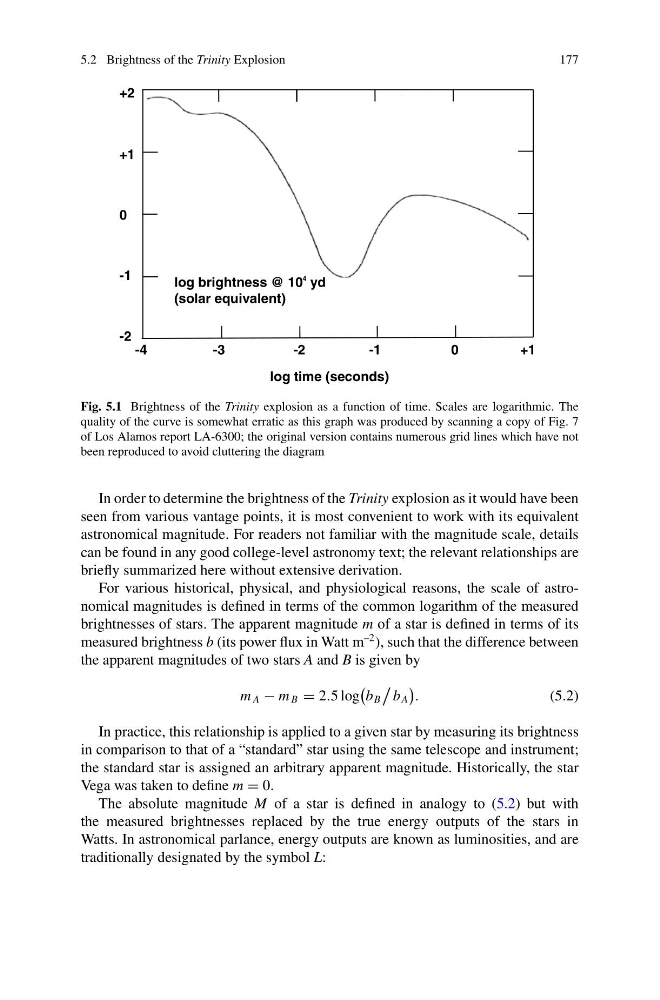
Fig. 5.1 Brightness of the Trinity explosion as a function of time. Scales are logarithmic. The
quality of the curve is somewhat erratic as this graph was produced by scanning a copy of Fig. 7
of Los Alamos report LA-6300; the original version contains numerous grid lines which have not
been reproduced to avoid cluttering the diagram
In order to determine the brightness of the Trinity explosion as it would have been
seen from various vantage points, it is most convenient to work with its equivalent
astronomical magnitude. For readers not familiar with the magnitude scale, details
can be found in any good college-level astronomy text; the relevant relationships are
briefly summarized here without extensive derivation.
For various historical, physical, and physiological reasons, the scale of astronomical magnitudes is defined in terms of the common logarithm of the measured
brightnesses of stars. The apparent magnitude m of a star is defined in terms of its
measured brightness b (its power flux in Watt m
–2 ), such that the difference between
the apparent magnitudes of two stars A and B is given by
m A − m B = 2.5 log
b B
b A
.
(5.2)
In practice, this relationship is applied to a given star by measuring its brightness
in comparison to that of a “standard” star using the same telescope and instrument;
the standard star is assigned an arbitrary apparent magnitude. Historically, the star
Vega was taken to define m = 0.
The absolute magnitude M of a star is defined in analogy to (5.2) but with
the measured brightnesses replaced by the true energy outputs of the stars in
Watts. In astronomical parlance, energy outputs are known as luminosities, and are
traditionally designated by the symbol L:
177
+2
-4
-3
-2
-1
0
+1
log time (seconds)
+1
0
-1
-2
log brightness @ 10
4 yd
(solar equivalent)
Fig. 5.1 Brightness of the Trinity explosion as a function of time. Scales are logarithmic. The
quality of the curve is somewhat erratic as this graph was produced by scanning a copy of Fig. 7
of Los Alamos report LA-6300; the original version contains numerous grid lines which have not
been reproduced to avoid cluttering the diagram
In order to determine the brightness of the Trinity explosion as it would have been
seen from various vantage points, it is most convenient to work with its equivalent
astronomical magnitude. For readers not familiar with the magnitude scale, details
can be found in any good college-level astronomy text; the relevant relationships are
briefly summarized here without extensive derivation.
For various historical, physical, and physiological reasons, the scale of astronomical magnitudes is defined in terms of the common logarithm of the measured
brightnesses of stars. The apparent magnitude m of a star is defined in terms of its
measured brightness b (its power flux in Watt m
–2 ), such that the difference between
the apparent magnitudes of two stars A and B is given by
m A − m B = 2.5 log
b B
b A
.
(5.2)
In practice, this relationship is applied to a given star by measuring its brightness
in comparison to that of a “standard” star using the same telescope and instrument;
the standard star is assigned an arbitrary apparent magnitude. Historically, the star
Vega was taken to define m = 0.
The absolute magnitude M of a star is defined in analogy to (5.2) but with
the measured brightnesses replaced by the true energy outputs of the stars in
Watts. In astronomical parlance, energy outputs are known as luminosities, and are
traditionally designated by the symbol L: