

4.5 Neutron Initiators
167
Development of the Project’s neutron initiators was such a highly-secret affair
that it received little attention in many official histories of the work, and so for
many years remained overlooked in Manhattan scholarship circles. The polonium
program received no mention at all in Henry Smyth’s August 1945 “Atomic Energy
for Military Purposes” public report on the bomb project (Smyth 1945). There is no
index entry for “polonium” or “Dayton” (Ohio, where the work was largely carried
out) in either Hewlett and Anderson’s 1962 history of the Atomic Energy Commission
or Vincent Jones’s 1988 history of the Army’s role in the Manhattan Project, although
Dayton receives a very brief mention in the latter; see (Jones 1988). Manhattan
Engineer District material on polonium remained classified until 1983, and some
aspects of the associated chemical research are still off-limits to outsiders. The focal
point of the polonium work was a highly-secret facility operated by the Monsanto
Chemical Company in Dayton, Ohio. The work was overseen by Charles Allen
Thomas, Monsanto’s vice-president for research. The Dayton work began to receive
more recognition in Manhattan Project history circles with the 1993 publication of
Hoddeson et al.’s technical history of Los Alamos, and then with the publication of a
personal memoir by Sopka and Sopka (2010). But it was not until the 2017 publication
of Polonium in the Playhouse by Thomas’s granddaughter, Linda Thomas, that the
Dayton effort begin to receive the recognition it deserves; see (Thomas 2017).
Since the timescale over which an initiator must function may be only a few
microseconds and one wants to be sure of having at least dozens of neutrons to absolutely ensure a detonation, the characteristics of the (α, n) source are crucial: One
must have a very copious α-emitter. Manhattan Project initiators used polonium-210
(
210 Po) because of its short half-life (138 days); a mere 0.24 mg emits a full Curie
of alpha particles, the same as an entire gram of radium. This short half-life was
both a blessing and a curse for Manhattan Project scientists: the half-life guaranteed a steady supply of alpha particles, but, conversely, initiators had very limited
shelf-lives once fabricated. Consequently, it became necessary to establish a dependable supply of polonium, which is otherwise a rare element. For practical purposes,
there are only two sources: extracting it as a decay product from waste ores from
uranium and radium-mining operations, or by breeding it via neutron bombardment
of bismuth within a reactor. During the Manhattan Project, some polonium was
produced by waste-ores extraction, but the vast majority was synthesized by the
bismuth-bombardment process.
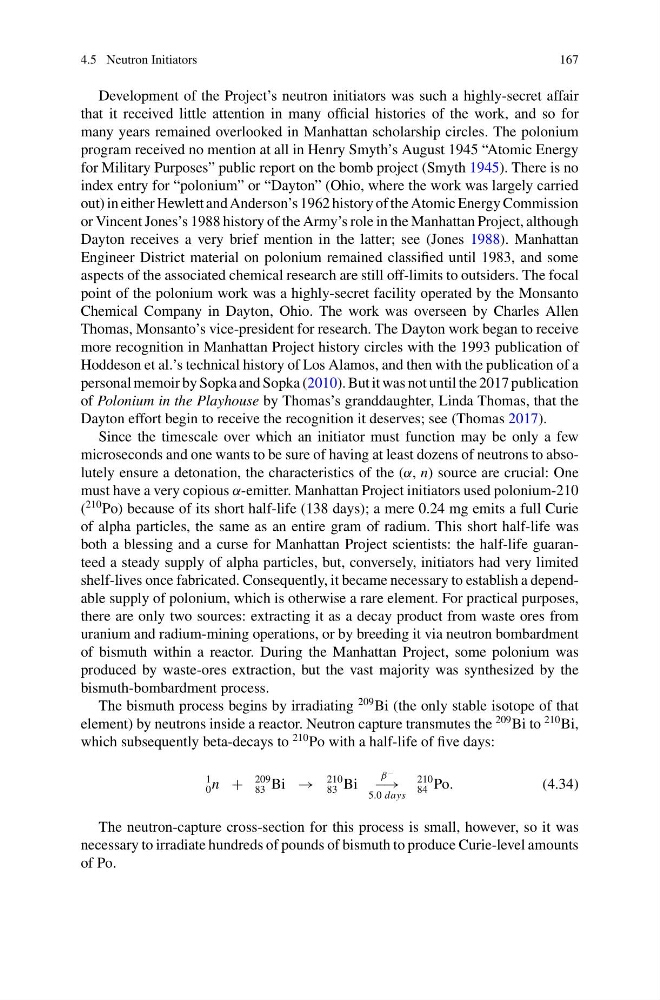
The bismuth process begins by irradiating
209 Bi (the only stable isotope of that
element) by neutrons inside a reactor. Neutron capture transmutes the
209 Bi to
210 Bi,
which subsequently beta-decays to
210 Po with a half-life of five days:
1
0 n +
209
83 Bi →
210
83 Bi
β
−
−→
5.0 days
210
84 Po.
(4.34)
The neutron-capture cross-section for this process is small, however, so it was
necessary to irradiate hundreds of pounds of bismuth to produce Curie-level amounts
of Po.
167
Development of the Project’s neutron initiators was such a highly-secret affair
that it received little attention in many official histories of the work, and so for
many years remained overlooked in Manhattan scholarship circles. The polonium
program received no mention at all in Henry Smyth’s August 1945 “Atomic Energy
for Military Purposes” public report on the bomb project (Smyth 1945). There is no
index entry for “polonium” or “Dayton” (Ohio, where the work was largely carried
out) in either Hewlett and Anderson’s 1962 history of the Atomic Energy Commission
or Vincent Jones’s 1988 history of the Army’s role in the Manhattan Project, although
Dayton receives a very brief mention in the latter; see (Jones 1988). Manhattan
Engineer District material on polonium remained classified until 1983, and some
aspects of the associated chemical research are still off-limits to outsiders. The focal
point of the polonium work was a highly-secret facility operated by the Monsanto
Chemical Company in Dayton, Ohio. The work was overseen by Charles Allen
Thomas, Monsanto’s vice-president for research. The Dayton work began to receive
more recognition in Manhattan Project history circles with the 1993 publication of
Hoddeson et al.’s technical history of Los Alamos, and then with the publication of a
personal memoir by Sopka and Sopka (2010). But it was not until the 2017 publication
of Polonium in the Playhouse by Thomas’s granddaughter, Linda Thomas, that the
Dayton effort begin to receive the recognition it deserves; see (Thomas 2017).
Since the timescale over which an initiator must function may be only a few
microseconds and one wants to be sure of having at least dozens of neutrons to absolutely ensure a detonation, the characteristics of the (α, n) source are crucial: One
must have a very copious α-emitter. Manhattan Project initiators used polonium-210
(
210 Po) because of its short half-life (138 days); a mere 0.24 mg emits a full Curie
of alpha particles, the same as an entire gram of radium. This short half-life was
both a blessing and a curse for Manhattan Project scientists: the half-life guaranteed a steady supply of alpha particles, but, conversely, initiators had very limited
shelf-lives once fabricated. Consequently, it became necessary to establish a dependable supply of polonium, which is otherwise a rare element. For practical purposes,
there are only two sources: extracting it as a decay product from waste ores from
uranium and radium-mining operations, or by breeding it via neutron bombardment
of bismuth within a reactor. During the Manhattan Project, some polonium was
produced by waste-ores extraction, but the vast majority was synthesized by the
bismuth-bombardment process.
The bismuth process begins by irradiating
209 Bi (the only stable isotope of that
element) by neutrons inside a reactor. Neutron capture transmutes the
209 Bi to
210 Bi,
which subsequently beta-decays to
210 Po with a half-life of five days:
1
0 n +
209
83 Bi →
210
83 Bi
β
−
−→
5.0 days
210
84 Po.
(4.34)
The neutron-capture cross-section for this process is small, however, so it was
necessary to irradiate hundreds of pounds of bismuth to produce Curie-level amounts
of Po.