

168
4 Complicating Factors
For processing in the Hanford reactors, bismuth was formed into five-pound slugs
which could be fed into the reactor’s fuel tubes. Irradiated slugs were delivered to
Dayton by train or truck, guarded by military couriers. By June 1945, Monsanto
was shipping 35 Curies of Po per week to Los Alamos; some fifty tons of irradiated
bismuth would be processed. The first full-scale initiator was not constructed at Los
Alamos until just a few weeks before the Trinity test; Hoddeson et al. (1993) relate
that the first one was nearly dropped down a drainpipe.
The predetonation issue studied in the preceding two sections gets to the heart
of why it was necessary to develop initiators. In Sect. 4.2, it was remarked that for
a 50 kg Little Boy
235 U core, only ~3 × 10
–5 spontaneous fissions will occur over
a 100 μs assembly timescale, a number far too small to guarantee detonation when
desired. Since initiators had to be developed for the Little Boy gun bomb, the thinking
at Los Alamos was that they might as well be used in the implosion bomb as well.
The calculations which follow are predicated on a neutron-emission time of ~1 μs.
If an initiator is to produce Oppenheimer’s 100 neutrons over one microsecond,
the number of curies of Po required can be estimated with the yield analysis of the
preceding section. Based on the figures given therein drawn from West and Sherwood
(1982), I adopt a yield y of polonium alphas on Be of 7 × 10
–5 . [Specifically, polonium
alphas have kinetic energies of ~5.3 MeV. West and Sherwood give the yields of 5.2
and 5.4-MeV alphas on Be as 6.47 and 7.50 × 10
–5 , so 7 × 10
–5 seems a sensible
compromise.] As in that section, if R α is the rate of alpha-emissions, then the rate of
neutron generation will be R n = yR α . With y = 7 × 10
–5 , demanding 100 neutrons
per microsecond corresponds to just less than 39 curies of Po, equivalent to about
8.6 mg. This is a substantial amount of any radioactive material; 40 Ci of
210 Po would
generate a decay heat of some 1.2 Watts.
The analysis of how to arrange for an appropriate rate of production of Po is more
complex, and involves two interlinking factors: the instantaneous rate of production
within the reactor, and any decay of the polonium so formed before it is extracted
from the bismuth. We deal with each of these in turn.
Since the production of polonium depends on having bismuth capture neutrons,
the rate of production depends on the available neutron flux within the reactor. For
this we can use the neutron flux/reaction rate equation of Sect. 3.3. In that analysis,
recall that for a flux of neutrons Φ per unit area per unit time incident on N target
nuclei of reaction cross-section σ, the reaction rate will be R = ΦN σ per second.
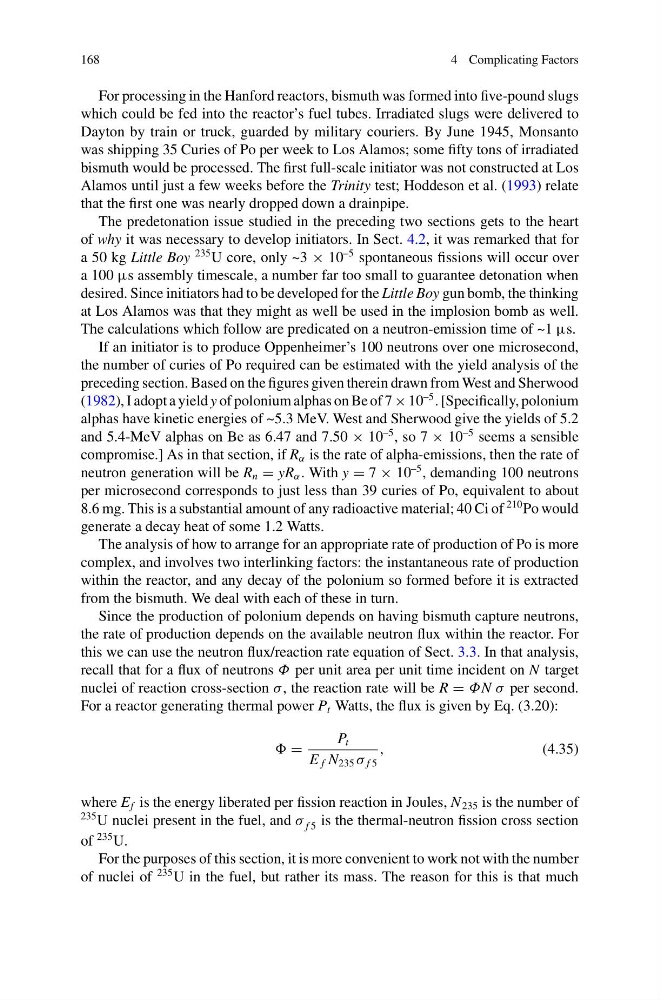
For a reactor generating thermal power P t Watts, the flux is given by Eq. (3.20):
=
P t
E f N 235 σ f 5
,
(4.35)
where E f is the energy liberated per fission reaction in Joules, N 235 is the number of
235 U nuclei present in the fuel, and σ f 5 is the thermal-neutron fission cross section
of
235 U.
For the purposes of this section, it is more convenient to work not with the number
of nuclei of
235 U in the fuel, but rather its mass. The reason for this is that much
4 Complicating Factors
For processing in the Hanford reactors, bismuth was formed into five-pound slugs
which could be fed into the reactor’s fuel tubes. Irradiated slugs were delivered to
Dayton by train or truck, guarded by military couriers. By June 1945, Monsanto
was shipping 35 Curies of Po per week to Los Alamos; some fifty tons of irradiated
bismuth would be processed. The first full-scale initiator was not constructed at Los
Alamos until just a few weeks before the Trinity test; Hoddeson et al. (1993) relate
that the first one was nearly dropped down a drainpipe.
The predetonation issue studied in the preceding two sections gets to the heart
of why it was necessary to develop initiators. In Sect. 4.2, it was remarked that for
a 50 kg Little Boy
235 U core, only ~3 × 10
–5 spontaneous fissions will occur over
a 100 μs assembly timescale, a number far too small to guarantee detonation when
desired. Since initiators had to be developed for the Little Boy gun bomb, the thinking
at Los Alamos was that they might as well be used in the implosion bomb as well.
The calculations which follow are predicated on a neutron-emission time of ~1 μs.
If an initiator is to produce Oppenheimer’s 100 neutrons over one microsecond,
the number of curies of Po required can be estimated with the yield analysis of the
preceding section. Based on the figures given therein drawn from West and Sherwood
(1982), I adopt a yield y of polonium alphas on Be of 7 × 10
–5 . [Specifically, polonium
alphas have kinetic energies of ~5.3 MeV. West and Sherwood give the yields of 5.2
and 5.4-MeV alphas on Be as 6.47 and 7.50 × 10
–5 , so 7 × 10
–5 seems a sensible
compromise.] As in that section, if R α is the rate of alpha-emissions, then the rate of
neutron generation will be R n = yR α . With y = 7 × 10
–5 , demanding 100 neutrons
per microsecond corresponds to just less than 39 curies of Po, equivalent to about
8.6 mg. This is a substantial amount of any radioactive material; 40 Ci of
210 Po would
generate a decay heat of some 1.2 Watts.
The analysis of how to arrange for an appropriate rate of production of Po is more
complex, and involves two interlinking factors: the instantaneous rate of production
within the reactor, and any decay of the polonium so formed before it is extracted
from the bismuth. We deal with each of these in turn.
Since the production of polonium depends on having bismuth capture neutrons,
the rate of production depends on the available neutron flux within the reactor. For
this we can use the neutron flux/reaction rate equation of Sect. 3.3. In that analysis,
recall that for a flux of neutrons Φ per unit area per unit time incident on N target
nuclei of reaction cross-section σ, the reaction rate will be R = ΦN σ per second.
For a reactor generating thermal power P t Watts, the flux is given by Eq. (3.20):
=
P t
E f N 235 σ f 5
,
(4.35)
where E f is the energy liberated per fission reaction in Joules, N 235 is the number of
235 U nuclei present in the fuel, and σ f 5 is the thermal-neutron fission cross section
of
235 U.
For the purposes of this section, it is more convenient to work not with the number
of nuclei of
235 U in the fuel, but rather its mass. The reason for this is that much