

166
4 Complicating Factors
4.5 Neutron Initiators
Material in this section is adopted from Reed (2019).
An important application of the yield concept introduced in the preceding section
involves the question of initiating a nuclear explosion once a core has been assembled
and (hopefully) avoided predetonation by spontaneous fission. In the Manhattan
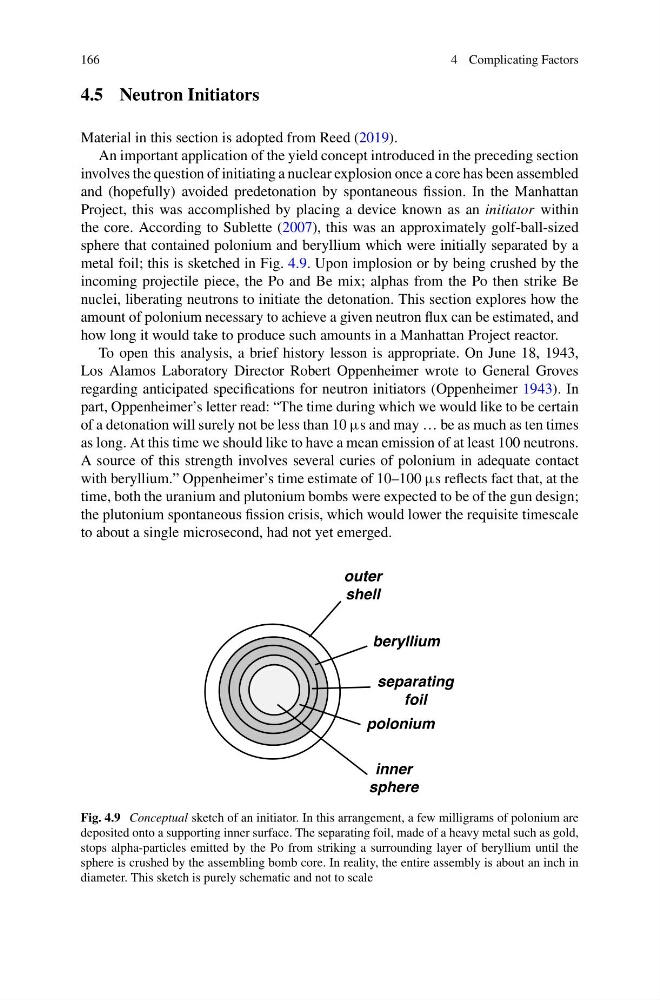
Project, this was accomplished by placing a device known as an initiator within
the core. According to Sublette (2007), this was an approximately golf-ball-sized
sphere that contained polonium and beryllium which were initially separated by a
metal foil; this is sketched in Fig. 4.9. Upon implosion or by being crushed by the
incoming projectile piece, the Po and Be mix; alphas from the Po then strike Be
nuclei, liberating neutrons to initiate the detonation. This section explores how the
amount of polonium necessary to achieve a given neutron flux can be estimated, and
how long it would take to produce such amounts in a Manhattan Project reactor.
To open this analysis, a brief history lesson is appropriate. On June 18, 1943,
Los Alamos Laboratory Director Robert Oppenheimer wrote to General Groves
regarding anticipated specifications for neutron initiators (Oppenheimer 1943). In
part, Oppenheimer’s letter read: “The time during which we would like to be certain
of a detonation will surely not be less than 10 μs and may … be as much as ten times
as long. At this time we should like to have a mean emission of at least 100 neutrons.
A source of this strength involves several curies of polonium in adequate contact
with beryllium.” Oppenheimer’s time estimate of 10–100 μs reflects fact that, at the
time, both the uranium and plutonium bombs were expected to be of the gun design;
the plutonium spontaneous fission crisis, which would lower the requisite timescale
to about a single microsecond, had not yet emerged.
Fig. 4.9 Conceptual sketch of an initiator. In this arrangement, a few milligrams of polonium are
deposited onto a supporting inner surface. The separating foil, made of a heavy metal such as gold,
stops alpha-particles emitted by the Po from striking a surrounding layer of beryllium until the
sphere is crushed by the assembling bomb core. In reality, the entire assembly is about an inch in
diameter. This sketch is purely schematic and not to scale
4 Complicating Factors
4.5 Neutron Initiators
Material in this section is adopted from Reed (2019).
An important application of the yield concept introduced in the preceding section
involves the question of initiating a nuclear explosion once a core has been assembled
and (hopefully) avoided predetonation by spontaneous fission. In the Manhattan
Project, this was accomplished by placing a device known as an initiator within
the core. According to Sublette (2007), this was an approximately golf-ball-sized
sphere that contained polonium and beryllium which were initially separated by a
metal foil; this is sketched in Fig. 4.9. Upon implosion or by being crushed by the
incoming projectile piece, the Po and Be mix; alphas from the Po then strike Be
nuclei, liberating neutrons to initiate the detonation. This section explores how the
amount of polonium necessary to achieve a given neutron flux can be estimated, and
how long it would take to produce such amounts in a Manhattan Project reactor.
To open this analysis, a brief history lesson is appropriate. On June 18, 1943,
Los Alamos Laboratory Director Robert Oppenheimer wrote to General Groves
regarding anticipated specifications for neutron initiators (Oppenheimer 1943). In
part, Oppenheimer’s letter read: “The time during which we would like to be certain
of a detonation will surely not be less than 10 μs and may … be as much as ten times
as long. At this time we should like to have a mean emission of at least 100 neutrons.
A source of this strength involves several curies of polonium in adequate contact
with beryllium.” Oppenheimer’s time estimate of 10–100 μs reflects fact that, at the
time, both the uranium and plutonium bombs were expected to be of the gun design;
the plutonium spontaneous fission crisis, which would lower the requisite timescale
to about a single microsecond, had not yet emerged.
Fig. 4.9 Conceptual sketch of an initiator. In this arrangement, a few milligrams of polonium are
deposited onto a supporting inner surface. The separating foil, made of a heavy metal such as gold,
stops alpha-particles emitted by the Po from striking a surrounding layer of beryllium until the
sphere is crushed by the assembling bomb core. In reality, the entire assembly is about an inch in
diameter. This sketch is purely schematic and not to scale