

4.4 Tolerable Limits for Light-Element Impurities
165
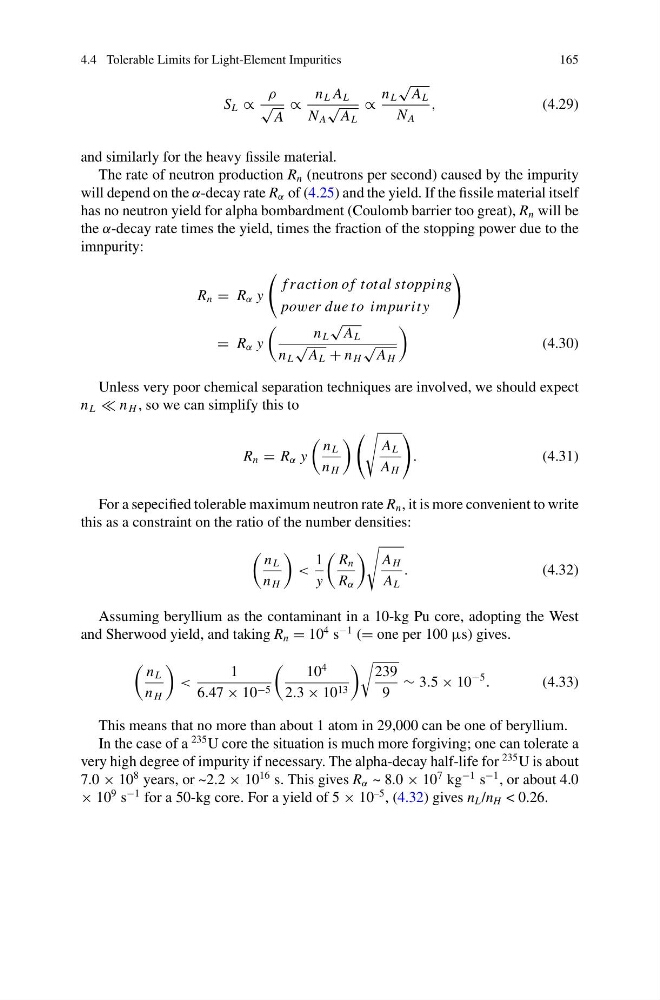
S L ∝
ρ
√
A
∝
n L A L
N A
√
A L
∝
n L
√
A L
N A
,
(4.29)
and similarly for the heavy fissile material.
The rate of neutron production R n (neutrons per second) caused by the impurity
will depend on the α-decay rate R α of (4.25) and the yield. If the fissile material itself
has no neutron yield for alpha bombardment (Coulomb barrier too great), R n will be
the α-decay rate times the yield, times the fraction of the stopping power due to the
imnpurity:
R n = R α y
f raction o f total stopping
power due to impurit y
= R α y
n L
√
A L
n L
√
A L + n H
√
A H
(4.30)
Unless very poor chemical separation techniques are involved, we should expect
n L n H , so we can simplify this to
R n = R α y
n L
n H
A L
A H
.
(4.31)
For a sepecified tolerable maximum neutron rate R n , it is more convenient to write
this as a constraint on the ratio of the number densities:
n L
n H
<
1
y
R n
R α
A H
A L
.
(4.32)
Assuming beryllium as the contaminant in a 10-kg Pu core, adopting the West
and Sherwood yield, and taking R n = 10
4 s
−1 (= one per 100 μs) gives.
n L
n H
<
1
6.47 × 10 −5
10
4
2.3 × 10 13
239
9
∼ 3.5 × 10
−5
.
(4.33)
This means that no more than about 1 atom in 29,000 can be one of beryllium.
In the case of a
235 U core the situation is much more forgiving; one can tolerate a
very high degree of impurity if necessary. The alpha-decay half-life for
235 U is about
7.0 × 10
8 years, or ~2.2 × 10
16 s. This gives R α ~ 8.0 × 10
7 kg
−1 s
−1 , or about 4.0
× 10
9 s
−1 for a 50-kg core. For a yield of 5 × 10
–5 , (4.32) gives n L /n H < 0.26.
165
S L ∝
ρ
√
A
∝
n L A L
N A
√
A L
∝
n L
√
A L
N A
,
(4.29)
and similarly for the heavy fissile material.
The rate of neutron production R n (neutrons per second) caused by the impurity
will depend on the α-decay rate R α of (4.25) and the yield. If the fissile material itself
has no neutron yield for alpha bombardment (Coulomb barrier too great), R n will be
the α-decay rate times the yield, times the fraction of the stopping power due to the
imnpurity:
R n = R α y
f raction o f total stopping
power due to impurit y
= R α y
n L
√
A L
n L
√
A L + n H
√
A H
(4.30)
Unless very poor chemical separation techniques are involved, we should expect
n L n H , so we can simplify this to
R n = R α y
n L
n H
A L
A H
.
(4.31)
For a sepecified tolerable maximum neutron rate R n , it is more convenient to write
this as a constraint on the ratio of the number densities:
n L
n H
<
1
y
R n
R α
A H
A L
.
(4.32)
Assuming beryllium as the contaminant in a 10-kg Pu core, adopting the West
and Sherwood yield, and taking R n = 10
4 s
−1 (= one per 100 μs) gives.
n L
n H
<
1
6.47 × 10 −5
10
4
2.3 × 10 13
239
9
∼ 3.5 × 10
−5
.
(4.33)
This means that no more than about 1 atom in 29,000 can be one of beryllium.
In the case of a
235 U core the situation is much more forgiving; one can tolerate a
very high degree of impurity if necessary. The alpha-decay half-life for
235 U is about
7.0 × 10
8 years, or ~2.2 × 10
16 s. This gives R α ~ 8.0 × 10
7 kg
−1 s
−1 , or about 4.0
× 10
9 s
−1 for a 50-kg core. For a yield of 5 × 10
–5 , (4.32) gives n L /n H < 0.26.