

150
4 Complicating Factors
To determine the probability of no predetonation, we have to account for all
possible number of occurrences of spontaneous fissions:
Pno
predet
=
k=0
P k
P escape
kn .
(4.7)
In principle, the sum here goes to infinity, but in practice the first few terms suffice
because P k in (4.6) declines very quickly with increasing k due to the factorial term.
The next part of the argument is to determine P escape , the overall escape probability
for a single neutron.
Neutrons can escape the core in one of two ways: they may escape directly by
traveling in a straight line from their point of origin to the edge of the sphere, or they
may scatter one or more times before escaping. For a given neutron, it is impossible
to predict how many times it will scatter before escaping, but we can develop an
expression for the probability that it will escape following a specified number of
scatterings; adding these probabilities gives P escape . It is useful to imagine that S max ,
the maximum possible number of scatterings before escape, is known in advance.
How S max is estimated is discussed following (4.13) below.
If π j represents the probability that a neutron escapes following j successive
scatterings, then the overall total probability of escape is
P escape = π 0 + π 1 + π 2 + · · · + π S max .
(4.8)
To determine the π j , recall the expression from Sect. 2.1 for the probability that a
neutron will penetrate through a linear distance x of material: P(x) = exp(−σ total nx),
where n is the number density of nuclei in the material and σ total is the total reaction
cross-section for neutrons against the material. As in the calculation of critical mass,
σ total is given by the sum of the scattering and fission cross sections, since any
type of interaction must be avoided if a neutron is to escape directly. We ignore
any possibility of non-fission neutron capture, which for any reasonably pure fissile
material should be small. Now, this P(x) refers to neutrons penetrating through a
linear distance x. If the neutrons are emitted in random directions within the bomb
core, we need to average P(x) over all possible directions of neutron emission from
all points within the sphere. So as not to disturb the flow of the present argument,
this issue is examined in Appendix F, where it is shown that the appropriate average,
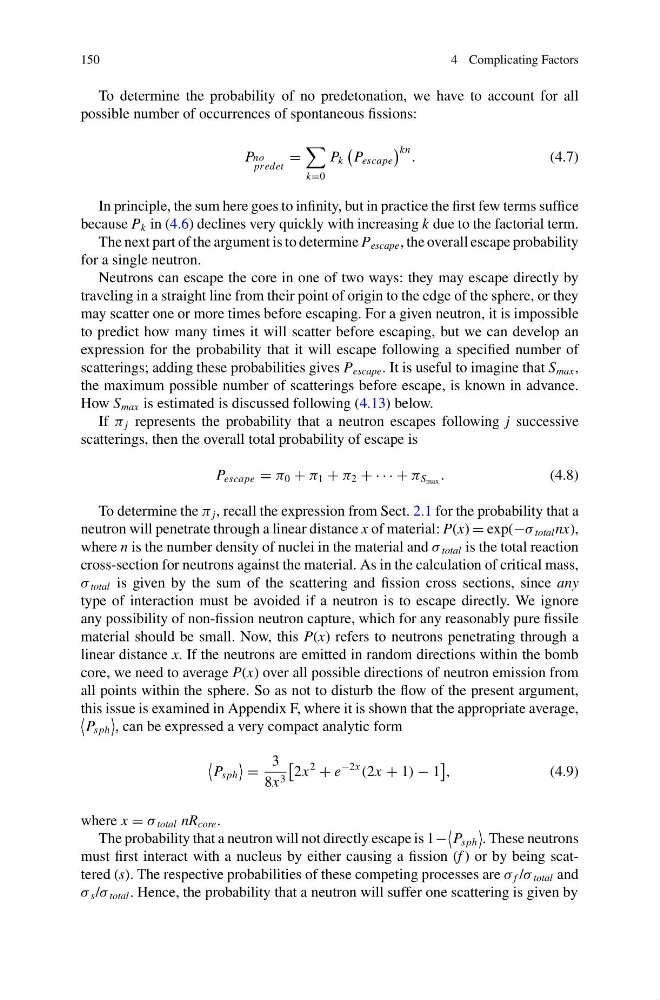
P sph
, can be expressed a very compact analytic form
P sph
=
3
8x 3
2x
2
+ e
−2x
(2x + 1) − 1
,
(4.9)
where x = σ total nR core .
The probability that a neutron will not directly escape is 1−
P sph
. These neutrons
must first interact with a nucleus by either causing a fission (f ) or by being scattered (s). The respective probabilities of these competing processes are σ f /σ total and
σ s /σ total . Hence, the probability that a neutron will suffer one scattering is given by
4 Complicating Factors
To determine the probability of no predetonation, we have to account for all
possible number of occurrences of spontaneous fissions:
Pno
predet
=
k=0
P k
P escape
kn .
(4.7)
In principle, the sum here goes to infinity, but in practice the first few terms suffice
because P k in (4.6) declines very quickly with increasing k due to the factorial term.
The next part of the argument is to determine P escape , the overall escape probability
for a single neutron.
Neutrons can escape the core in one of two ways: they may escape directly by
traveling in a straight line from their point of origin to the edge of the sphere, or they
may scatter one or more times before escaping. For a given neutron, it is impossible
to predict how many times it will scatter before escaping, but we can develop an
expression for the probability that it will escape following a specified number of
scatterings; adding these probabilities gives P escape . It is useful to imagine that S max ,
the maximum possible number of scatterings before escape, is known in advance.
How S max is estimated is discussed following (4.13) below.
If π j represents the probability that a neutron escapes following j successive
scatterings, then the overall total probability of escape is
P escape = π 0 + π 1 + π 2 + · · · + π S max .
(4.8)
To determine the π j , recall the expression from Sect. 2.1 for the probability that a
neutron will penetrate through a linear distance x of material: P(x) = exp(−σ total nx),
where n is the number density of nuclei in the material and σ total is the total reaction
cross-section for neutrons against the material. As in the calculation of critical mass,
σ total is given by the sum of the scattering and fission cross sections, since any
type of interaction must be avoided if a neutron is to escape directly. We ignore
any possibility of non-fission neutron capture, which for any reasonably pure fissile
material should be small. Now, this P(x) refers to neutrons penetrating through a
linear distance x. If the neutrons are emitted in random directions within the bomb
core, we need to average P(x) over all possible directions of neutron emission from
all points within the sphere. So as not to disturb the flow of the present argument,
this issue is examined in Appendix F, where it is shown that the appropriate average,
P sph
, can be expressed a very compact analytic form
P sph
=
3
8x 3
2x
2
+ e
−2x
(2x + 1) − 1
,
(4.9)
where x = σ total nR core .
The probability that a neutron will not directly escape is 1−
P sph
. These neutrons
must first interact with a nucleus by either causing a fission (f ) or by being scattered (s). The respective probabilities of these competing processes are σ f /σ total and
σ s /σ total . Hence, the probability that a neutron will suffer one scattering is given by