

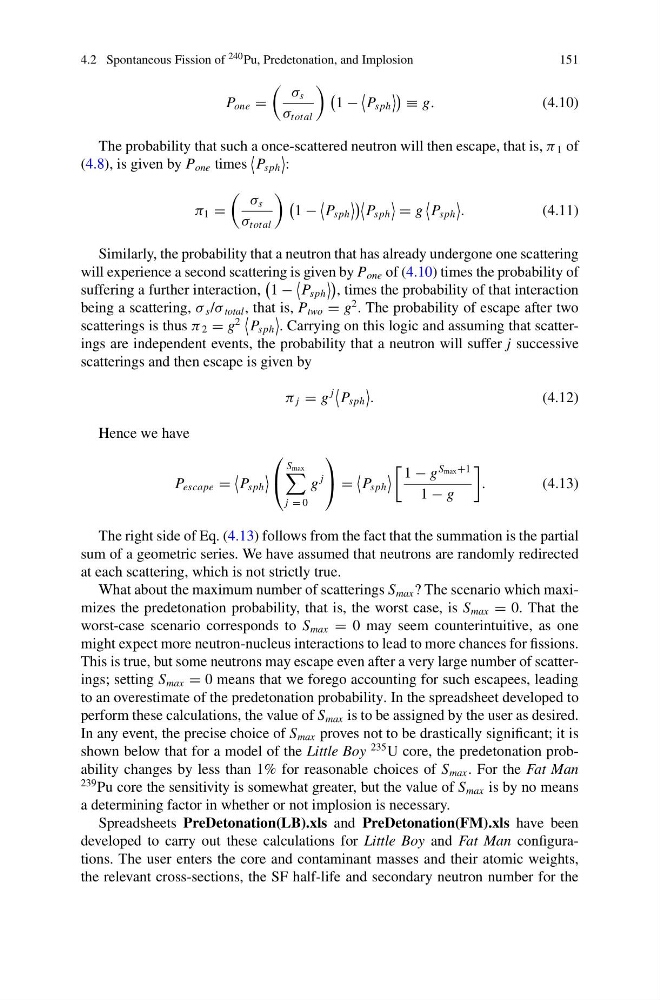
4.2 Spontaneous Fission of 240 Pu, Predetonation, and Implosion
151
P one =
σ s
σ total
1 −
P sph
≡ g.
(4.10)
The probability that such a once-scattered neutron will then escape, that is, π 1 of
(4.8), is given by P one times
P sph
:
π 1 =
σ s
σ total
1 −
P sph
P sph
= g
P sph
.
(4.11)
Similarly, the probability that a neutron that has already undergone one scattering
will experience a second scattering is given by P one of (4.10) times the probability of
suffering a further interaction,
1 −
P sph
, times the probability of that interaction
being a scattering, σ s /σ total , that is, P two = g
2 . The probability of escape after two
scatterings is thus π 2 = g
2
P sph
. Carrying on this logic and assuming that scatterings are independent events, the probability that a neutron will suffer j successive
scatterings and then escape is given by
π j = g
j
P sph
.
(4.12)
Hence we have
P escape =
P sph
⎛
⎝
S max
j = 0
g
j
⎞
⎠ =
P sph
1 − g
S max +1
1 − g
.
(4.13)
The right side of Eq. (4.13) follows from the fact that the summation is the partial
sum of a geometric series. We have assumed that neutrons are randomly redirected
at each scattering, which is not strictly true.
What about the maximum number of scatterings S max ? The scenario which maximizes the predetonation probability, that is, the worst case, is S max = 0. That the
worst-case scenario corresponds to S max = 0 may seem counterintuitive, as one
might expect more neutron-nucleus interactions to lead to more chances for fissions.
This is true, but some neutrons may escape even after a very large number of scatterings; setting S max = 0 means that we forego accounting for such escapees, leading
to an overestimate of the predetonation probability. In the spreadsheet developed to
perform these calculations, the value of S max is to be assigned by the user as desired.
In any event, the precise choice of S max proves not to be drastically significant; it is
shown below that for a model of the Little Boy
235 U core, the predetonation probability changes by less than 1% for reasonable choices of S max . For the Fat Man
239 Pu core the sensitivity is somewhat greater, but the value of S max is by no means
a determining factor in whether or not implosion is necessary.
Spreadsheets PreDetonation(LB).xls and PreDetonation(FM).xls have been
developed to carry out these calculations for Little Boy and Fat Man configurations. The user enters the core and contaminant masses and their atomic weights,
the relevant cross-sections, the SF half-life and secondary neutron number for the
151
P one =
σ s
σ total
1 −
P sph
≡ g.
(4.10)
The probability that such a once-scattered neutron will then escape, that is, π 1 of
(4.8), is given by P one times
P sph
:
π 1 =
σ s
σ total
1 −
P sph
P sph
= g
P sph
.
(4.11)
Similarly, the probability that a neutron that has already undergone one scattering
will experience a second scattering is given by P one of (4.10) times the probability of
suffering a further interaction,
1 −
P sph
, times the probability of that interaction
being a scattering, σ s /σ total , that is, P two = g
2 . The probability of escape after two
scatterings is thus π 2 = g
2
P sph
. Carrying on this logic and assuming that scatterings are independent events, the probability that a neutron will suffer j successive
scatterings and then escape is given by
π j = g
j
P sph
.
(4.12)
Hence we have
P escape =
P sph
⎛
⎝
S max
j = 0
g
j
⎞
⎠ =
P sph
1 − g
S max +1
1 − g
.
(4.13)
The right side of Eq. (4.13) follows from the fact that the summation is the partial
sum of a geometric series. We have assumed that neutrons are randomly redirected
at each scattering, which is not strictly true.
What about the maximum number of scatterings S max ? The scenario which maximizes the predetonation probability, that is, the worst case, is S max = 0. That the
worst-case scenario corresponds to S max = 0 may seem counterintuitive, as one
might expect more neutron-nucleus interactions to lead to more chances for fissions.
This is true, but some neutrons may escape even after a very large number of scatterings; setting S max = 0 means that we forego accounting for such escapees, leading
to an overestimate of the predetonation probability. In the spreadsheet developed to
perform these calculations, the value of S max is to be assigned by the user as desired.
In any event, the precise choice of S max proves not to be drastically significant; it is
shown below that for a model of the Little Boy
235 U core, the predetonation probability changes by less than 1% for reasonable choices of S max . For the Fat Man
239 Pu core the sensitivity is somewhat greater, but the value of S max is by no means
a determining factor in whether or not implosion is necessary.
Spreadsheets PreDetonation(LB).xls and PreDetonation(FM).xls have been
developed to carry out these calculations for Little Boy and Fat Man configurations. The user enters the core and contaminant masses and their atomic weights,
the relevant cross-sections, the SF half-life and secondary neutron number for the