

4.2 Spontaneous Fission of 240 Pu, Predetonation, and Implosion
149
assembly would suffer some 2.81 × 10
–5 spontaneous fissions; the probability of
predetonation would be miniscule (although not zero). Also, contamination of a few
percent
238 U in a
235 U core will not present a significant hazard as far as spontaneous
fissions are concerned. Similarly, for a pure 10-kg
239 Pu core, the rate is about 0.007
spontaneous fissions per 100 μs. However, a 10-kg plutonium core contaminated
with even only 1%
240 Pu is likely to suffer some 5 spontaneous fissions during this
brief time; the core pieces are unlikely to reach their fully assembled configuration
before a spontaneous fission causes a pre-detonation. The only option, aside from
the virtually impossible task of trying to remove the offending
240 Pu, is to speed up
the assembly process to on the order of a microsecond.
While the above numbers give a sense of the potential magnitude of the possibility
of a SF-induced predetonation, a more careful analysis is necessary to fully quantify
this risk. Because spontaneous fission is a random phenomenon, one is restricted to
speaking in terms of probabilities. The physics of the situation will dictate a certain
probability that a predetonation may happen; it is then a judgment call as to the
acceptability of that risk.
The approach taken here is based on a probabilistic model of neutrons traveling
through a bomb core, and should be understandable to readers familiar with the
concept of multiplying together independent probabilities to generate an overall
probability. To calculate the predetonation probability, we have to treat two effects:
(i) The probabilities that 0, 1, 2, ... spontaneous fissions occur during the assembly
time; and (ii) The probability that the secondary neutrons so released travel to the
edge of the core and escape without causing secondary fissions.
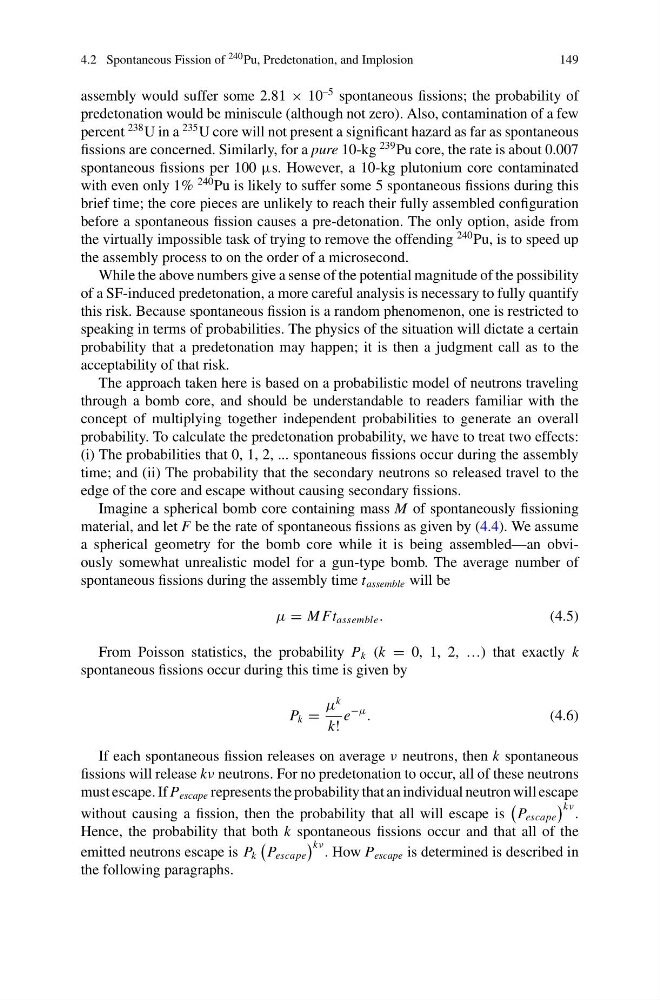
Imagine a spherical bomb core containing mass M of spontaneously fissioning
material, and let F be the rate of spontaneous fissions as given by (4.4). We assume
a spherical geometry for the bomb core while it is being assembled—an obviously somewhat unrealistic model for a gun-type bomb. The average number of
spontaneous fissions during the assembly time t assemble will be
μ = M Ft assemble .
(4.5)
From Poisson statistics, the probability P k (k = 0, 1, 2, …) that exactly k
spontaneous fissions occur during this time is given by
P k =
μ
k
k!
e
−μ
.
(4.6)
If each spontaneous fission releases on average ν neutrons, then k spontaneous
fissions will release kν neutrons. For no predetonation to occur, all of these neutrons
must escape. If P escape represents the probability that an individual neutron will escape
without causing a fission, then the probability that all will escape is
P escape
kν .
Hence, the probability that both k spontaneous fissions occur and that all of the
emitted neutrons escape is P k
P escape
kν . How P escape is determined is described in
the following paragraphs.
149
assembly would suffer some 2.81 × 10
–5 spontaneous fissions; the probability of
predetonation would be miniscule (although not zero). Also, contamination of a few
percent
238 U in a
235 U core will not present a significant hazard as far as spontaneous
fissions are concerned. Similarly, for a pure 10-kg
239 Pu core, the rate is about 0.007
spontaneous fissions per 100 μs. However, a 10-kg plutonium core contaminated
with even only 1%
240 Pu is likely to suffer some 5 spontaneous fissions during this
brief time; the core pieces are unlikely to reach their fully assembled configuration
before a spontaneous fission causes a pre-detonation. The only option, aside from
the virtually impossible task of trying to remove the offending
240 Pu, is to speed up
the assembly process to on the order of a microsecond.
While the above numbers give a sense of the potential magnitude of the possibility
of a SF-induced predetonation, a more careful analysis is necessary to fully quantify
this risk. Because spontaneous fission is a random phenomenon, one is restricted to
speaking in terms of probabilities. The physics of the situation will dictate a certain
probability that a predetonation may happen; it is then a judgment call as to the
acceptability of that risk.
The approach taken here is based on a probabilistic model of neutrons traveling
through a bomb core, and should be understandable to readers familiar with the
concept of multiplying together independent probabilities to generate an overall
probability. To calculate the predetonation probability, we have to treat two effects:
(i) The probabilities that 0, 1, 2, ... spontaneous fissions occur during the assembly
time; and (ii) The probability that the secondary neutrons so released travel to the
edge of the core and escape without causing secondary fissions.
Imagine a spherical bomb core containing mass M of spontaneously fissioning
material, and let F be the rate of spontaneous fissions as given by (4.4). We assume
a spherical geometry for the bomb core while it is being assembled—an obviously somewhat unrealistic model for a gun-type bomb. The average number of
spontaneous fissions during the assembly time t assemble will be
μ = M Ft assemble .
(4.5)
From Poisson statistics, the probability P k (k = 0, 1, 2, …) that exactly k
spontaneous fissions occur during this time is given by
P k =
μ
k
k!
e
−μ
.
(4.6)
If each spontaneous fission releases on average ν neutrons, then k spontaneous
fissions will release kν neutrons. For no predetonation to occur, all of these neutrons
must escape. If P escape represents the probability that an individual neutron will escape
without causing a fission, then the probability that all will escape is
P escape
kν .
Hence, the probability that both k spontaneous fissions occur and that all of the
emitted neutrons escape is P k
P escape
kν . How P escape is determined is described in
the following paragraphs.