

148
4 Complicating Factors
4.2 Spontaneous Fission of 240 Pu, Predetonation,
and Implosion
Material in this section is adopted from Reed (2010).
Emilio Segrè’s discovery in December, 1943, that
235 U has a very low spontaneous
fission (SF) rate cleared the way for that material’s use in the “gun assembly” mechanism of the Little Boy bomb. Conversely, his later discovery that reactor-produced
plutonium has a very high SF rate meant that a gun assembly method would be far
too slow for the Trinity and Fat Man bombs. The problem was not with the
239 Pu to
be used as fissile material for the bombs, but rather that some
240 Pu was inevitably
formed in the Hanford reactors as a consequence of already-formed
239 Pu nuclei
capturing neutrons.
240 Pu has an extremely high SF rate, and only implosion could
trigger a plutonium bomb quickly enough to prevent a SF from causing a premature
detonation. In this section we examine the probability of predetonation; in Sect. 4.3
we look at a model for estimating what fraction of a bomb’s design yield we might
expect to realize given the possibility of predetonation. How one can estimate the
amount of
240 Pu created in a reactor is analyzed in Sect. 5.3.
Let A designate the atomic weight (gr mol
−1 ) of some spontaneously fissioning
material. The number of atoms in one kilogram of material will then be 10
3 (N A /A).
For any decay process characterized by a half-life t 1/2 s, the average lifetime is t 1/2 /(ln
2). Consequently, the average spontaneous fission rate F (number per kilogram per
second) is given by the number of nuclei divided by their average lifetime:
F = 10
3
N A
A
ln 2
t 1/2
kg
−1 s
−1
.
(4.4)
Recommended values for SF half-lives for heavy isotopes have been published
by Holden and Hoffman (2000). Numbers for four isotopes of interest are given in
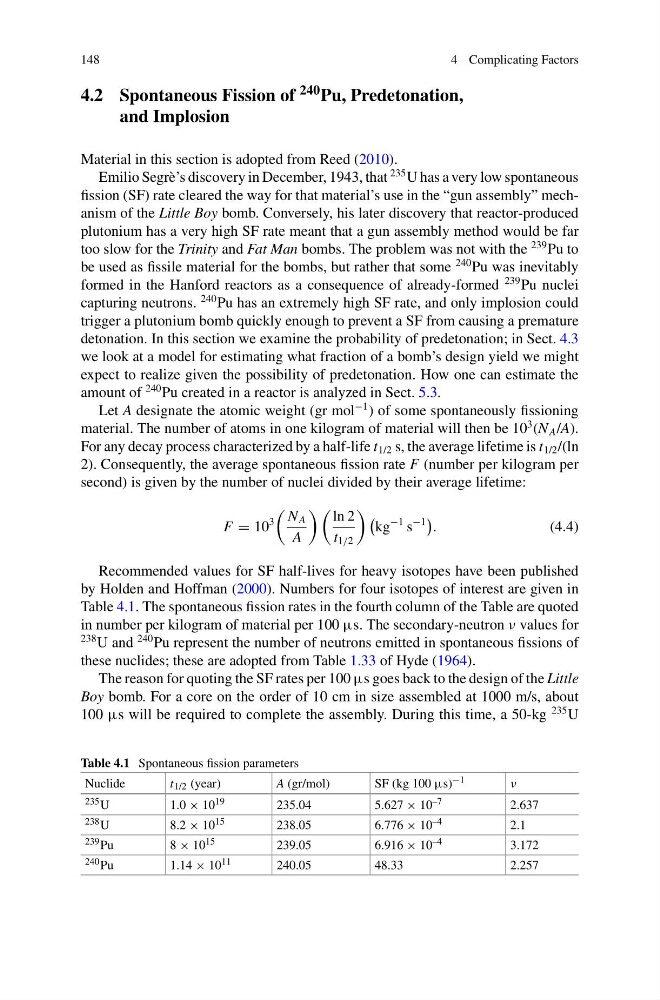
Table 4.1. The spontaneous fission rates in the fourth column of the Table are quoted
in number per kilogram of material per 100 μs. The secondary-neutron ν values for
238 U and
240 Pu represent the number of neutrons emitted in spontaneous fissions of
these nuclides; these are adopted from Table 1.33 of Hyde (1964).
The reason for quoting the SF rates per 100 μs goes back to the design of the Little
Boy bomb. For a core on the order of 10 cm in size assembled at 1000 m/s, about
100 μs will be required to complete the assembly. During this time, a 50-kg
235 U
Table 4.1 Spontaneous fission parameters
Nuclide
t 1/2 (year)
A (gr/mol)
SF (kg 100 μs) −1
ν
235 U
1.0 × 10 19
235.04
5.627 × 10 –7
2.637
238 U
8.2 × 10 15
238.05
6.776 × 10 –4
2.1
239 Pu
8 × 10 15
239.05
6.916 × 10 –4
3.172
240 Pu
1.14 × 10 11
240.05
48.33
2.257
4 Complicating Factors
4.2 Spontaneous Fission of 240 Pu, Predetonation,
and Implosion
Material in this section is adopted from Reed (2010).
Emilio Segrè’s discovery in December, 1943, that
235 U has a very low spontaneous
fission (SF) rate cleared the way for that material’s use in the “gun assembly” mechanism of the Little Boy bomb. Conversely, his later discovery that reactor-produced
plutonium has a very high SF rate meant that a gun assembly method would be far
too slow for the Trinity and Fat Man bombs. The problem was not with the
239 Pu to
be used as fissile material for the bombs, but rather that some
240 Pu was inevitably
formed in the Hanford reactors as a consequence of already-formed
239 Pu nuclei
capturing neutrons.
240 Pu has an extremely high SF rate, and only implosion could
trigger a plutonium bomb quickly enough to prevent a SF from causing a premature
detonation. In this section we examine the probability of predetonation; in Sect. 4.3
we look at a model for estimating what fraction of a bomb’s design yield we might
expect to realize given the possibility of predetonation. How one can estimate the
amount of
240 Pu created in a reactor is analyzed in Sect. 5.3.
Let A designate the atomic weight (gr mol
−1 ) of some spontaneously fissioning
material. The number of atoms in one kilogram of material will then be 10
3 (N A /A).
For any decay process characterized by a half-life t 1/2 s, the average lifetime is t 1/2 /(ln
2). Consequently, the average spontaneous fission rate F (number per kilogram per
second) is given by the number of nuclei divided by their average lifetime:
F = 10
3
N A
A
ln 2
t 1/2
kg
−1 s
−1
.
(4.4)
Recommended values for SF half-lives for heavy isotopes have been published
by Holden and Hoffman (2000). Numbers for four isotopes of interest are given in
Table 4.1. The spontaneous fission rates in the fourth column of the Table are quoted
in number per kilogram of material per 100 μs. The secondary-neutron ν values for
238 U and
240 Pu represent the number of neutrons emitted in spontaneous fissions of
these nuclides; these are adopted from Table 1.33 of Hyde (1964).
The reason for quoting the SF rates per 100 μs goes back to the design of the Little
Boy bomb. For a core on the order of 10 cm in size assembled at 1000 m/s, about
100 μs will be required to complete the assembly. During this time, a 50-kg
235 U
Table 4.1 Spontaneous fission parameters
Nuclide
t 1/2 (year)
A (gr/mol)
SF (kg 100 μs) −1
ν
235 U
1.0 × 10 19
235.04
5.627 × 10 –7
2.637
238 U
8.2 × 10 15
238.05
6.776 × 10 –4
2.1
239 Pu
8 × 10 15
239.05
6.916 × 10 –4
3.172
240 Pu
1.14 × 10 11
240.05
48.33
2.257