

4.1 Boron Contamination in Graphite
147
Let the number of boron atoms per carbon atom be B. Then the number of boron
atoms per uranium atom will be BR, and, in analogy to (3.3), we can write the total
effective cross section per atom as
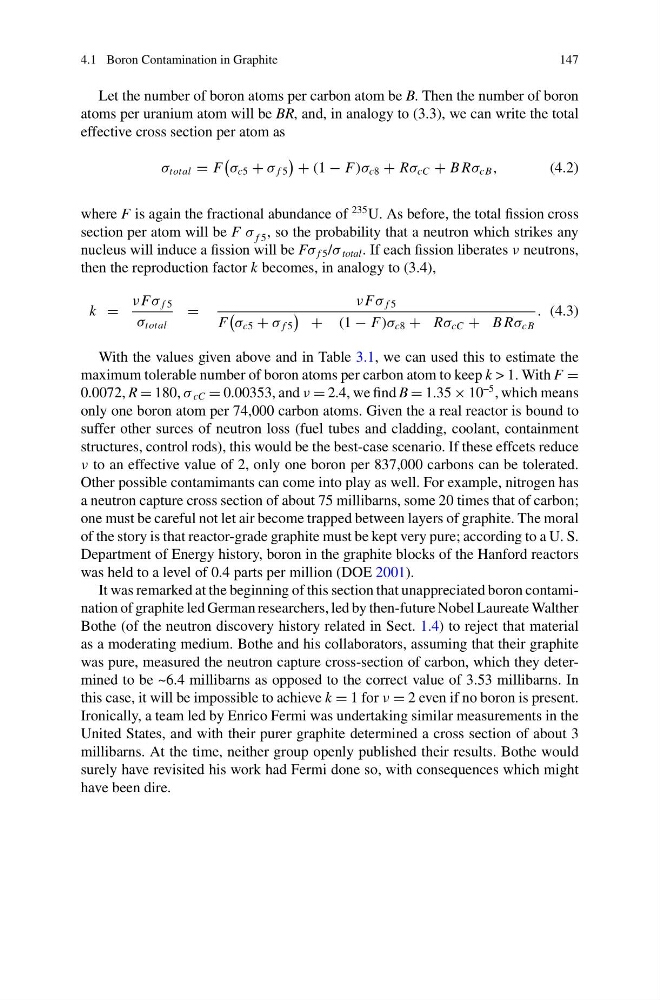
σ total = F
σ c5 + σ f 5
+ (1 − F)σ c8 + Rσ cC + B Rσ cB ,
(4.2)
where F is again the fractional abundance of
235 U. As before, the total fission cross
section per atom will be F σ f 5 , so the probability that a neutron which strikes any
nucleus will induce a fission will be Fσ f 5 /σ total . If each fission liberates ν neutrons,
then the reproduction factor k becomes, in analogy to (3.4),
k =
ν Fσ f 5
σ total
=
ν Fσ f 5
F
σ c5 + σ f 5
+ (1 − F)σ c8 + Rσ cC + B Rσ cB
. (4.3)
With the values given above and in Table 3.1, we can used this to estimate the
maximum tolerable number of boron atoms per carbon atom to keep k > 1. With F =
0.0072, R = 180, σ cC = 0.00353, and ν = 2.4, we find B = 1.35 × 10
–5 , which means
only one boron atom per 74,000 carbon atoms. Given the a real reactor is bound to
suffer other surces of neutron loss (fuel tubes and cladding, coolant, containment
structures, control rods), this would be the best-case scenario. If these effcets reduce
ν to an effective value of 2, only one boron per 837,000 carbons can be tolerated.
Other possible contamimants can come into play as well. For example, nitrogen has
a neutron capture cross section of about 75 millibarns, some 20 times that of carbon;
one must be careful not let air become trapped between layers of graphite. The moral
of the story is that reactor-grade graphite must be kept very pure; according to a U. S.
Department of Energy history, boron in the graphite blocks of the Hanford reactors
was held to a level of 0.4 parts per million (DOE 2001).
It was remarked at the beginning of this section that unappreciated boron contamination of graphite led German researchers, led by then-future Nobel Laureate Walther
Bothe (of the neutron discovery history related in Sect. 1.4) to reject that material
as a moderating medium. Bothe and his collaborators, assuming that their graphite
was pure, measured the neutron capture cross-section of carbon, which they determined to be ~6.4 millibarns as opposed to the correct value of 3.53 millibarns. In
this case, it will be impossible to achieve k = 1 for ν = 2 even if no boron is present.
Ironically, a team led by Enrico Fermi was undertaking similar measurements in the
United States, and with their purer graphite determined a cross section of about 3
millibarns. At the time, neither group openly published their results. Bothe would
surely have revisited his work had Fermi done so, with consequences which might
have been dire.
147
Let the number of boron atoms per carbon atom be B. Then the number of boron
atoms per uranium atom will be BR, and, in analogy to (3.3), we can write the total
effective cross section per atom as
σ total = F
σ c5 + σ f 5
+ (1 − F)σ c8 + Rσ cC + B Rσ cB ,
(4.2)
where F is again the fractional abundance of
235 U. As before, the total fission cross
section per atom will be F σ f 5 , so the probability that a neutron which strikes any
nucleus will induce a fission will be Fσ f 5 /σ total . If each fission liberates ν neutrons,
then the reproduction factor k becomes, in analogy to (3.4),
k =
ν Fσ f 5
σ total
=
ν Fσ f 5
F
σ c5 + σ f 5
+ (1 − F)σ c8 + Rσ cC + B Rσ cB
. (4.3)
With the values given above and in Table 3.1, we can used this to estimate the
maximum tolerable number of boron atoms per carbon atom to keep k > 1. With F =
0.0072, R = 180, σ cC = 0.00353, and ν = 2.4, we find B = 1.35 × 10
–5 , which means
only one boron atom per 74,000 carbon atoms. Given the a real reactor is bound to
suffer other surces of neutron loss (fuel tubes and cladding, coolant, containment
structures, control rods), this would be the best-case scenario. If these effcets reduce
ν to an effective value of 2, only one boron per 837,000 carbons can be tolerated.
Other possible contamimants can come into play as well. For example, nitrogen has
a neutron capture cross section of about 75 millibarns, some 20 times that of carbon;
one must be careful not let air become trapped between layers of graphite. The moral
of the story is that reactor-grade graphite must be kept very pure; according to a U. S.
Department of Energy history, boron in the graphite blocks of the Hanford reactors
was held to a level of 0.4 parts per million (DOE 2001).
It was remarked at the beginning of this section that unappreciated boron contamination of graphite led German researchers, led by then-future Nobel Laureate Walther
Bothe (of the neutron discovery history related in Sect. 1.4) to reject that material
as a moderating medium. Bothe and his collaborators, assuming that their graphite
was pure, measured the neutron capture cross-section of carbon, which they determined to be ~6.4 millibarns as opposed to the correct value of 3.53 millibarns. In
this case, it will be impossible to achieve k = 1 for ν = 2 even if no boron is present.
Ironically, a team led by Enrico Fermi was undertaking similar measurements in the
United States, and with their purer graphite determined a cross section of about 3
millibarns. At the time, neither group openly published their results. Bothe would
surely have revisited his work had Fermi done so, with consequences which might
have been dire.