

3.4 Electromagnetic Separation of Isotopes
133
x =
1
α
[A sin(αt) − C cos(αt)] + K x
y =
1
α
[D sin(αt) − E cos(αt)] + K y
⎫
⎪ ⎬
⎪ ⎭
,
(3.34)
where K x and K y are further constants of integration.
Not all of A, C, D, and E are independent. This can be seen by back-substituting
(3.33) into (3.27) [or into (3.28)—the result is the same]:
dv x
dt
= α v y
⇒ −A sin(αt) + C cos(αt) = D cos(αt) + E sin(αt).
(3.35)
This shows that we must have D = C and E = –A. These constraints simplify
(3.33) and (3.34) to
v x = A cos(αt) + C sin(αt)
v y = C cos(αt) − A sin(αt)
(3.36)
and
x =
1
α
[A sin(αt) − C cos(αt)] + K x
y =
1
α
[C sin(αt) + A cos(αt)] + K y
⎫
⎪ ⎬
⎪ ⎭
.
(3.37)
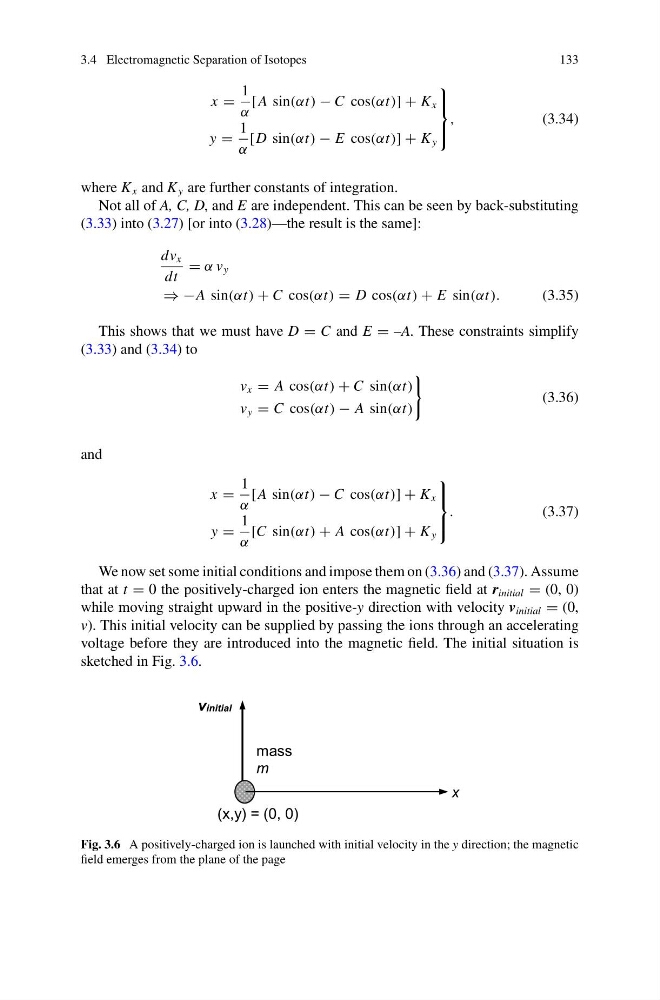
We now set some initial conditions and impose them on (3.36) and (3.37). Assume
that at t = 0 the positively-charged ion enters the magnetic field at r initial = (0, 0)
while moving straight upward in the positive-y direction with velocity v initial = (0,
v). This initial velocity can be supplied by passing the ions through an accelerating
voltage before they are introduced into the magnetic field. The initial situation is
sketched in Fig. 3.6.
Fig. 3.6 A positively-charged ion is launched with initial velocity in the y direction; the magnetic
field emerges from the plane of the page
133
x =
1
α
[A sin(αt) − C cos(αt)] + K x
y =
1
α
[D sin(αt) − E cos(αt)] + K y
⎫
⎪ ⎬
⎪ ⎭
,
(3.34)
where K x and K y are further constants of integration.
Not all of A, C, D, and E are independent. This can be seen by back-substituting
(3.33) into (3.27) [or into (3.28)—the result is the same]:
dv x
dt
= α v y
⇒ −A sin(αt) + C cos(αt) = D cos(αt) + E sin(αt).
(3.35)
This shows that we must have D = C and E = –A. These constraints simplify
(3.33) and (3.34) to
v x = A cos(αt) + C sin(αt)
v y = C cos(αt) − A sin(αt)
(3.36)
and
x =
1
α
[A sin(αt) − C cos(αt)] + K x
y =
1
α
[C sin(αt) + A cos(αt)] + K y
⎫
⎪ ⎬
⎪ ⎭
.
(3.37)
We now set some initial conditions and impose them on (3.36) and (3.37). Assume
that at t = 0 the positively-charged ion enters the magnetic field at r initial = (0, 0)
while moving straight upward in the positive-y direction with velocity v initial = (0,
v). This initial velocity can be supplied by passing the ions through an accelerating
voltage before they are introduced into the magnetic field. The initial situation is
sketched in Fig. 3.6.
Fig. 3.6 A positively-charged ion is launched with initial velocity in the y direction; the magnetic
field emerges from the plane of the page