

134
3 Producing Fissile Material
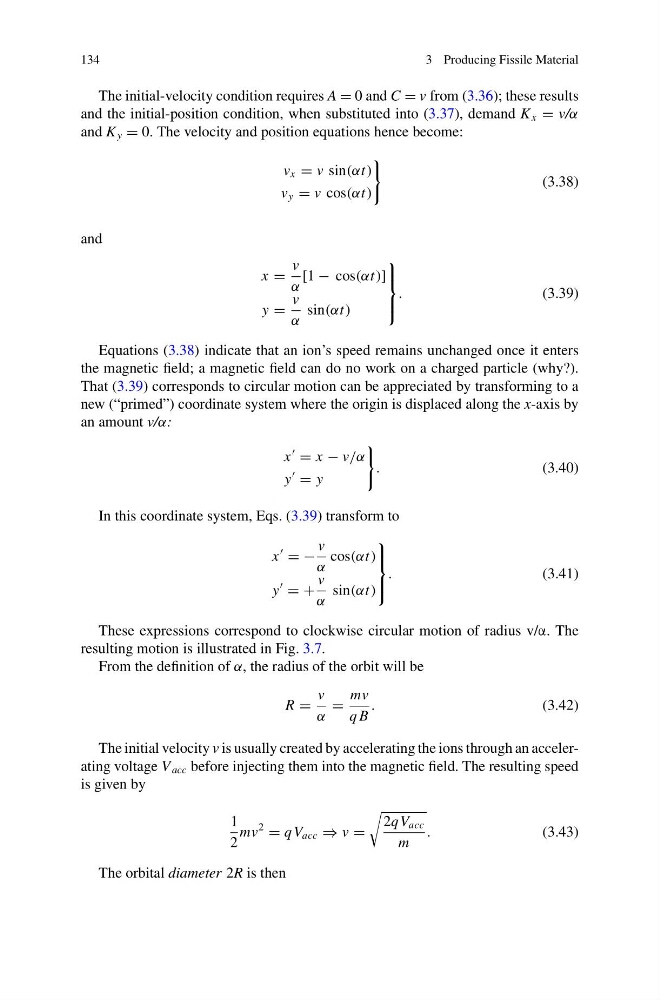
The initial-velocity condition requires A = 0 and C = v from (3.36); these results
and the initial-position condition, when substituted into (3.37), demand K x = v/α
and K y = 0. The velocity and position equations hence become:
v x = v sin(αt)
v y = v cos(αt)
(3.38)
and
x =
v
α
[1 − cos(αt)]
y =
v
α
sin(αt)
⎫
⎪ ⎬
⎪ ⎭
.
(3.39)
Equations (3.38) indicate that an ion’s speed remains unchanged once it enters
the magnetic field; a magnetic field can do no work on a charged particle (why?).
That (3.39) corresponds to circular motion can be appreciated by transforming to a
new (“primed”) coordinate system where the origin is displaced along the x-axis by
an amount v/α:
x
= x − v/α
y
= y
.
(3.40)
In this coordinate system, Eqs. (3.39) transform to
x
= −
v
α
cos(αt)
y
= +
v
α
sin(αt)
⎫
⎪ ⎬
⎪ ⎭
.
(3.41)
These expressions correspond to clockwise circular motion of radius v/α. The
resulting motion is illustrated in Fig. 3.7.
From the definition of α, the radius of the orbit will be
R =
v
α
=
mv
q B
.
(3.42)
The initial velocity v is usually created by accelerating the ions through an accelerating voltage V acc before injecting them into the magnetic field. The resulting speed
is given by
1
2
mv
2
= qV acc ⇒ v =
2qV acc
m
.
(3.43)
The orbital diameter 2R is then
3 Producing Fissile Material
The initial-velocity condition requires A = 0 and C = v from (3.36); these results
and the initial-position condition, when substituted into (3.37), demand K x = v/α
and K y = 0. The velocity and position equations hence become:
v x = v sin(αt)
v y = v cos(αt)
(3.38)
and
x =
v
α
[1 − cos(αt)]
y =
v
α
sin(αt)
⎫
⎪ ⎬
⎪ ⎭
.
(3.39)
Equations (3.38) indicate that an ion’s speed remains unchanged once it enters
the magnetic field; a magnetic field can do no work on a charged particle (why?).
That (3.39) corresponds to circular motion can be appreciated by transforming to a
new (“primed”) coordinate system where the origin is displaced along the x-axis by
an amount v/α:
x
= x − v/α
y
= y
.
(3.40)
In this coordinate system, Eqs. (3.39) transform to
x
= −
v
α
cos(αt)
y
= +
v
α
sin(αt)
⎫
⎪ ⎬
⎪ ⎭
.
(3.41)
These expressions correspond to clockwise circular motion of radius v/α. The
resulting motion is illustrated in Fig. 3.7.
From the definition of α, the radius of the orbit will be
R =
v
α
=
mv
q B
.
(3.42)
The initial velocity v is usually created by accelerating the ions through an accelerating voltage V acc before injecting them into the magnetic field. The resulting speed
is given by
1
2
mv
2
= qV acc ⇒ v =
2qV acc
m
.
(3.43)
The orbital diameter 2R is then