

132
3 Producing Fissile Material
and
dv y
dt
= −α v x ,
(3.28)
where
α =
q B
m
.
(3.29)
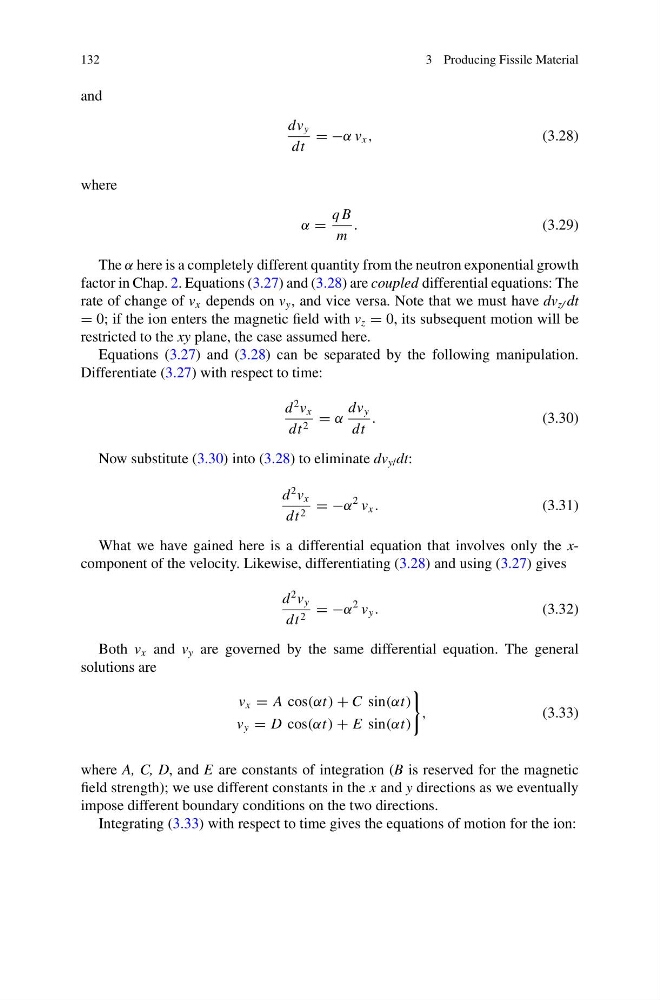
The α here is a completely different quantity from the neutron exponential growth
factor in Chap. 2. Equations (3.27) and (3.28) are coupled differential equations: The
rate of change of v x depends on v y , and vice versa. Note that we must have dv z/ dt
= 0; if the ion enters the magnetic field with v z = 0, its subsequent motion will be
restricted to the xy plane, the case assumed here.
Equations (3.27) and (3.28) can be separated by the following manipulation.
Differentiate (3.27) with respect to time:
d
2 v x
dt 2 = α
dv y
dt
.
(3.30)
Now substitute (3.30) into (3.28) to eliminate dv y/ dt:
d
2 v x
dt 2 = −α
2 v x .
(3.31)
What we have gained here is a differential equation that involves only the xcomponent of the velocity. Likewise, differentiating (3.28) and using (3.27) gives
d
2 v y
dt 2 = −α
2 v y .
(3.32)
Both v x and v y are governed by the same differential equation. The general
solutions are
v x = A cos(αt) + C sin(αt)
v y = D cos(αt) + E sin(αt)
,
(3.33)
where A, C, D, and E are constants of integration (B is reserved for the magnetic
field strength); we use different constants in the x and y directions as we eventually
impose different boundary conditions on the two directions.
Integrating (3.33) with respect to time gives the equations of motion for the ion:
3 Producing Fissile Material
and
dv y
dt
= −α v x ,
(3.28)
where
α =
q B
m
.
(3.29)
The α here is a completely different quantity from the neutron exponential growth
factor in Chap. 2. Equations (3.27) and (3.28) are coupled differential equations: The
rate of change of v x depends on v y , and vice versa. Note that we must have dv z/ dt
= 0; if the ion enters the magnetic field with v z = 0, its subsequent motion will be
restricted to the xy plane, the case assumed here.
Equations (3.27) and (3.28) can be separated by the following manipulation.
Differentiate (3.27) with respect to time:
d
2 v x
dt 2 = α
dv y
dt
.
(3.30)
Now substitute (3.30) into (3.28) to eliminate dv y/ dt:
d
2 v x
dt 2 = −α
2 v x .
(3.31)
What we have gained here is a differential equation that involves only the xcomponent of the velocity. Likewise, differentiating (3.28) and using (3.27) gives
d
2 v y
dt 2 = −α
2 v y .
(3.32)
Both v x and v y are governed by the same differential equation. The general
solutions are
v x = A cos(αt) + C sin(αt)
v y = D cos(αt) + E sin(αt)
,
(3.33)
where A, C, D, and E are constants of integration (B is reserved for the magnetic
field strength); we use different constants in the x and y directions as we eventually
impose different boundary conditions on the two directions.
Integrating (3.33) with respect to time gives the equations of motion for the ion: